Introduction
Even a well-stocked store with great products goes nowhere without traffic. That's the core tension every new dropshipper faces: the products are ready, the store looks professional, but the customers aren't showing up.
In 2026, buyer attention across ecommerce platforms is fiercely contested. Ad costs on Meta swung hard — Instagram CPM rose 14% year-over-year in Q1 2025 before pulling back — while privacy regulations continue reshaping how platforms track and target users. At the same time, AI-driven bidding tools, short-form video, and social commerce have opened new, cost-efficient paths to reaching buyers.
Knowing which platforms fit your products — and what separates a converting creative from a wasted impression — is what determines whether a store struggles or scales. This guide walks through the best paid and free advertising channels for dropshipping stores, what makes ads actually convert in 2026, and how to build a strategy that doesn't burn budget before it finds traction.
Key Takeaways
- Paid platforms — Facebook/Instagram, TikTok, Google Shopping, YouTube, and Pinterest — each serve different buyer intents and product types
- Free methods (SEO, organic social, email) build long-term traffic without growing ad spend
- Short-form video ads dominate customer acquisition in 2026 due to high engagement and lower costs versus static formats
- A full-funnel strategy (awareness + retargeting + retention) consistently outperforms single-platform campaigns
- Your store must be conversion-ready before scaling any ad spend
Why Dropshipping Ads Matter in 2026
Dropshipping stores sell products available from dozens of competitors. The product itself rarely differentiates you — your marketing does. Without advertising, there's no visibility, no traffic, and no sales.
The market opportunity is real. Allied Market Research projects the global dropshipping market will reach $1.67 trillion by 2031, growing at a 27.1% CAGR from 2022 to 2031. That growth brings more competition, which makes ad strategy more consequential, not less.
What's Changed in 2026
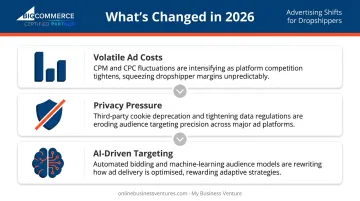
The advertising environment has shifted in three meaningful ways:
- Volatile ad costs — Meta CPM swung from +14% to -2% across quarters in 2024-2025; Google Shopping CPC actually fell 1% in Q3 2025. Costs aren't uniformly rising, but they're unpredictable
- Privacy pressure — 95% of US advertising decision-makers expect continued signal loss from privacy legislation, pushing marketers toward first-party data and owned channels
- AI-driven targeting — Platforms now automate bidding, audience segmentation, and creative optimization, rewarding stores that invest in creative quality over those relying on raw budget and broad targeting
Each of these shifts points to the same conclusion: paid ads alone won't carry a store. The dropshippers gaining ground in 2026 pair strong ad creative with owned channels — email lists, SEO traffic, and repeat customer relationships — so no single platform holds their growth hostage.
Best Paid Dropshipping Ad Platforms
Paid ads deliver immediate traffic and product visibility. The key is matching the right platform to your product type, audience, and budget rather than spreading spend thin across every channel at once.
Facebook and Instagram Ads
Meta's ad platform offers the deepest targeting options available to dropshippers. Interest-based, behavioral, and lookalike audiences make it the go-to choice for impulse-buy products: fashion accessories, home gadgets, beauty items, and similar categories where discovery drives purchase.
Key ad formats for dropshipping:
- Carousel ads — showcase multiple products or product angles
- Video ads — demonstrate the product in action
- Stories — full-screen, high-attention placements
- Advantage+ Catalog Ads — dynamic retargeting that automatically shows relevant products to previous visitors
Two features make Meta particularly powerful for full-funnel advertising:
- Facebook Pixel retargeting tracks store visitors so you can re-engage people who viewed a product but didn't buy — typically your highest-intent audience
- Lookalike audiences use your existing customer data to find new buyers with similar characteristics, effectively scaling what's already working
Facebook reported 3.07 billion MAUs at end of 2023, and Instagram reached 3 billion MAUs in September 2025 (with significant audience overlap). For dropshippers, that scale matters less than the targeting precision: no other platform lets you drill down to product-level audiences as accurately as Meta.
TikTok Ads
TikTok is the dominant short-form video platform for product discovery in 2026, with more than 170 million American users. Its algorithm surfaces relevant content to new audiences regardless of account size, which gives dropshipping stores genuine organic reach potential alongside paid campaigns.
According to TikTok's own research, 61% of users discover brands or products on TikTok — that's 1.5x the discovery rate reported on other social platforms.
Key ad formats:
- In-Feed Ads — native video placements in the For You feed
- Spark Ads — boosting existing organic posts; TikTok reports Spark Ads generate 43% higher conversion rates and 4% lower CPM than standard In-Feed Ads
- TopView Ads — premium full-screen placement, best for product launches
What wins on TikTok: ads that look like organic content. UGC-style video, a strong visual hook in the first 3 seconds, problem-solution demonstrations, and trend-aligned audio consistently outperform polished commercials. Launch multiple creatives and scale only those with strong click-through rates Short testing cycles are non-optional here.
Google Shopping and Search Ads
Unlike social platforms where you interrupt a scroll, Google reaches buyers who are already searching for what you sell. That intent gap matters: 42% of US consumers began their shopping searches on search engines in 2024, which makes Google essential for any product with existing search demand. 42% of US consumers began their shopping searches on search engines in 2024
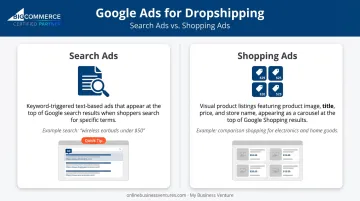
Two distinct formats to understand:
| Format | How It Works | Best For |
|---|---|---|
| Search Ads | Text-based, keyword-triggered | High-intent queries like "wireless earbuds under $50" |
| Shopping Ads | Visual product listings with image, price, and reviews | Comparison shopping and category browsing |
Google Shopping spend grew 14% YoY in Q3 2025 with clicks up 15% Both numbers point in the same direction: the format is growing.
For dropshipping, product feed optimization is critical: keyword-rich titles, accurate categories, high-resolution images, and GTINs improve ad eligibility and placement. Negative keyword filtering and long-tail targeting reduce wasted spend on irrelevant searches.
YouTube Video Ads
Some products need to be seen working before people will buy them. Home improvement tools, fitness equipment, tech gadgets, skincare routines — YouTube is where those purchase decisions get made. Showing the product in actual use reduces hesitation in ways a static image simply cannot.
Format breakdown:
- Skippable in-stream ads — best for product demos and retargeting warm audiences
- Non-skippable bumper ads — best for brand awareness during product launches
Google's ABCD creative framework for YouTube ads averages a 30% lift in short-term sales likelihood when followed correctly:
- Attention — hook within the first 5 seconds
- Branding — logo and product visible early
- Connection — show the product solving a real problem
- Direction — clear, specific CTA
YouTube integrates directly with Google Ads, allowing audience targeting based on search behavior This makes it a logical complement to any Google Shopping campaign already running.
Pinterest Ads
Pinterest users browse with purchase intent — they're actively looking for ideas, not just killing time. That makes it a strong fit for home décor, fashion, beauty, DIY, and lifestyle products.
Key audience facts:
- 578 million global MAUs as of Q2 2025, up 11% year-over-year
- 96% of top searches are unbranded — users are looking for ideas, not specific retailers
- 80% of weekly users say Pinterest inspires them to shop
Promoted Pins blend with organic content and remain discoverable long after publication unlike Facebook or TikTok ads that disappear from feeds within hours. For dropshippers in visually oriented niches, that longevity means a single well-performing Pin can keep driving traffic for weeks.
Practically speaking: use lifestyle imagery over plain product shots, and write Pin descriptions the way a user would search — because Pinterest's algorithm treats them like search queries.
Best Free Dropshipping Ad Methods
Free advertising methods take longer to show results than paid ads, but they build compounding traffic that doesn't disappear when you stop spending. For dropshippers managing tight margins, combining free and paid methods creates a more stable growth engine.
Search Engine Optimization (SEO)
SEO generates consistent organic traffic by ranking product pages, category pages, and blog content for relevant search queries. Unlike paid ads, pages that rank today continue driving traffic without additional cost.
Core tactics for dropshipping stores:
- Optimize product titles and descriptions with long-tail transactional keywords (e.g., "waterproof running shoes for women")
- Build internal links between product pages and blog content
- Use structured data markup to improve search visibility for product listings
MBV's BigCommerce-powered storefronts handle the technical SEO groundwork for you — Google-friendly design, XML sitemaps, mobile-responsive templates, SSL security, and built-in blog functionality are included out of the box.
Technical SEO essentials that matter for conversions:
- Fast page load speeds (a direct Google ranking signal)
- Mobile-responsive design (most ecommerce traffic comes from smartphones)
- HTTPS security (both an SEO signal and a trust signal for paid traffic)
Organic Social Media Marketing
Platforms like TikTok, Instagram, Facebook, and Pinterest reward consistent posting with algorithmic reach — meaning a dropshipping store can gain product visibility without any ad budget. TikTok in particular favors new accounts and can deliver significant organic reach even without an existing follower base.
Content types that perform best:
- Short product demonstration videos
- Before-and-after visuals
- User-generated content (UGC)-style posts that look like genuine customer experiences
- Trend-based content tied to current audio or formats
Organic content also amplifies paid advertising. When users encounter your paid ad after already seeing organic content from your brand, conversion rates improve — the brand feels familiar rather than unknown.
Email Marketing
That familiarity carries over to email, too. When someone has already engaged with your brand organically, a targeted email hits differently. Email consistently delivers the highest ROI of any ecommerce channel — Litmus reports an average $36 return for every $1 spent on email marketing, and for abandoned cart flows specifically, Klaviyo's ecommerce benchmarks show $3.65 average revenue per recipient and a 3.33% placed-order rate.
Core automation sequences every dropshipping store needs:
- Welcome emails — sent within minutes of signup, introduce the brand and offer an incentive
- Abandoned cart sequences — recover browsers with urgency messages or discount offers
- Post-purchase emails — review requests, upsell recommendations, replenishment reminders
Omnisend reports that welcome, abandoned cart, and browse-abandonment automations generated 87% of all automated email orders in 2024 — a strong case for prioritizing these three flows first.
List-building tactics:
- Exit-intent popups with a first-purchase discount
- Email capture via social media giveaways
- SMS opt-ins at checkout
Content Marketing and Affiliate Programs
Blogging with SEO-optimized content — buying guides, product comparisons, how-to tutorials tied to your niche — drives organic search traffic that can later be retargeted with paid ads. Visitors arriving from informational content are earlier in the buying journey and tend to convert better when exposed to retargeting.
Affiliate and referral programs extend reach without direct ad spend:
- Affiliates (bloggers, creators, niche influencers) promote products via unique links and earn commission only on completed sales, reducing upfront advertising risk
- Referral programs reward existing customers for bringing in new buyers, turning satisfied customers into a distribution channel
What Makes a High-Converting Dropshipping Ad in 2026
The Core Creative Formula
The proven structure for dropshipping video ads — applicable across TikTok, Facebook, Instagram, and YouTube — follows four stages:
- Hook — bold visual, surprising claim, or relatable problem in the first 3 seconds
- Problem — identify the pain point the product solves
- Product Demo — show the item in use with real-world context
- CTA — clear, direct action ("Shop Now," "Limited Stock," "Order Today")
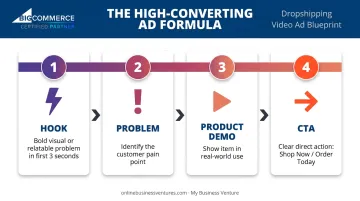
This structure outperforms generic promotional content because it connects to a customer need before pitching a product. TikTok reports that 90% of ad-recall impact occurs within the first six seconds — making the hook the single most important element of any video ad.
Why UGC-Style Creative Wins
That four-part formula only works if the creative itself earns trust — which is why UGC-style content has become the default for high-performing dropshipping ads in 2026. Authentic, phone-shot video that looks like an organic social post consistently outperforms polished commercial production on TikTok and Instagram.
Audiences have trained themselves to skip content that "looks like an ad." Bazaarvoice research found that 53% of shoppers feel more confident buying after seeing UGC than after seeing professional photography. And Wyzowl's 2026 survey found 85% of consumers had been convinced to buy a product after watching a video.
TikTok's own analysis found creator-led ads generated 70% higher CTR and 159% higher engagement at the same CPM compared to non-creator ads. Brands working with micro-influencers or producing UGC-style creatives in-house often achieve stronger returns than those relying on high-production video.
Key Metrics to Track
| Metric | What It Tells You |
|---|---|
| CTR (Click-Through Rate) | Whether your creative captures attention |
| ROAS (Return on Ad Spend) | Revenue generated per dollar spent |
| CAC (Customer Acquisition Cost) | Total spend divided by customers acquired |
| Conversion Rate | Percentage of ad clicks that result in a purchase |
A/B test different hooks, headlines, and CTAs consistently. Even a small improvement in CTR compounds into significantly lower customer acquisition costs over time.
How to Build Your Dropshipping Ad Strategy
The Full-Funnel Framework
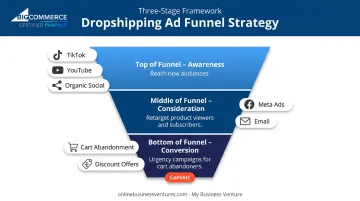
Dropshippers who run only bottom-funnel conversion campaigns struggle to scale because their retargeting pool is too small. A sustainable strategy covers all three stages:
- Top of Funnel (Awareness) — TikTok, YouTube, organic social content; goal is reaching new audiences who don't know your brand
- Middle of Funnel (Consideration) — Facebook/Instagram dynamic retargeting for product viewers; email sequences for subscribers who haven't purchased
- Bottom of Funnel (Conversion) — Urgency-driven campaigns with free shipping offers, limited-time discounts, and personalized retargeting for cart abandoners
Budget Guidance for Beginners
Shopify recommends $5-$10 per day as a starting budget for small businesses, with campaigns running for at least seven days before making major adjustments. Meta recommends running ads longer than six days before drawing conclusions.
Testing phase approach:
- Launch 3-5 creative variations across 2-3 platforms
- Run each for 7-14 days before scaling or cutting
- Allocate a dedicated budget to retargeting — cart abandoners and product viewers typically deliver the highest ROAS and shouldn't compete with prospecting spend
Scaling phase: Once a creative and audience combination proves profitable, increase budget incrementally (20-30% every few days) rather than doubling overnight.
Your Store Must Be Ready Before You Spend
No ad strategy overcomes a store that doesn't convert. Before launching campaigns, confirm your store has:
- Fast load times and mobile-optimized design
- Professional product pages with strong descriptions and clear pricing
- Trust signals: SSL security, visible security badges, clear return policies
- A simple, frictionless checkout process
- Social proof through reviews or testimonials
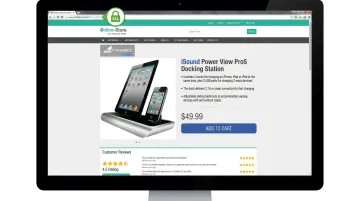
Every item on that checklist affects your conversion rate — and most ad spend that "doesn't work" traces back to store gaps, not the ads themselves. If you're starting from scratch, My Business Venture (MBV) builds BigCommerce-powered stores that come pre-loaded with over 2,500 curated products, SSL-secured checkout, fraud prevention, and one-on-one marketing consulting. Stores go live within days, so you can focus on running ads instead of fixing technical problems.
Conclusion
Effective dropshipping advertising in 2026 comes down to three things: matching ad types to your products, pairing paid channels with organic reach, and letting performance data drive creative decisions. No single platform wins every time — the mix that works depends on what you sell and who you're selling to.
Advertising works best when the store behind the ads is built to convert. A clean storefront, compelling product pages, and reliable fulfillment are what turn ad clicks into actual revenue.
If you're ready to launch a dropshipping store backed by over 30 years of e-commerce experience — including built-in marketing support, one-on-one business consulting, and a BBB A+-rated team — My Business Venture offers turnkey e-commerce solutions built for entrepreneurs starting from scratch. Reach out to the MBV team at 1-800-639-6644 or visit MyBusinessVenture.com to learn more.
Frequently Asked Questions
What's the best way to advertise dropshipping?
The most effective approach combines paid social ads (Facebook, TikTok, or Instagram) for immediate visibility with organic methods like SEO and email marketing for long-term traffic. The best channel depends on your product type and target audience — there's no single universal answer.
Which ad platform works best for beginner dropshippers?
Facebook and Instagram Ads are the go-to starting points for beginners — they offer advanced targeting, flexible budgets, and strong ecommerce integrations. TikTok is a solid alternative with high organic reach potential and lower initial costs, especially for visually appealing products.
How much should I budget for dropshipping ads when starting out?
A common industry starting point is $5–$10 per day, running campaigns for at least seven days before evaluating results. Early spend should focus on data collection — testing multiple creatives and audiences — before scaling what works.
Are free advertising methods effective for dropshipping stores?
Yes, but they require consistent effort and longer timelines than paid ads. SEO, TikTok organic content, and email marketing are effective, and they work best as complements to paid campaigns rather than complete replacements.
What types of products perform best with paid dropshipping ads?
Products with strong visual appeal, clear problem-solving benefits, impulse-buy potential, and competitive pricing convert best. Trending gadgets, home accessories, fashion items, and beauty tools consistently perform well across Facebook, TikTok, and Instagram.
How long does it take to see results from dropshipping ads?
Most campaigns require several weeks of testing and optimization before becoming consistently profitable. The timeline depends on product demand, ad creative quality, targeting accuracy, and how much budget you can dedicate to the testing phase.