
The real competitive edge on social media isn't posting frequency or follower count. It's engagement — the two-way conversations that build trust, signal algorithms, and turn browsers into buyers. Many online entrepreneurs, especially those launching their first e-commerce store, miss this distinction entirely.
This article breaks down what customer engagement on social media actually means, why it produces measurable business outcomes, and what's at stake when it's done well versus ignored.
Key Takeaways
- Customer engagement means joining and responding to conversations — not just publishing content
- Consistent engagement signals platform algorithms to expand your organic reach
- 73% of consumers say they'll buy from a competitor if a brand doesn't respond on social
- Engagement generates social proof — reviews, replies, and reactions — that directly shapes purchase decisions
- Daily engagement builds audience loyalty and increases the likelihood of repeat sales from existing followers
What Is Customer Engagement on Social Media?
Customer engagement on social media is the two-way interaction between a business and its audience across platforms like Instagram, Facebook, and TikTok — encompassing comments, shares, direct messages, mentions, and replies.
Interaction and engagement are not the same thing:
- Interaction (one-way): A like, a reshare, a passive view
- Engagement (two-way): A personalized reply, a direct conversation, a response that acknowledges a specific customer
Businesses often mistake the former for the latter. Racking up likes feels good, but likes don't build relationships — and relationships are what drive actual buying decisions.
Customer engagement is not a vanity metric. It's the mechanism through which trust is earned, platform reach is extended, and purchase decisions are influenced. That makes it a core business function, not just something the marketing team handles between campaigns.
Key Advantages of Customer Engagement on Social Media
The advantages below connect directly to business outcomes: brand reputation, discoverability, and revenue. Not follower counts.
Advantage 1: It Builds Brand Trust and Customer Loyalty
When a business replies to a comment by name, addresses a concern publicly, or responds to a tagged post with a genuine message, something shifts. Customers realize there's a real person on the other side. That human quality is exactly what differentiates smaller e-commerce brands from faceless competitors.
Trust drives repeat business — and repeat business is significantly cheaper than acquiring new customers. Harvard Business Review notes that acquiring a new customer can cost 5–25x more than retaining an existing one. Engagement is one of the most cost-efficient retention tools available.
The data reinforces this. According to the 2025 Sprout Social Index, 78% of consumers agreed that a brand's social presence has a larger impact on whether they trust it compared to a year prior.
Sprout's 2023 Index adds more detail: 76% of consumers noticed and valued when brands prioritized customer support on social, and 70% expected personalized responses when reaching out.
KPIs most impacted:
- Customer retention rate
- Repeat purchase rate
- Customer lifetime value (CLV)
- Brand sentiment scores
When this matters most: For new e-commerce businesses without large ad budgets, trust earned through genuine engagement can substitute for paid credibility. When a potential customer is choosing between your store and a more established competitor, visible responsiveness often tips the decision.
Advantage 2: It Amplifies Organic Reach Through Algorithm Signals
Every major social platform uses engagement signals to determine which content gets distributed more widely.
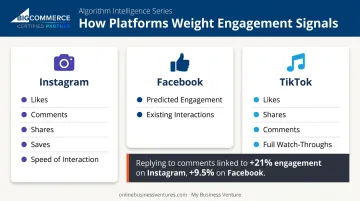
- Instagram factors in predicted likes, comments, shares, and saves — and considers how quickly those interactions occur in Explore
- Facebook predicts what users are likely to engage with and weighs how others have already interacted with a post
- TikTok explicitly states that user interactions (likes, shares, comments, full watches) are generally weighted more heavily than other ranking factors
When your audience engages with your content — and especially when you engage back — the algorithm reads that as a signal of value and shows your content to more people.
Buffer's analysis of nearly 2 million posts found that posts where creators replied to comments were associated with 21% higher engagement on Instagram and 9.5% higher on Facebook. (Buffer notes this is correlation, not proven causation — but the pattern holds.)
Organic reach is free advertising — and for entrepreneurs building stores on limited budgets, every impression that doesn't require ad spend directly improves their margin.
KPIs most impacted:
- Organic impressions and post reach
- Follower growth rate
- Engagement rate (interactions per follower)
- Website referral traffic from social
When this matters most: Early-stage businesses with minimal ad spend benefit most from algorithm-driven reach. It's especially valuable during product launches or when trying to reach a new customer segment without paid campaigns.
Advantage 3: It Generates Social Proof That Converts Browsers into Buyers
Social proof is the visible evidence that real people are buying from and trusting your brand — and it directly shapes purchase decisions.
Bazaarvoice's Shopper Experience Index, based on research among more than 8,000 consumers across seven countries, found that 65% of shoppers rely on user-generated content — reviews, shopper photos — when deciding what to buy. That's not a marginal influence. It's the majority of your potential customers actively looking for signals from other buyers before they commit.
Unlike an ad that tells people a product is great, social proof shows it through real people's actions. When a prospect sees comments, tagged posts, and quick replies on your brand's page, it reduces purchase hesitation — particularly for a brand they've never bought from before.
Businesses that actively engage with customers also generate more public UGC: tagged photos, positive mentions, and visible interactions that appear to anyone researching a purchase.
KPIs most impacted:
- Conversion rate
- Add-to-cart rate
- Average order value
- Cost per acquisition
- Return on ad spend (ROAS) when UGC is incorporated into paid content
When this matters most: First-time purchases from unknown brands are the highest-friction moments in e-commerce. Social proof is what bridges that gap — especially when customers can't touch, test, or try a product before buying.
What Happens When Customer Engagement Is Ignored
Skipping engagement isn't neutral. It has compounding costs.
Algorithm deprioritization: Platforms distribute content based on predicted engagement. Low engagement signals low relevance. Over time, inactive brands lose organic reach while responsive competitors widen the gap.
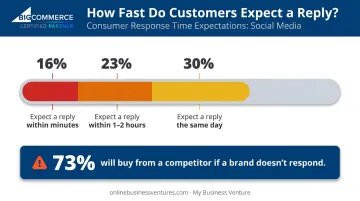
Trust erosion: Unanswered comments and an empty DM inbox send a clear message — this brand doesn't value its audience. According to the 2025 Sprout Social Index, 73% of consumers say they'll buy from a competitor if a brand doesn't respond on social media. Response timing shapes that decision too.
Response timing matters too. Sprout's research breaks it down:
- 16% expect a reply within minutes
- 23% expect one within 1–2 hours
- 30% expect a response the same day
Missed intelligence: Social media engagement is one of the best real-time feedback loops available to any business. When it's ignored, you lose organic visibility into what customers want, what concerns are emerging, and what content actually resonates — leaving decisions driven by guesswork instead of data.
Together, these three consequences compound quickly. Brands that ignore engagement don't just miss conversations — they lose reach, trust, and the market intelligence needed to compete.
How to Get the Most Value from Customer Engagement on Social Media
Consistency matters more than intensity. Occasional engagement spikes don't compound. Daily engagement does.
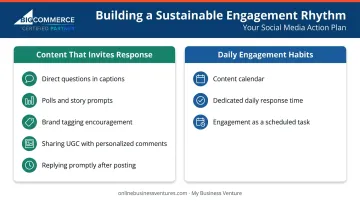
Build a sustainable rhythm:
- Use a content calendar to plan posts in advance
- Set aside dedicated time each day to respond to comments and DMs
- Treat engagement as a scheduled business task, not a reaction to a viral post
Create content that invites response:
- Ask direct questions in captions
- Run polls and story prompts
- Encourage customers to tag your brand
- Share user-generated content with personalized comments
- Reply to comments promptly after posting, when algorithm signals carry the most weight
Measure what actually matters:
Don't track only follower counts. Review the metrics that reflect two-way interaction:
| Metric | What It Tells You |
|---|---|
| Engagement rate | Interactions relative to reach or followers |
| Comment volume | Depth of audience response to content |
| DM response rate | How consistently you're holding conversations |
| Share rate | Content resonance — audiences sharing with their networks |
| Follower growth rate | Directional signal of expanding reach over time |
For entrepreneurs building their online store and social presence at the same time, MBV's social media integration and marketing campaign support (available across all three package tiers) provides a structured foundation so your store launches with engagement already in place.
The Millennium package includes a full Social Media Upgrade Package where MBV's team handles account setup, content creation, and ongoing channel management through MBV Digital. Through MBV University, coaches like Kurt Higgins cover social media algorithms and engagement strategies in one-on-one sessions, giving clients practical skills from day one.
Conclusion
The importance of customer engagement on social media comes down to three compounding outcomes: it builds the trust that retains customers, earns the algorithmic reach that attracts new ones, and generates the social proof that converts both.
None of these advantages require a large budget. They require consistency, responsiveness, and a genuine commitment to the conversation.
Entrepreneurs who embed engagement into their daily business rhythm — particularly first-time business owners still establishing their presence — create a real advantage that compounds over time. For entrepreneurs who want that foundation built in from the start, My Business Venture provides the digital marketing training, social media tools, and one-on-one consulting to help you show up consistently from launch.
Frequently Asked Questions
What is customer engagement on social media?
Customer engagement on social media is the two-way interaction between a business and its audience — including replies to comments, DM conversations, responses to mentions, and sharing of UGC — that goes beyond simply posting content. It's how brands build real relationships through ongoing dialogue rather than one-way broadcasting.
What is the 5-3-2 rule on social media?
The 5-3-2 rule is a content balance framework attributed to T.A. McCann: for every 10 posts, 5 should be curated content from other sources, 3 should be original educational or value-driven content, and 2 should be personal or humanizing posts. The ratio keeps feeds varied and avoids coming across as purely promotional.
Why is engaging with customers on social media important for small businesses?
For small businesses without large ad budgets, social engagement is one of the most cost-effective growth tools available. It builds brand trust without paid promotion, triggers algorithmic boosts to organic reach, and generates the social proof that influences purchasing decisions — all without requiring significant financial investment.
What are examples of customer engagement on social media?
Examples include replying to a customer's product question in the comments, resharing a tagged customer photo with a personalized message, running an Instagram poll to gather product feedback, or hosting a live Q&A where you answer audience questions in real time.
How do you measure customer engagement on social media?
Key metrics include engagement rate (interactions divided by reach or followers), comment volume, share rate, DM response rate, and follower growth over time. These can all be tracked through native platform tools like Instagram Insights, Facebook Page Analytics, or TikTok Analytics.
What happens if you don't engage with customers on social media?
Ignoring engagement causes platform algorithms to deprioritize your content, reducing organic reach over time. It also erodes customer trust — 73% of consumers say they'll turn to a competitor if a brand doesn't respond — and cuts off a real-time feedback loop for content and product decisions.