

Introduction
You've got a solid product idea and genuine enthusiasm — but when it comes to turning that idea into a structured plan, things get murky fast. Which features come first? What do you tell investors? How do you stop chasing every shiny new request and actually build something coherent?
This is exactly where most first-time entrepreneurs lose momentum. Without a clear plan connecting your vision to daily decisions, you end up with scattered efforts, missed priorities, and a product that drifts from its original purpose.
A product roadmap solves this. It's the strategic document that tells your entire organization — what you're building, why it matters, and when it's happening.
This guide covers what a product roadmap is, why it matters for every business owner, and a practical five-step process for building one that works.
Key Takeaways
- A product roadmap is a high-level visual plan connecting your vision to prioritized outcomes over time
- Roadmaps align founders, team members, and investors around shared goals — strategy first, features second
- Effective roadmaps stay flexible; they're living documents, not fixed delivery schedules
- Building one follows five steps: define your vision, gather input, prioritize initiatives, set a timeline, and revisit regularly
- For e-commerce entrepreneurs, roadmaps clarify which product categories to launch first and in what order to grow
What Is a Product Roadmap?
ProductPlan defines a product roadmap as a high-level visual summary that communicates a product's vision, direction, and priorities over time. Critically, a good roadmap doesn't just show what you're building — it explains why.
What a Roadmap Is Not
This distinction matters for entrepreneurs who often confuse a roadmap with similar-sounding documents:
- A to-do list — Roadmaps capture strategic outcomes, not daily tasks
- A project plan — Project plans detail specific tasks, owners, and deadlines for executing individual initiatives; a roadmap sits above that level
- A product backlog — A backlog is a granular, task-level queue for implementation; the roadmap is what guides what goes into that backlog
The Planning Hierarchy
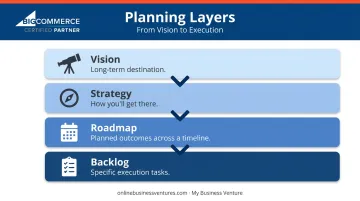
The planning process breaks into four layers, each feeding directly into the next:
- Vision — Your long-term destination ("What does success look like in 3–5 years?")
- Strategy — How you'll reach that destination
- Roadmap — Translates strategy into planned outcomes across a timeline
- Backlog — The specific tasks that execute each roadmap initiative
Roadmaps Beyond Software
That hierarchy applies well beyond software. For e-commerce entrepreneurs, a roadmap might cover which product categories to launch first, what store features to add over the next two quarters, or how to scale from 2,500 to 10,000 products. Any business making decisions over time can benefit from this kind of deliberate planning.
Why Every Business Owner Needs a Product Roadmap
Without a roadmap, businesses tend to operate reactively — adding products because a customer asked, chasing competitors, or pivoting to whatever feels urgent that week. For entrepreneurs building an online store or growing a home-based business, that reactive pattern is especially costly. Here's what a roadmap actually fixes:
Alignment
Every stakeholder — a business partner, an investor, a team member — gets a shared view of where the business is headed. This prevents duplicated work, conflicting priorities, and the kind of confusion that stalls progress.
Prioritization
PMI reported that 52% of projects experience scope creep — a direct result of not having clear boundaries around what's in and out of scope at any given time. A roadmap forces you to make deliberate choices about what actually moves the needle — and what to defer.
Communication
A roadmap becomes a single source of truth that reduces the constant back-and-forth of status updates and one-off questions. When your plan is visible, questions get answered before they're asked — freeing you to focus on execution rather than internal alignment. That clarity compounds over time: fewer meetings, fewer misunderstandings, faster decisions.
Types of Product Roadmaps
The format you choose should match your audience. A roadmap for your development team looks different from one you'd share with investors or customers.
Common Formats
| Format | Best For | Key Characteristic |
|---|---|---|
| Now/Next/Later | Small teams, early-stage businesses | Groups priorities by horizon without fixed dates |
| Feature Roadmap | Teams needing deliverable-level visibility | Specific features mapped to a timeline |
| Outcome-Based | Strategy-first planning | Organized by business goals, not deliverables |
That last format — outcome-based — is less common than you'd expect. Research from ProductPlan's 2023 report found that 54% of roadmaps focused on outputs (features and deliverables) while only 44% communicated outcomes — a gap that often leads to building things that miss the mark strategically.
Start Simple
If you're just starting out, a Now/Next/Later format is the most practical starting point. You don't need specialized software — any of these works fine:
- A whiteboard for in-person team alignment
- A spreadsheet for easy sharing and editing
- A simple visual template from tools like Miro or Notion
Pick one and start filling it in. A roadmap that exists beats a perfect one that's still being planned.
How to Create a Product Roadmap: A Step-by-Step Guide
Step 1: Define Your Vision and Strategic Goals
Your roadmap needs an anchor. Without a clear vision — a concise statement of what success looks like for your customers and your business — the roadmap becomes a disorganized wish list.
Once you have a vision, set 2–4 measurable strategic goals that will drive roadmap decisions. Examples for an e-commerce business:
- Expand into two new product categories within 6 months
- Increase repeat customer rate from 15% to 25% by year-end
- Reduce average order fulfillment time by 30%
- Reach 500 active monthly customers within 12 months
These goals become the filter for every roadmap decision that follows. If an initiative doesn't serve at least one of these goals, it doesn't belong on the roadmap yet.
Step 2: Gather Input from Customers and Stakeholders
Don't build a roadmap in isolation. The best roadmaps pull from multiple inputs before any priorities are set:
- Customer feedback — reviews, support tickets, direct conversations
- Competitor analysis — what are others offering that you're not?
- Market trends — where is your industry heading?
- Team input — your operational team often sees problems customers haven't named yet
According to ProductPlan's 2024 survey of 1,440+ product professionals, customer needs ranked first among prioritization considerations — yet senior leadership was the primary roadmap influence for 31% of teams, while customer feedback drove only 27%. That gap is where many roadmaps go wrong.
Talk to real customers before committing to any initiative.
Step 3: Prioritize Initiatives Based on Value and Effort
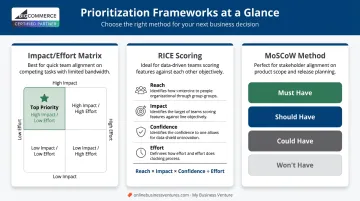
With a pool of ideas gathered, the next challenge is choosing what actually makes the roadmap. A few simple frameworks:
- Impact/Effort Matrix — Plot initiatives on a 2x2 grid by expected impact vs. implementation effort. High-impact, low-effort items go first.
- RICE Scoring — Reach × Impact × Confidence ÷ Effort. Developed by Intercom, this method scores initiatives on a common scale so you can compare them objectively.
- MoSCoW Method — Sort initiatives into Must Have, Should Have, Could Have, and Won't Have categories for this planning period.
You don't need formal product management training to use any of these. Pick one, apply it consistently, and let it guide your decisions rather than gut feel alone.
Step 4: Map Initiatives to a Timeline
With priorities set, organize them into time horizons. The Now/Next/Later structure works well here — it gives your roadmap clear shape without locking you into hard deadlines you can't yet commit to.
Use these time horizons as a guide:
- Now = what you're actively working on this quarter
- Next = what you're planning to tackle after current work wraps up
- Later = what's on the horizon but not yet scheduled
Historical data from ProductPlan suggests an average roadmap horizon of around nine months, with most teams planning across a 4–12 month window. That's a reasonable target for most small businesses.
Don't overload the roadmap. An overpacked roadmap isn't ambitious — it's a trust problem waiting to happen. Include only what you can realistically commit to.
Step 5: Share, Collaborate, and Keep It Updated
Your roadmap only delivers value when people can actually see it. Keep it visible, shared, and revisited regularly.
At minimum, review your roadmap quarterly — or whenever something significant changes, like a shift in customer needs, a new competitor, or an unexpected business constraint. Treat it as a living document, not a finished artifact.
Share different versions with different audiences:
- Executives and investors want strategic themes and goal alignment
- Development teams need more granular detail on what's coming
- Customers often benefit from a simplified view of what's next
If you're launching an e-commerce business for the first time, MBV University's one-on-one consulting can help you work through these planning decisions — so you're not making them blind.
Common Product Roadmap Mistakes to Avoid
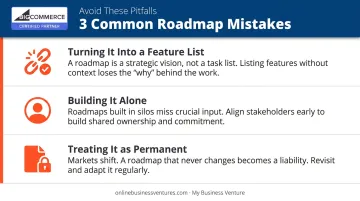
Even well-intentioned roadmaps can fail. Here are the three most common traps to watch for:
- Turning it into a feature list. When a roadmap is packed with deliverables but disconnected from goals, efforts become bloated and unfocused. Every item should tie back to a customer outcome or business goal — if you can't answer "why does this matter?", it doesn't belong yet.
- Building it alone. Roadmaps created without stakeholder, team, or customer input often lack buy-in and feasibility. Other perspectives surface constraints you'd miss and build the shared ownership that makes execution smoother.
- Treating it as permanent. Failing to update the roadmap as priorities shift, new data arrives, or market conditions change makes it obsolete fast — and erodes trust with anyone relying on it. As ProductPlan notes, when product strategy changes, the roadmap should change with it.
Frequently Asked Questions
How do product managers create a roadmap?
Product managers start by defining strategic goals and gathering customer input, then prioritize initiatives based on value and feasibility. Those priorities get mapped onto a timeline — usually organized by quarters or Now/Next/Later horizons — and shared iteratively with cross-functional stakeholders throughout the process.
What should be included in a product roadmap?
A roadmap should include strategic goals, planned initiatives or themes, and a timeline or time horizon (such as Now/Next/Later or quarterly). Release milestones and key metrics are optional but useful additions.
How often should a product roadmap be updated?
Roadmaps should be reviewed at least quarterly — or whenever significant new information warrants a change in direction, such as a shift in customer needs, a market change, or a new business priority.
What is the difference between a product roadmap and a project plan?
A product roadmap is a high-level, strategic view of what you're building and why over time. A project plan details the specific tasks, owners, and deadlines needed to execute individual initiatives within that broader strategy.
What format should a product roadmap be in?
The best format depends on the audience. Executives typically prefer a high-level view organized by themes or goals; development teams need more feature-level detail. For most small business owners, a simple Now/Next/Later visual is the most practical and effective starting point.
What are the most common product roadmap mistakes?
The most frequent pitfalls include treating the roadmap as a fixed delivery schedule, filling it with feature lists disconnected from business goals, building it without stakeholder or customer input, and failing to review and update it as priorities evolve.