Introduction
The appeal is real: work from anywhere, set your own schedule, and build something that's genuinely yours. But many aspiring entrepreneurs stall at the starting line because the path forward isn't obvious: which business model fits? Where does the money come from? What do you actually do on day one?
According to a 2024 Gallup survey of nearly 47,000 U.S. adults, 62% would prefer to be their own boss — yet the same research found that 60% of aspiring entrepreneurs cite lack of funding and 50% cite personal financial risk as real barriers.
The good news: online entrepreneurship has lower startup costs, no geographic limits, and more accessible tools than ever before. The challenge is knowing which steps to take, in what order, and how to avoid the mistakes that derail most early-stage businesses.
This guide walks through what online entrepreneurship actually is, which business models exist, a concrete step-by-step launch roadmap, the skills worth building, and the pitfalls worth avoiding.
Key Takeaways
- An online entrepreneur builds and runs a business through digital channels — from e-commerce to consulting to content.
- Niche selection comes first; every other decision flows from it.
- Mastering digital marketing, SEO, copywriting, and financial literacy gives you a stronger foundation than any degree or large startup budget.
- Turn-key dropship solutions can launch a fully stocked online store in days — no inventory, warehousing, or fulfillment required.
- Most early failures trace back to two mistakes: skipping market research and underinvesting in marketing.
What Is an Online Entrepreneur?
An online entrepreneur identifies a market opportunity and builds a business primarily through digital channels — selling products, delivering services, or creating content without the overhead of a physical storefront.
Compared to traditional entrepreneurship, the key differences are:
- Lower startup costs — no lease, no physical inventory requirement in many models
- Geographic freedom — operate from anywhere with an internet connection
- Global reach — access customers in any market from day one
Common Types of Online Entrepreneurs
The umbrella covers more ground than it might seem. Common models include:
- E-commerce store owners — selling physical or digital products online
- Dropshippers — running a store without holding inventory
- Freelancers — selling skills directly to clients (writing, design, development)
- Online consultants and coaches — monetizing expertise through sessions or programs
- Digital course creators — packaging knowledge into structured learning
- Bloggers and affiliate marketers — building audiences and earning through referrals or ads
- Content creators — monetizing through brand partnerships, memberships, or platforms
No single model fits everyone. Your starting point — what you know, what you have, and how much time you can commit — determines which path makes the most sense.
What Does an Online Entrepreneur Do?
Day-to-day responsibilities vary significantly by business model, but most online entrepreneurs manage a consistent core set of tasks.
Daily Responsibilities
- Responding to customer inquiries and support requests
- Updating or managing their website and product listings
- Creating or reviewing marketing content
- Running and monitoring paid or organic marketing campaigns
- Reviewing sales and traffic analytics
- Coordinating with vendors, suppliers, or fulfillment partners
The Reality of Running It Alone Early On
Early-stage online entrepreneurs typically wear every hat simultaneously — marketer, customer service rep, product manager, and bookkeeper. This isn't sustainable long-term, but it's a normal part of getting started.
What distinguishes businesses that grow from ones that plateau is delegation and automation. Once systems or team members handle routine tasks, the owner can focus on strategy, partnerships, and growth.
Building the right skills from the start directly affects how fast that transition becomes possible — which is why the skills section later in this guide matters more than most people expect.
Popular Online Business Models to Consider
Your niche and available resources should drive the model you choose — not the other way around. Here are the three models most new online entrepreneurs start with.
E-Commerce and Dropshipping
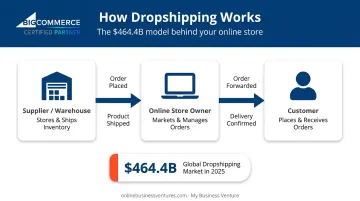
E-commerce means selling products through an online store. Dropshipping is a lower-overhead variation where a third-party supplier handles inventory storage and order fulfillment — the entrepreneur focuses on marketing, customer experience, and store management.
This model is accessible for beginners because it removes the three biggest startup barriers:
- No warehouse or inventory required
- No bulk purchasing or upfront stock costs
- No shipping logistics to manage yourself
The global dropshipping market was valued at $464.4 billion in 2025 and is forecast to reach $2.18 trillion by 2033, according to Grand View Research. For those who want a faster entry point, companies like My Business Venture (MBV) offer turn-key e-commerce packages starting at $3,995 — including a live BigCommerce store, access to 1M+ products, and one-on-one training — with most clients going live within a week.
Service-Based and Consulting Businesses
Freelancing, virtual assistance, coaching, and consulting leverage existing expertise directly. These models require minimal startup capital and are often the fastest path to first revenue — because you're selling your knowledge or skills, not a product that needs marketing infrastructure.
Upwork's 2023 Freelance Forward report estimated 64 million Americans freelanced in 2023, contributing $1.27 trillion to the U.S. economy — with 47% providing skilled knowledge services like marketing, IT, and consulting.
Content Creation and Digital Products
Blogging, affiliate marketing, online courses, and newsletters fall into this category. These models often take longer to generate meaningful revenue, but they scale into passive income streams over time. Goldman Sachs estimated the creator economy at $250 billion in 2023, potentially reaching $480 billion by 2027 — though only about 4% of creators earn over $100,000 annually, a useful reality check on timeline expectations.
Each model has a different risk profile, startup cost, and revenue timeline. The right choice depends on what you already know, how much capital you're working with, and how quickly you need to generate income.
Steps to Become an Online Entrepreneur
This is a practical roadmap. You don't need to complete each step perfectly before moving forward — but skipping steps entirely, especially research and planning, is one of the most consistent reasons new businesses stall.
Step 1: Identify Your Niche
A strong niche sits at the intersection of three things: something you have genuine skill or interest in, real market demand, and a problem customers are already paying to solve.
How to evaluate a niche:
- Check search volume using Google Keyword Planner or Ubersuggest
- Browse Amazon Best Sellers to spot where spending is already happening
- Search Reddit communities to find what frustrations people voice repeatedly
- Look at what competitors exist — some competition is a sign of a healthy market
Zero competition usually signals no demand, while fierce competition with no clear differentiation makes the road harder — the sweet spot is a market with buyers and room for a distinct angle.
Step 2: Research Your Market and Competition
Market research for an online business doesn't require expensive agencies. Free tools cover most of what you need:
- Google Trends — tracks relative search interest over time and by geography
- Reddit communities — reveals real buyer language and recurring pain points
- Amazon Best Sellers — shows marketplace momentum by category
Study your top competitors: what do they do well, where do customers complain, and what gaps remain unfilled? That gap is your opening.
Step 3: Choose Your Business Model
Your niche naturally points toward the right model. A product-focused niche (home goods, electronics, pet accessories) often suits e-commerce or dropshipping. A knowledge-based niche (marketing, finance, fitness) often suits consulting, courses, or coaching.
Match the model to your reality:
- Time available — content models require consistent output over months
- Starting capital — service businesses cost nearly nothing; e-commerce requires modest investment
- Existing skills — play to your strengths at the start
Step 4: Write a Business Plan
It doesn't need to be a formal 50-page document. For an online entrepreneur, a working plan should cover:
- The business concept and what problem it solves
- Target customer — who they are, what they need, where they spend time
- Competitive landscape and your differentiation
- Revenue model — how money actually flows in
- Estimated startup costs and monthly expenses
- 6–12 month goals, specific and measurable
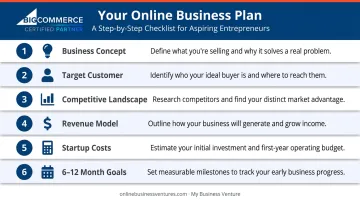
Having it written down creates accountability and exposes blind spots before they cost money.
Step 5: Build Your Online Presence
Getting a site live involves more decisions than most people expect, but none of them are technically overwhelming. Core setup tasks include:
- Registering a domain name
- Choosing and configuring a website or e-commerce platform
- Setting up payment processing
- Building your store, landing page, or service site
For e-commerce entrepreneurs who want to skip the configuration grind, turn-key solutions handle much of this upfront work. My Business Venture, for example, delivers a fully configured BigCommerce store — products loaded, payment processing active, SSL security in place, and branding applied — that can be operational within days. Their consulting team and MBV University training program cover the launch process step by step.
Step 6: Launch, Market, and Iterate
Before launch, have at minimum:
- A social media presence on 1–2 platforms where your audience actually spends time
- Basic SEO applied to your key pages
- An email capture mechanism so you can build a list from day one
After launch, the work shifts to consistency and honest analysis. Review analytics weekly — traffic sources, bounce rates, conversion rates — and test different messaging based on what the numbers show, not gut feeling alone. Most online entrepreneurs don't see traction in the first 30 days. The ones who build something real are those who treat slow early results as data, not failure.
Essential Skills Every Online Entrepreneur Needs
A formal degree isn't required — but building specific skills improves your odds considerably. These can be developed through online courses, practice, and mentorship.
Digital Marketing
Digital marketing is the umbrella covering social media, email campaigns, paid advertising, and content strategy. Strong marketing skills let you attract and retain customers without a massive budget. Even if you eventually outsource execution, understanding how each channel works — and why — keeps you from being dependent on whoever you hire.
Core channels to understand:
- Social media — building audience and brand awareness organically or through paid posts
- Email campaigns — nurturing leads and driving repeat purchases from existing customers
- Paid advertising — PPC and display ads that generate traffic on demand
- Content strategy — planning what you publish, when, and for whom
Search Engine Optimization (SEO)
SEO is the practice of optimizing your website to rank higher in search engines, driving organic (non-paid) traffic. BrightEdge research found that organic search generates 53% of trackable website traffic — making it one of the highest-value acquisition channels available.
Key components to learn:
- Keyword research — finding what your customers actually search for
- On-page optimization — titles, headers, meta descriptions, and content structure
- Content quality — depth, accuracy, and relevance to the query
- Link building — earning credibility through external references
Copywriting and Content Creation
Getting traffic through SEO and ads only matters if your words close the deal. Copywriting — product descriptions, landing pages, emails, social posts — is one of the highest-leverage skills you can develop. Strong copy converts visitors into buyers; weak copy loses them no matter how good your product is. Even if you hire writers eventually, knowing what effective copy looks like helps you give direction and catch what misses the mark.
Financial Literacy and Basic Accounting
You need to know:
- The difference between revenue and profit
- How to track expenses and categorize them correctly
- What your break-even point is
- When the business is actually profitable (not just generating sales)
Separate personal and business finances from day one — a dedicated business bank account and basic accounting software (QuickBooks, Wave, or similar) makes tax time manageable and gives you an accurate picture of business health.
Time Management and Self-Discipline
Without a boss setting deadlines, online entrepreneurs must build their own systems. Three components matter:
- Organization — tracking responsibilities, deadlines, and priorities in one place
- Prioritization — focusing on revenue-generating tasks before administrative ones
- Delegation — recognizing when hiring or outsourcing frees you for higher-value work
Most early-stage entrepreneurs underestimate how much unstructured time slips away. Building even a basic daily schedule — and protecting it — is what separates consistent progress from spinning wheels.
Common Mistakes New Online Entrepreneurs Make
These are the patterns that consistently derail early-stage businesses. Awareness alone can help you sidestep them.
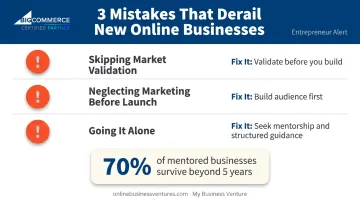
Skipping market validation. Falling in love with an idea before confirming customers will pay for it is costly. Research from Harvard Business School Online indicates that approximately 34% of startups fail due to poor product-market fit. Validate before investing significantly: pre-sell the product, run a simple landing page test, or conduct five to ten customer interviews before building anything.
Neglecting marketing until after launch. Many new entrepreneurs spend most of their energy on the product or store, then expect customers to appear. A good product with poor marketing almost always underperforms a decent product with strong marketing. Build an audience and marketing infrastructure before launch, not after.
Trying to figure everything out alone. Avoiding mentorship or expert guidance to "save money" tends to cost more in the long run through lost time, wasted ad spend, and avoidable early mistakes. An SBA-referenced survey found that 70% of mentored small businesses survived beyond five years, compared to roughly half of small businesses generally.
Successful online entrepreneurs actively seek experienced advisors, peer communities, and structured training programs. MBV, for example, pairs every new store owner with a dedicated consultant so they're not navigating the early learning curve alone.
Frequently Asked Questions
What does an online entrepreneur do?
Online entrepreneurs build and manage businesses through digital channels — handling tasks like marketing, customer communication, product or service delivery, and website management. Their specific day-to-day activities vary significantly depending on which business model they operate.
How much money do you need to start an online business?
Startup costs vary widely. Service-based businesses like freelancing or consulting can launch for almost nothing, while e-commerce typically requires a modest investment for a website and tools. Turn-key solutions like MBV bundle website setup, product access, training, and support into a single one-time package starting at $3,995.
Can I become an online entrepreneur with no prior experience?
Yes. Many successful online entrepreneurs started with no formal experience and built skills through online courses, mentorship, and hands-on practice. The key is choosing a model that aligns with your current strengths while investing in the skills the business requires.
What is the most profitable online business model for beginners?
Dropshipping and service-based businesses are frequently recommended for beginners due to low startup costs and relatively fast paths to first revenue. Profitability depends on niche selection, marketing effectiveness, and consistency more than on the model itself.
How long does it take to start making money as an online entrepreneur?
Service-based businesses can generate income within weeks after landing the first client. Content-driven models like blogging or affiliate marketing often take several months to build meaningful revenue.
Do I need a business degree to become an online entrepreneur?
No. Practical skills in digital marketing, SEO, copywriting, and basic financial management are more valuable day-to-day than formal credentials. Most can be developed through free or low-cost online resources, certifications, and mentorship programs.