
Store management is the discipline that holds all of those moving parts together. Without it, even a well-stocked store with great products can hemorrhage revenue through stockouts, poor customer experiences, and operational chaos.
This guide is written for aspiring entrepreneurs, first-time store owners, and small business operators who want to build a well-run, profitable operation from the start. We'll cover what store management actually means, its core components, why it matters, and the best practices that separate struggling stores from thriving ones.
Key Takeaways
- Store management covers every core function — inventory, customer service, sales, staffing, and financials — all aimed at keeping operations efficient and profitable
- The six core components are inventory management, customer service, sales and marketing, employee management, store layout/product presentation, and financial oversight
- Tracking KPIs, building SOPs, and auditing regularly beats reactive firefighting every time
- Technology now handles much of what used to require manual effort, from inventory syncing to order processing
- Every store management principle in this guide applies to e-commerce businesses, even without a physical location
What Is Store Management?
Store management is the practice of overseeing and coordinating all aspects of a store's daily operations — inventory, staffing, sales, marketing, customer service, and financial performance — so the business runs smoothly and profitably.
Traditionally, the term applies to physical retail. But it's equally essential for online stores, where the same core functions just run digitally.
The Store Manager's Role
A store manager translates business strategy into daily execution. That means setting targets, managing people and processes, and making sure every function of the store works together. In a solo e-commerce operation, that person is you.
Reactive vs. Proactive Management
How you respond to problems defines the kind of store you build:
- Reactive managers deal with problems as they surface — stockouts, complaints, unexpected turnover
- Proactive managers track KPIs, anticipate issues, and continuously refine their systems before problems escalate
Most struggling stores don't have a product problem — they have a management approach problem. Shifting from reactive to proactive is usually the single biggest operational upgrade a store owner can make.
Store Management in E-Commerce
That same proactive discipline applies directly to e-commerce. For online store owners, store management expands to include product catalog maintenance, order fulfillment coordination, platform optimization, and digital customer experience. Managing an e-commerce store is just as operationally complex as running a physical storefront — the channels are different, but the disciplines are the same.
Key Components of Store Management
Inventory Management
Inventory management is the financial backbone of any store. Having the right products available in the right quantities at the right time prevents both stockouts (lost sales) and overstocking (tied-up capital).
The scale of the problem is significant: IHL estimates that worldwide inventory distortion — including overstocks and out-of-stocks — cost retailers $1.77 trillion in 2023. Separately, the NRF reported $112.1 billion in US retail shrink losses in FY2022 alone.
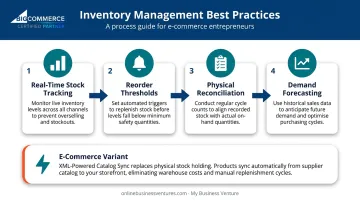
Core inventory management practices include:
- Tracking stock levels in real time
- Setting reorder thresholds before items run out
- Reconciling physical counts with digital records
- Using demand forecasting based on sales history and seasonal trends
For online and dropship store owners, inventory management looks different. Rather than holding physical stock, it means relying on supplier integrations and real-time product data feeds to keep catalog accuracy and availability current. Platforms built on this model use XML technology to automatically add new arrivals and remove out-of-stock or discontinued items — so customers only ever see products that can actually be fulfilled. MBV's BigCommerce-based stores are built on exactly this architecture.
Customer Service and Experience
Customer experience is one of the most powerful differentiators in both retail and e-commerce. According to PwC's 2025 Customer Experience Survey, 52% of US consumers stopped buying from a company after a bad product or service experience.
Strong customer service in practice means:
- Fast, clear responses to inquiries
- Transparent return and shipping policies
- Proactive resolution when something goes wrong
- Personalized communication that makes customers feel recognized
For online stores, this extends to website usability, accurate product descriptions, and responsive support channels. A customer who can't find the information they need — or who experiences friction at checkout — is already halfway out the door.
Retention compounds over time. Bain & Company notes that a 5% increase in customer retention can boost profits by as much as 95% — making every service interaction a long-term financial decision.
Sales and Marketing
Strong retention builds a foundation, but growth still requires active effort. Store managers must drive revenue through deliberate strategy, not just day-to-day operations. That means:
- Setting monthly sales targets
- Running promotions and loyalty programs
- Identifying growth opportunities in the product catalog
- Tracking what's working and cutting what isn't
For e-commerce operators, digital marketing is the equivalent of in-store promotions. Social media, email campaigns, and search visibility drive traffic the way a window display or end-cap drives foot traffic. A marketing strategy is as fundamental to store management as stocking shelves.
Employee Management
In traditional retail, employee management covers hiring, onboarding, scheduling, performance coaching, and team motivation. Every one of these functions directly impacts customer experience and operational efficiency.
Even solo online entrepreneurs benefit from applying these principles. Clear roles, defined workflows, and accountability systems keep operations from becoming chaotic as the business grows. When you eventually bring on a virtual assistant, a customer service rep, or a marketing contractor, having those structures in place already makes scaling far smoother.
Store Layout and Product Presentation
Physical stores use layout and visual merchandising to guide customer flow, highlight high-margin products, and encourage unplanned purchases. Strategic zoning, focal points, and display rotation all influence buying decisions — POPAI's study of nearly 3,000 mass-merchant shoppers found an 82% in-store purchase decision rate, with displays playing a notable role in brand selection.
For e-commerce stores, the equivalent is:
- Site navigation structure and category organization
- Product photography quality
- Homepage and featured collection strategy
- Search and filtering functionality
Baymard Institute found that 58% of desktop e-commerce sites and 67% of mobile sites rated mediocre-to-poor on navigation. Poor navigation is the digital equivalent of a disorganized store floor — customers leave without buying.
Financial Oversight and Reporting
Effective store managers track the numbers that reveal store health:
| KPI | What It Reveals |
|---|---|
| Revenue & gross margin | Whether the business is profitable |
| Inventory turnover | How efficiently stock is being sold |
| Average order value | Upsell and cross-sell effectiveness |
| Conversion rate | How well traffic is converting to sales |
| Customer acquisition cost | Whether marketing spend is sustainable |
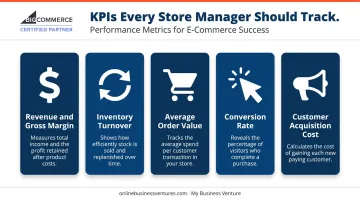
Regular financial reporting turns raw data into actionable decisions about pricing, purchasing, and staffing. Without it, store management becomes guesswork.
Why Store Management Matters for Business Success
Most store failures aren't caused by bad products — they're caused by poor operations. Here's what strong management actually delivers:
- Operational efficiency improves when every function has clear processes and accountability — daily tasks run with less friction, freeing time for growth instead of reactive problem-solving.
- Customer retention follows consistency. Shoppers who find products easily, get reliable service, and breeze through checkout come back — and bring others. McKinsey's analysis found that customer experience leaders achieved more than twice the revenue growth of CX laggards between 2016 and 2021.
- Profitability improves as waste shrinks. Strong management cuts overstocking, reduces shrinkage, and enables data-driven decisions that lift margins directly.
Best Practices for Effective Store Management
Set Clear, Measurable Goals
Vague goals produce vague results. Define specific business targets using a SMART framework — monthly sales revenue, inventory turnover rate, customer satisfaction scores. Goals give teams direction and provide a benchmark for evaluating what's working.
Build Standard Operating Procedures (SOPs)
Document recurring tasks: opening/closing routines, order processing, customer complaint handling, inventory receiving. SOPs create consistency and reduce dependency on any one person's knowledge.
For e-commerce operators, SOPs govern how products are listed, how orders are processed, and how customer inquiries are handled. As the business grows, these systems are what allow you to delegate without losing quality.
Prioritize Customer Feedback and Data
Gather reviews, monitor return reasons, track conversion rates, and analyze purchasing patterns. Data-driven adjustments to product selection, pricing, and marketing consistently outperform instinct-based decisions — because every data point tells you something a hunch can't.
Invest in Ongoing Training
Skills atrophy without practice, and the e-commerce landscape changes quickly. Whether you're developing your own skills or those of your team, ongoing training in product knowledge, platform proficiency, and customer service pays dividends at every stage of growth.
MBV University, for example, offers tiered one-on-one coaching for new store owners — covering everything from foundational setup to digital marketing strategy — with support available at every stage of the business journey.
Audit and Iterate Regularly
Schedule performance reviews at consistent intervals:
- Weekly: Sales check-ins, traffic monitoring
- Monthly: Inventory audits, financial reporting
- Quarterly: Strategy reviews, KPI benchmarking
Regular audits catch discrepancies early and surface inefficiencies before they become expensive problems.
How Technology Simplifies Store Management
Modern store management — especially in e-commerce — relies on technology to automate time-consuming processes, reduce human error, and provide real-time visibility across all store functions.
Key categories of tools include:
- Inventory management software — tracks stock levels and automates reorder triggers
- E-commerce platforms — consolidate catalog management, order processing, payments, and reporting
- CRM platforms — manage customer data and support targeted follow-up
- Analytics dashboards — surface KPIs and conversion data in real time
- POS systems — for physical retail environments
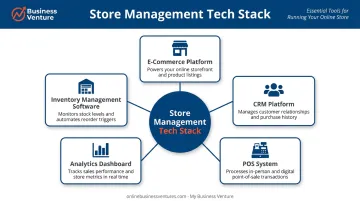
Integrated e-commerce platforms are particularly valuable because they consolidate multiple store management functions in one place — eliminating disconnected spreadsheets, manual tracking, and the errors that follow. BigCommerce, for instance, enables entrepreneurs to launch professional stores with product catalog management, order processing, payment handling, customer data, and performance reporting built in.
For entrepreneurs launching their first online store, My Business Venture (MBV) offers a turn-key e-commerce solution built on BigCommerce that handles most of the operational complexity from day one. The platform includes:
- Real-time product catalog updates via XML technology
- Access to over 1 million products through Doba's dropship network
- Built-in payment processing with fraud screening
- One-on-one business consulting through MBV University
Most new store owners go live in under a week, with the technical infrastructure already in place — leaving them free to focus on marketing and customer acquisition from the start.
Frequently Asked Questions
What do you mean by store management?
Store management refers to overseeing and coordinating all operations within a retail or e-commerce store — including inventory, sales, customer service, staffing, and financial performance. Done well, it keeps every function working together toward consistent growth and profitability.
What is 5S in store management?
5S is a Japanese workplace organization method covering five steps: Sort, Set in Order, Shine, Standardize, and Sustain. Applied to store operations, it reduces waste, improves efficiency, and creates repeatable systems for maintaining an organized environment.
What are the key components of store management?
The main components are inventory management, customer service, sales and marketing, employee management, store layout and product presentation, and financial oversight. Each function affects the others — strong management keeps all of them aligned.
What is the difference between store management and inventory management?
Inventory management is one component of store management, covering stock tracking, ordering, and organization. Store management is the broader discipline that encompasses inventory alongside staffing, customer experience, marketing, and financial performance.
What skills are needed for effective store management?
Store managers need soft skills like leadership, communication, and customer empathy, alongside hard skills: financial literacy, data analysis, and working knowledge of retail technology and inventory systems.
How does store management apply to online or e-commerce stores?
The core principles are the same — e-commerce store management covers catalog and inventory accuracy, digital customer experience, order fulfillment, online marketing, and performance analytics. The platform is digital, but the operational disciplines — tracking, fulfillment, customer service, and performance review — translate directly from physical retail.