The reality is that "multichannel selling" sounds straightforward until you're manually updating stock counts across three platforms, a customer orders the last unit that just sold on Amazon, and your fulfillment team is reconciling spreadsheets instead of shipping. These problems outgrow manual processes quickly — often faster than sellers expect.
This article breaks down what a multichannel order manager actually does, which features genuinely matter, and an honest look at both the advantages and limitations. The goal is to help you determine whether one is right for your business — and when the timing makes sense.
Key Takeaways
- A multichannel order manager unifies orders, inventory, and fulfillment from all sales channels into one dashboard
- Real-time inventory sync prevents overselling and protects marketplace account health
- Automation allows small teams to handle significantly higher order volumes without adding headcount
- Implementation takes four to six weeks on average and typically requires $500–$2,000+ in platform and setup costs
- For first-time sellers, building a solid single-channel foundation first is the smarter starting point
What Is a Multichannel Order Manager?
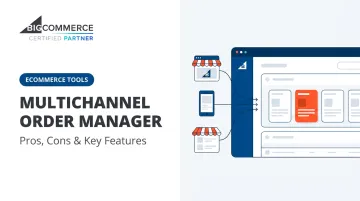
A multichannel order manager is software that connects multiple sales channels — e-commerce stores, online marketplaces, retail POS systems, and wholesale portals — into a single platform. The result is one source of truth for orders, inventory, and fulfillment, rather than separate systems running in parallel with no shared visibility.
It's typically used by online retailers selling across platforms like Shopify, BigCommerce, Amazon, eBay, or Walmart who need stock levels and orders to stay synchronized in real time. According to Digital Commerce 360's 2022 survey of 124 retailers, marketplace participation breaks down as: 60% on Amazon, 35% on eBay, and 29% on Walmart — meaning most growing sellers are juggling at least two of these simultaneously.
Without synchronization, selling the same last unit on two channels at once is a common and costly mistake. The consequences go beyond unhappy customers:
- Amazon requires a seller-fulfilled cancellation rate below 2.5% over any seven-day period — violations put your selling account at risk
- eBay treats out-of-stock cancellations as transaction defects, directly damaging seller ratings
Managing these risks manually across two or more channels isn't scalable. A multichannel order manager handles the synchronization automatically — so sellers spend less time firefighting stockouts and more time growing.
Key Features of a Multichannel Order Manager
Not all multichannel order managers are equal. The features below separate tools that genuinely improve operations from ones that look good in a demo but create new bottlenecks in practice.
Real-Time Inventory Synchronization
When a product sells on any connected channel, stock levels update everywhere instantly. This prevents overselling and the customer service fallout that follows.
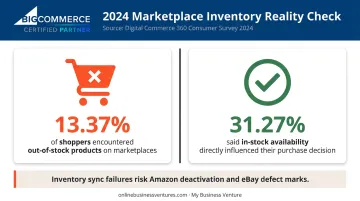
The stakes are real: a Digital Commerce 360 consumer survey found that 13.37% of shoppers encountered out-of-stock products when trying to buy on marketplaces, and **31.27% said in-stock availability directly influenced their purchase decisions**. Beyond the lost sale, failing to sync inventory risks Amazon account deactivation and eBay defect marks.
One documented example: Rinkit, a UK housewares retailer, was manually maintaining Excel spreadsheets across channels — and oversold thousands of champagne glasses before adopting synchronized inventory management.
Automated Order Routing
The system automatically assigns each incoming order to the best fulfillment location based on stock availability, customer proximity, and shipping cost. This eliminates manual decision-making for every order, which becomes a real time drain when you're processing dozens or hundreds of orders daily across multiple warehouses or fulfillment nodes.
Native Channel Integrations
There's a meaningful difference between native (built-in) integrations and middleware-dependent connections. Native integrations are maintained by one vendor, which typically means better reliability, automatic API updates, and faster troubleshooting.
As IBM notes, native integrations provide better performance because one vendor handles retries, throttling, and monitoring. That said, they can face throughput limitations at very high scale.
A strong multichannel order manager should connect natively to:
- E-commerce platforms (Shopify, BigCommerce, WooCommerce, Magento)
- Marketplaces (Amazon, eBay, Walmart)
- Retail POS systems
- B2B and wholesale portals
- Accounting software
Cross-Channel Reporting and Analytics
Once your channels are connected, the data they generate becomes one of your most valuable assets. Centralized reporting reveals which channels are actually profitable after fees, which products move fastest, and where inventory capital is tied up. Without it, decisions get made on partial data or instinct alone.
Returns and Exception Management
Handling returns across multiple channels from one place, with automatic inventory restocking and refund processing, is a feature that often gets overlooked during evaluation. For marketplace sellers, returns mismanagement directly affects performance metrics: poor returns handling can suppress your Buy Box eligibility on Amazon or trigger account warnings that limit your selling access.
Pros of Using a Multichannel Order Manager
Centralized Control Eliminates Costly Operational Silos
Without a centralized system, each sales channel operates as a separate mini-business. Amazon doesn't know what Shopify just sold. The warehouse team is reacting to email threads and manually updated sheets. A multichannel order manager collapses all of this into one operational view.
KPIs most impacted: order accuracy rate, inventory discrepancy rate, hours spent on manual reconciliation. Impact is highest when a business manages three or more sales channels or experiences frequent stock count mismatches.
Automation Enables Scaling Without Proportional Headcount Growth
Multichannel order managers automate the repetitive work: order routing, label generation, status updates, inventory adjustments. A small team can handle significantly more order volume without additional hires.
The numbers from vendor-reported cases are instructive:
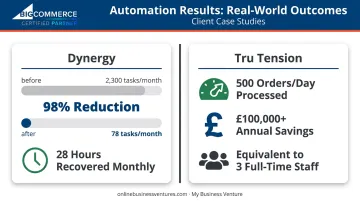
- Dynergy reduced recurring manual tasks from 2,300 to 78 per month — a 98% reduction — and recovered more than 28 hours monthly using Linnworks
- Tru Tension processed approximately 500 orders per day and attributed savings of over £100,000 annually — equivalent to three full-time staff — to the platform
KPIs most impacted: cost per order, fulfillment speed, team capacity. Most relevant during peak seasons or when expanding into new channels without budget to grow headcount proportionally.
Smarter Inventory Decisions Through Consolidated Data
When all order and inventory data flows into one system, sellers gain accurate demand signals — which products sell fastest, on which channels, and when. This supports better purchasing decisions rather than reactive restocking.
The cost of getting this wrong is substantial. IHL Group's 2025 research puts annual inventory distortion at $1.77 trillion across retail globally:
- $1.2 trillion lost to out-of-stocks
- $572 billion lost to overstocks
These are retail-wide figures, but the signal is clear: mismanaged inventory destroys margin at scale.
KPIs most impacted: inventory turnover rate, stockout frequency, carrying costs. Especially critical for businesses with seasonal demand or a large SKU count across multiple channels.
Cons of Using a Multichannel Order Manager
Upfront Cost and Ongoing Subscription Fees
Multichannel order management software carries real costs. Public pricing varies widely by platform and order volume:
| Platform | Starting Price | Pricing Model |
|---|---|---|
| Sellbrite | Free (up to 30 orders) | Order-volume tiers; up to $679/month for 100K orders |
| Ordoro | $299–$349/month | Per app; inventory and dropshipping separate |
| ShipStation | $14.99/month | Shipment-volume tiers |
| Linnworks | Quote only | Volume-based, custom onboarding fee |
| Extensiv Order Manager | Quote only | Enterprise pricing |
| Rithum (formerly ChannelAdvisor) | Quote + GMV fee | Enterprise; setup fees in contract |
Beyond the subscription, factor in implementation fees, integration costs, and staff training time. For early-stage sellers, these combined expenses can outweigh the operational benefit.
Implementation Complexity and Learning Curve
Setting up a multichannel order manager requires connecting multiple platforms, migrating data, configuring routing rules, and training staff. Extensiv reports that 90% of customers complete implementation in four to six weeks; Linnworks reports an average of 40 days. Both are vendor-reported and tend to reflect favorable conditions.
Real-world user reviews paint a more complicated picture. Capterra reviewers have cited:
- A steep initial learning curve described as "slow and frustrating"
- Limited support quality for complex setups
- Problematic marketplace integrations (particularly Walmart)
- Weak communication during onboarding
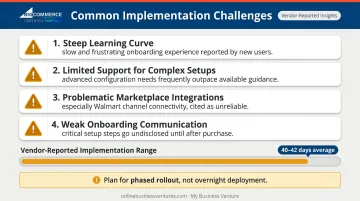
For small teams without dedicated technical resources, this is a real obstacle, not a one-time setup headache.
Risk of Over-Investing Before the Business Is Ready
For sellers just starting out with one or two channels and low order volume, a full multichannel OMS may create more complexity than it solves. Most of these systems are built for businesses with established operations, multiple warehouse locations, and consistent order volume.
Adopting one too early drains resources and introduces operational overhead before a seller has even validated their product-market fit. A simpler, channel-specific tool is often the better starting point — with room to upgrade as order volume and channel count grow.
How to Get the Most Value from a Multichannel Order Manager
Connect every active channel from day one. Partial integration defeats the purpose. If one channel operates outside the system, inventory discrepancies return and reporting becomes unreliable.
Review performance data on a consistent cadence. Weekly or monthly reporting reviews are only valuable when someone acts on the insights — adjusting purchasing decisions, shifting inventory, or repricing based on channel profitability. An unmonitored dashboard is an expensive decoration.
Build a solid single-channel foundation first. For entrepreneurs just beginning their e-commerce journey, launching a properly configured store before adding multichannel complexity is the stronger move. My Business Venture's turn-key e-commerce packages — built on BigCommerce by a certified developer — are built for exactly this starting point. Each package includes:
- Real-time inventory syncing via XML technology
- Dropship fulfillment with no inventory stocking required
- One-on-one training and consulting through MBV University
New sellers gain a fully operational store and the fundamentals to run it confidently — before layering in channels like Amazon or eBay.
Frequently Asked Questions
What is the difference between a multichannel order manager and a single-channel order system?
A single-channel system manages orders from one platform only. A multichannel order manager unifies orders, inventory, and fulfillment from all sales channels into one dashboard — making it essential once you're selling on two or more platforms simultaneously.
Do small businesses or first-time sellers actually need a multichannel order manager?
Not necessarily at the start. It becomes necessary when inventory discrepancies, manual errors, or fulfillment delays start happening regularly across multiple active channels.
What are the biggest drawbacks of multichannel order management software?
Cost, implementation complexity, and the learning curve — especially for smaller operations. Choosing a solution that matches your current business stage matters as much as the feature list.
How much does multichannel order management software typically cost?
Pricing ranges from free tiers for low-volume sellers to enterprise contracts with custom pricing. Beyond the subscription, account for implementation fees, per-integration charges, and onboarding costs.
Can a multichannel order manager handle dropshipping alongside owned inventory?
Most capable platforms support both. Platforms like Linnworks and Ordoro handle both within the same system, using separate tracking and routing logic for dropship supplier orders and owned warehouse inventory.
How long does it take to implement a multichannel order management system?
Vendor averages range from four to six weeks, though timelines vary based on channel count, data migration complexity, and your team's technical capacity. Plan for a phased rollout rather than an overnight switch.