Many aspiring POD sellers get stuck here. Etsy offers a built-in audience but limits your brand. Shopify hands you full control but leaves traffic entirely up to you. Pick the wrong one at the wrong stage and you'll either burn months without a sale, or cap your growth just as things start moving.
This comparison breaks down exactly what each platform costs, where buyers come from, how much control you get, and — most importantly — when each platform makes sense for where you are right now.
Key Takeaways
- Etsy provides built-in marketplace traffic — ideal for validating POD designs quickly with minimal upfront cost
- Shopify gives you full brand ownership, customer data, and scaling tools. Traffic generation is entirely on you.
- Etsy's fees are transaction-based; Shopify charges a monthly subscription starting at $39/month
- The smartest sequencing for most sellers: validate on Etsy, then scale on Shopify
- No universal winner exists — your current stage and biggest bottleneck determine the right fit
Shopify vs Etsy for Print on Demand: Quick Comparison
Here's how the two platforms compare at a glance.
| Factor | Shopify | Etsy |
|---|---|---|
| Monthly Cost | $39–$399/month (or $29–$299 billed yearly) | No required monthly fee |
| Listing Fee | None (varies by app) | $0.20 per listing |
| Transaction Fee | 0.6%–2% if not using Shopify Payments | 6.5% of item price + shipping |
| Payment Processing | Included with Shopify Payments | 3% + $0.25 per order (US) |
| Traffic Source | Self-generated (SEO, ads, social) | Built-in marketplace buyers |
| Brand Control | Full storefront customization | Limited within Etsy's framework |
| Scalability | Highly scalable with tiered plans + apps | Scalable but marketplace-dependent |
| Best For | Building a long-term brand | Fast validation, low-risk entry |
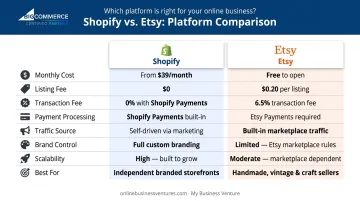
Etsy also charges an Offsite Ads fee — 15% on attributed sales for shops under $10,000/year in Etsy revenue, dropping to 12% once you cross that threshold. On a $40 sale, that's $6 going to Etsy before payment processing fees even apply.
What Is Shopify for Print on Demand?
Shopify is a self-hosted e-commerce platform, not a marketplace. You build your own branded store, connect a POD fulfillment provider like Printful or Printify, and orders route automatically to production — no inventory, no warehouse.
The Core Advantages
- Complete brand ownership — your domain, your design, your checkout experience
- 800+ themes ranging from free to premium, plus full Liquid/Hydrogen development options
- 8,000+ app integrations — abandoned cart recovery, upsell flows, email capture, loyalty programs
- Customer data is yours — email lists, purchase history, remarketing audiences
These aren't just features — they translate directly into revenue. Upsells raise average order value, email capture enables repeat purchases, and abandoned cart flows recover sales that would otherwise disappear. None of that exists within Etsy's marketplace model.
The Traffic Tradeoff
Shopify gives you a fully operational store — but no built-in audience to fill it. Shopify notes that most new merchants should expect two to four weeks of consistent marketing before seeing a first sale — and that's with active promotion, not waiting around.
You'll need SEO, paid ads, social media, or an existing audience to drive visitors. For sellers without those assets already in place, this is a significant barrier.
Cost Structure
- Basic plan: $39/month ($29/month billed annually) + 2% third-party transaction fee if not using Shopify Payments
- Grow plan: $105/month ($79/month annually) + 1% third-party transaction fee; supports up to 5 staff accounts
- Advanced plan: $399/month ($299/month annually) + 0.6% transaction fee; supports up to 15 accounts
- Add-ons: Premium themes, paid apps, custom domains, and POD app subscriptions stack on top
Shopify currently offers a 3-day free trial followed by $1/month for the first three months — a low-risk way to test the setup before committing.
Use Cases Where Shopify Excels
Shopify is the right environment for:
- Premium niche apparel brands built around a specific identity or community (think: a fishing lifestyle brand or a gym culture label)
- Fan community merchandise where repeat buyers and brand loyalty drive lifetime value
- Curated home décor collections where brand aesthetics and storytelling justify higher price points
What these use cases share is an audience that already exists — and a seller ready to stop renting space on someone else's platform and start building something that compounds over time.
What Is Etsy for Print on Demand?
Etsy is a curated marketplace built around handmade, vintage, and unique goods. POD fits naturally here — buyers come to Etsy specifically looking for personalized, one-of-a-kind products, and your custom-designed items show up in searches they're already running.
The Core Advantages
According to Etsy's 2025 annual results, the platform had 86.5 million active buyers at year-end 2025 and generated $10.46 billion in gross merchandise sales. That's a large, purchase-ready audience you tap into the moment your listing goes live — no ads required, no audience to build first.
For POD specifically, Etsy's buyer intent is unusually well-matched. Categories that consistently surface in Etsy's own trend data:
- Personalized gifts: searches for engraved and sentimental items were up 60% in Etsy's Fall/Winter 2025 trend report
- Wall art: maximalist print searches tripled as of September 2025
- Apparel: "tshirt" and "shirt" rank among Etsy's 20 most-searched terms; "mothers day shirt" posted a 147% average CTR in March 2025
The Limitations
As volume grows, Etsy's constraints become friction:
- Brand customization is limited to banners, logos, and shop arrangement — every store shares the same structural layout
- You can't email buyers outside Etsy's messaging system, so your customer list stays locked on the platform
- A single ranking change or policy update can impact your visibility overnight
- At higher sales volumes, the fee stack compounds and noticeably narrows margins
Etsy's Full Fee Stack
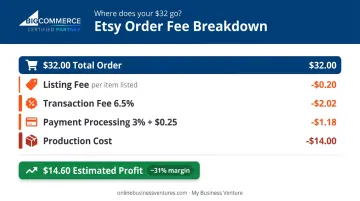
On a $32 order ($25 item + $7 shipping), here's what Etsy takes:
- $0.20 listing fee
- $2.02 transaction fee (6.5%)
- $1.18 payment processing fee (3% + $0.25)
- Total fees: ~$3.40
That leaves roughly $14.60 in profit after production costs — before any Offsite Ads spend, refunds, or design labor. According to Printful's 2025 fee breakdown, that works out to a ~31% margin on a typical $32 POD shirt before advertising costs.
Use Cases Where Etsy Excels
Etsy is the right starting point for:
- Beginners testing designs without a monthly software commitment
- Sellers of personalized gifts — custom pet portraits, name-personalized mugs, occasion-specific apparel
- Niche humor or occupational tees that buyers are actively searching for by keyword
- Custom wall art in trending styles like maximalist, boho, and vintage
If what you're making naturally fits what Etsy buyers are already searching for, there's no faster way to get your first sale.
Shopify vs Etsy for POD: Which Platform Is Right for You?
This isn't a permanent either-or decision. It's a stage-based one.
Choose Etsy If:
- You're new to POD and haven't validated a product-market fit yet
- You don't have a marketing budget or strategy to drive traffic independently
- Your products are personalized, giftable, or niche in a way that matches Etsy's buyer intent
- You want to generate early revenue and design feedback before investing in a brand
Choose Shopify If:
- You've already proven a product or niche and are ready to build around it
- You want to own your customer list, run upsell flows, and build repeat purchase habits
- You're prepared to invest in traffic generation — paid ads, SEO, social media, or email
- You want to grow beyond what a marketplace model allows
The Hybrid Strategy Most Serious Sellers Use
Many successful POD sellers run both platforms in sequence. Start on Etsy to surface winning designs with real buyer data. Once a product shows consistent demand, bring it to Shopify — where you set the margins, own the customer relationship, and build the brand on your own terms. Over time, Etsy handles discovery while Shopify becomes your brand's home base.
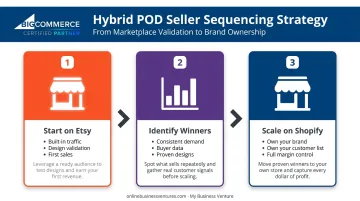
Both Printful and Printify support this setup — one account can connect to multiple stores, and products can be copied between channels. Printify's free plan supports up to 5 connected stores.
A Note on Operational Complexity
Running two platforms adds real overhead — separate listing workflows, order dashboards, fee structures, and customer inboxes. Before committing to both, be honest about your bandwidth. For most early-stage sellers, starting with one platform and adding the second only after the first is profitable is the lower-risk path.
Conclusion
Etsy and Shopify solve different problems at different stages. Etsy accelerates validation and early cash flow. Shopify builds brand equity, customer lifetime value, and scalable margins. The sellers who grow the fastest tend to use both — in the right order.
Stop thinking in terms of platform loyalty and start thinking in terms of sequencing. If you don't have buyers yet, go where buyers already are. Once you have proof, build something you own.
For entrepreneurs ready to build something they own, My Business Venture offers turn-key e-commerce stores backed by 30+ years of experience, one-on-one consulting, and a product catalog of over one million items — so you can launch a branded online store without starting from scratch.
Frequently Asked Questions
Which is more profitable for print on demand, Shopify or Etsy?
Shopify typically offers higher long-term profit potential through better margin control, upsell capabilities, and customer ownership. Etsy can generate faster early revenue, but rising fees compress margins at scale. In practice, sellers who succeed on one platform tend to succeed on the other — product quality and pricing strategy matter more than the platform itself.
Is it better to start with Etsy or Shopify for print on demand?
Most beginners benefit from starting on Etsy because built-in traffic removes the need to master marketing before validating products. Shopify becomes the stronger choice once you've established product-market fit and are ready to invest in building a brand and driving your own traffic.
Can you sell print on demand on both Etsy and Shopify at the same time?
Yes — many successful POD sellers run both simultaneously, using Etsy for discovery and finding new customers while building their brand and customer list through Shopify. POD providers like Printful and Printify support multi-store connections from a single account.
How much does it cost to start print on demand on Shopify vs Etsy?
Etsy has no monthly fee — you pay $0.20 per listing plus a 6.5% transaction fee and payment processing. Shopify starts at $29/month (billed annually) or $39/month, plus costs for apps and themes, though a $1/month introductory rate is currently available for new accounts.
Does Etsy or Shopify drive more traffic for print-on-demand stores?
Etsy provides built-in marketplace traffic from 86.5 million active buyers already shopping for unique and personalized items. Shopify requires sellers to generate all their own traffic through SEO, ads, or social media. New sellers without an existing audience almost always see faster traffic on Etsy.
Can you move your print-on-demand store from Etsy to Shopify later?
Yes, and many sellers do exactly this once they've proven their products. Listings need to be recreated manually, but you bring proven designs and real sales data with you — and on Shopify, you fully own the customer relationship going forward.