
Introduction
Most aspiring entrepreneurs don't have a marketing problem — they have a service marketing problem. They invest in building something real, then struggle to communicate its value because customers can't touch, test, or preview what they're buying.
That gap between a great service and a customer's willingness to trust it is exactly what service marketing exists to close. Case studies are one of the most effective tools for closing it: they convert abstract promises into documented proof that buyers can actually evaluate.
This guide covers what service marketing is, how the 7 P's framework works, a step-by-step approach to solving any service marketing case study, and a real-world e-commerce example that puts every concept into practice.
Key Takeaways
- Service marketing sells intangible outcomes, so trust-building and proof replace the ability to "try before you buy"
- The 7 P's framework (Product, Price, Place, Promotion, People, Process, Physical Evidence) is the standard diagnostic tool for service businesses
- Strong case studies map problems to specific P's and recommend targeted solutions — not generic fixes
- People and Process determine customer experience long after the initial sale
- Physical evidence (SSL security, BBB accreditation, verified reviews) converts intangible promises into buyer confidence
What Is Service Marketing?
Service marketing promotes intangible offerings: expertise, experiences, and outcomes rather than physical goods. Customers can't evaluate a service before purchasing it — no unboxing, no trial run, no product image that shows what they're actually getting.
Zeithaml defines services as "deeds, processes, and performances" — and notes that services contain more experience qualities (assessed during use) and credence qualities (difficult to assess even afterward) than physical products. This raises perceived risk and shifts purchasing decisions toward trust signals, social proof, and process transparency.
The Four IHIP Characteristics
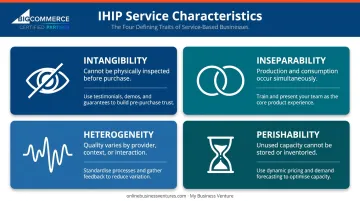
The traditional framework for understanding why services require different marketing approaches is IHIP:
- Intangibility — the service can't be physically inspected before purchase
- Inseparability — production and consumption happen simultaneously; the customer is part of the delivery
- Heterogeneity — quality can vary by provider, context, or individual interaction
- Perishability — unused service capacity can't be stored or inventoried
Each characteristic creates a distinct marketing challenge. Intangibility demands proof; inseparability requires clear roles for both provider and customer. Heterogeneity calls for standardization, while perishability rewards careful capacity planning and client retention.
Why Case Studies Are Central to Service Marketing
Case studies are the closest thing to a product demo in a service context. They document a real problem, a specific solution, and a measurable outcome — giving prospects a concrete basis for trust before they commit. A well-constructed case study goes further than describing what a service does — it shows what that service delivered for someone in the buyer's exact position.
The 7 P's of Service Marketing: A Framework for Analysis
Booms and Bitner extended the traditional 4 P's marketing mix in 1981 specifically for service firms, adding People, Process, and Physical Evidence to address the unique challenges of intangible offerings. The Chartered Institute of Marketing provides the current practitioner framework.
Applied to a case study, the 7 P's reveal exactly where a service business is strong — and where gaps are costing it customers.
| P | What It Covers in a Service Context |
|---|---|
| Product | The core offering, scope, deliverables, and transformation promised |
| Price | Fee structure, value perception, and pricing model (flat fee, retainer, tiered) |
| Place | Channels and environments through which the service is accessed and delivered |
| Promotion | Credibility signals — cases, testimonials, certifications, media, affiliations |
| People | The expertise, empathy, and responsiveness of everyone who delivers the service |
| Process | The repeatable steps through which value is consistently produced |
| Physical Evidence | Every tangible cue that makes an intangible service feel real and trustworthy |
The Three Differentiating P's
In practice, these three extensions are where service businesses create — or lose — their competitive edge. Each one targets a gap that the original 4 P's left unaddressed.
People is the most powerful lever and the hardest to manage consistently. Service quality passes through human interaction — and variability in training, empathy, or responsiveness directly shapes customer perception. Named consultants, visible credentials, and clear role ownership all build confidence before the first conversation happens.
Process determines repeatability. A structured, documented delivery process reduces the variability that quietly erodes trust. Customers who know what happens next feel more confident — and generate fewer support requests.
Physical Evidence makes an intangible promise inspectable: a professional website, SSL security, accreditation badges, advisor profiles, and verified client testimonials. An HBS field experiment found that making work processes visible to customers raised perceived quality by 22.2% and perceived value by 18.51% — concrete proof that transparency directly affects what customers are willing to pay.
How to Solve a Service Marketing Case Study
Every case study follows the same diagnostic logic. Here's the five-step approach that works across industries and contexts.
Step 1 — Identify the Core Problem
Start by separating symptoms from root causes. Is the business losing customers after the first transaction? That's likely a People or Process failure. Are prospects hesitating to buy at all? That points to Promotion or Physical Evidence gaps. Are clients confused about what they're getting? That's a Product definition problem.
Map symptoms to the 7 P's first — solutions come after.
Step 2 — Analyze the Stakeholders
Service marketing failures are rarely one-dimensional. Map three perspectives:
- The service provider — what they believe they're delivering
- The customer — what they expected and what they experienced
- Any third parties — platforms, partners, or intermediaries involved
Misaligned expectations between provider and customer are the most common source of service breakdown. Services are co-produced — the customer participates in delivery, which means their inputs, timing, and decisions affect quality. Documenting both parties' responsibilities before work begins is a structural fix, not a soft suggestion.
Step 3 — Apply the 7 P's Audit
Score each P against the case evidence. The goal isn't to find problems everywhere — it's to identify the one or two variables driving the core issue. A structured audit keeps analysis grounded in evidence rather than assumption.
A quick scoring approach:
- Rate each P as strong, weak, or unclear based on case facts
- Flag any P where customer experience contradicts stated intent
- Prioritize the two weakest P's for deeper analysis
Step 4 — Develop Solutions Tied to Specific P's
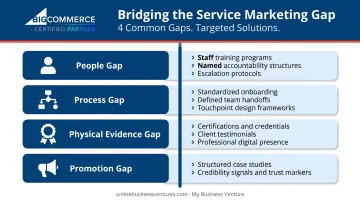
Generic recommendations ("improve customer service") don't hold up in case analysis. Solutions must map directly to the weak P:
- People gap → staff training, named accountability, escalation protocols
- Process gap → standardized onboarding, defined handoffs, touchpoint design
- Physical Evidence gap → visible certifications, client testimonials, professional digital presence
- Promotion gap → structured case studies, credibility signals at every customer touchpoint
Step 5 — Evaluate Outcomes and Transferable Lessons
Once solutions are in place, the analysis isn't finished. A complete case study closes with what actually changed — measurable or observable — and the principles other service businesses can apply. Did retention improve? Did complaint volume drop? Did conversion rates shift?
Those outcomes are the proof of concept. Naming them specifically is what separates a strong case analysis from a theoretical one.
Service Marketing in Action: A Real-World E-Commerce Case Study
The Challenge
An aspiring entrepreneur wants to launch an online business. They have motivation, but lack technical knowledge, product sourcing infrastructure, and a marketing strategy. The real barriers are concrete: finding reliable suppliers, building a credible storefront, and knowing which marketing channels to use first.
The global dropshipping market reached an estimated $464.4 billion in 2025, with a forecast CAGR of approximately 20.7% through 2033. The opportunity is real — but so is the learning curve. That's where My Business Venture (MBV) enters the picture.
The 7 P's Applied
Product, Price & Place
Product — MBV delivers turn-key e-commerce stores pre-loaded with 2,500+ curated products from a catalog of 1M+ items, with built-in profit margins of 35–200%. Clients receive a branded storefront, drop-ship fulfillment (no inventory required), and ongoing consulting — not just a website.
Price — Three tiers at $3,995 (Enterprise), $4,995 (Premier), and $5,995 (Millennium), each structured as a one-time investment with escalating marketing, training, and credibility features. Ongoing merchant fees (2.19% + $0.20/transaction + $15.95/month) are disclosed upfront — a deliberate transparency move that reduces skepticism.
Place — Nationwide digital-first delivery through a certified BigCommerce platform, with offices in New York, Georgia, South Carolina, Pennsylvania, and California. Clients reach support via:
- Phone, email, and live chat (Monday–Friday, 9am–6pm EST)
- MBV University for self-paced training
- 24/7 email support for urgent issues
Promotion, People, Process & Physical Evidence
Promotion — MBV leads with institutional credibility: BBB A+ accreditation, Dun & Bradstreet registration, certified BigCommerce developer status, and a strategic advisory relationship with Kevin Harrington — an original Shark Tank investor with $6B+ in global sales across 1,000+ product launches. For a first-time buyer who can't inspect the service beforehand, third-party verification from recognized institutions carries more weight than any marketing copy.
People — Named consultants (Jason Backer, Kurt Higgins, Bruce Witkin, John Helleis) are selectable before purchase and serve as dedicated partners through launch and beyond:
- Client Gilbert K. had his website live within a week, with a marketing strategy already in development
- Client Mitra K. went from "brand new to this business" to operational confidence through one-on-one MBV University coaching with Kurt Higgins
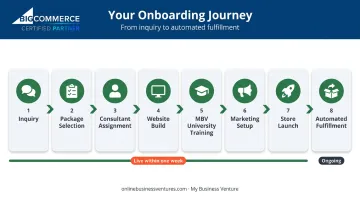
Process — The onboarding sequence runs from inquiry → package selection → consultant assignment → website build → MBV University training → marketing setup → store launch → automated drop-ship fulfillment. Multiple clients confirm stores go live within one week. The process is visible, structured, and repeatable.
Physical Evidence — SSL-secured storefronts, custom logo design, professional branded email (Millennium tier), trust badges, and live website demos at mbvdemo.com. The Millennium package's Website Verification Program directly addresses one of the most specific friction points in e-commerce: convincing first-time visitors a store is safe to buy from. An extensive testimonial library — written, video, and audio — rounds out the proof layer.
Transferable Lessons
This case study surfaces three principles that hold across service industries:
- Credibility must be proven, not claimed. BBB ratings, named advisors, and platform certifications aren't decorative — they're the primary purchase driver for customers who can't inspect the service beforehand.
- The structured consultant model and named accountability give customers a relationship, not just a receipt. People and process determine the experience after the sale — not the sales page.
- Physical evidence is the most direct bridge from intangible promise to buyer confidence. A branded, SSL-secured, professionally designed storefront converts the abstract concept of "a turn-key e-commerce business" into something a prospect can see, navigate, and trust.
Common Service Marketing Challenges and How to Solve Them
Challenge 1 — The Intangibility Barrier
Customers can't evaluate the service before buying, which creates hesitation. Solutions that work:
- Structured case studies with real problems and measurable outcomes
- Client testimonials (video and written) from relatable buyers
- Free consultations that demonstrate expertise before commitment
- Transparent process documentation showing what happens after sign-up
- Third-party certifications that independent parties have verified quality
Forrester's 2024 research found that more than two-thirds of US online adults rely on ratings and reviews to evaluate services — which means verified social proof directly shapes whether a prospect converts or walks away.
Challenge 2 — Inconsistent Service Quality
Because service delivery depends on people and context, quality varies — and inconsistency destroys trust faster than almost any other variable. PwC's 2025 research found that 32% of consumers would leave a brand over inconsistent experiences.
Primary defenses:
- Standardized onboarding sequences with defined steps and owners
- Named consultant accountability (clients know who is responsible)
- Training programs that align delivery quality across the team
- Escalation protocols so problems don't fall through the cracks
Closing that consistency gap matters most at a specific moment: right after the sale. That's when retention is won or lost.
Challenge 3 — Customer Retention After the First Transaction
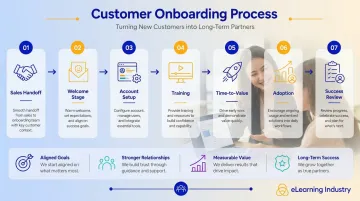
Service businesses often overinvest in acquisition and underinvest in post-sale experience. A field experiment with 2,673 service customers found that proactive onboarding education halved first-week churn and reduced support questions by nearly 20%.
What keeps customers coming back:
- Proactive follow-up and scheduled check-ins, not just reactive support
- Ongoing education through training programs or resource libraries
- Dedicated account support with consistent named contacts
- Clear communication of what's coming next at every stage
Key Strategies to Strengthen Your Service Marketing
Lead With Social Proof at Every Touchpoint
Case studies, accreditations, and expert endorsements shouldn't live only on a testimonials page. They belong on landing pages, in email sequences, in sales conversations, and in onboarding materials — because trust requires repeated reinforcement before it converts.
The real question is: where in the customer journey does doubt appear — and is proof already waiting there?
Make Your Process Visible
One of the most underused service marketing tools is simply showing customers what happens after they sign on. A clear, step-by-step onboarding overview reduces anxiety, sets expectations, and positions the provider as organized and competent.
MBV does this by publishing its onboarding sequence, offering live website demos, and communicating a concrete timeline: clients go from purchase to a live store in days. Speed and structure become part of the marketing story — not just operational details.
Invest in the People Who Deliver the Service
The expertise and responsiveness of a service team is the most powerful marketing asset — and the most underpromoted. Named consultants, visible credentials, and advisor profiles move a service company from faceless vendor to trusted partner.
MBV puts this into practice in concrete ways:
- Prospects select their personal advisor before purchasing — by name
- Consultant profiles list credentials, specialties, and client reviews
- Kevin Harrington (Shark Tank) serves as Strategic Advisor, lending immediate credibility
- MBV University coaches provide hands-on training, not generic onboarding
That front-facing team becomes the marketing — not a footnote buried in an "About Us" page.
Frequently Asked Questions
How do you solve a service marketing case study?
Identify the core problem, map it to the 7 P's framework, analyze all stakeholder perspectives, develop targeted solutions for the weakest P's, and evaluate measurable outcomes. The goal is to locate the one or two variables driving the issue — not critique everything simultaneously.
What are the 7 P's of service marketing?
Product, Price, Place, Promotion, People, Process, and Physical Evidence. Booms and Bitner added the last three in 1981 specifically for service firms, addressing the challenges of intangibility, variability, and customer involvement that the original 4 P's don't capture.
What is service marketing and how does it differ from product marketing?
Service marketing promotes intangible offerings defined by expertise, experience, and outcomes. Unlike product marketing, it must account for intangibility, inseparability, heterogeneity, and perishability — each requiring trust-building, process design, and social proof in place of physical evaluation.
What makes a strong service marketing case study?
A clearly defined problem, a specific and contextualized solution, measurable or observable outcomes, and transferable lessons — told from the perspective of the customer's transformation, not the provider's capabilities.
How do the 7 P's apply to an online or e-commerce service business?
Product is the digital service or platform delivered. Place shifts to digital accessibility and user experience. Physical Evidence includes website design, SSL certificates, and trust badges. People reflects the quality of remote consulting and support — and often determines whether a customer stays or leaves.
What is the most challenging P in service marketing?
People. Service quality is ultimately delivered through human interaction, and variability in training, empathy, or responsiveness directly shapes customer perception. Unlike a product spec, you can't inspect a conversation before it happens — which is why consistent hiring, training, and accountability systems matter more in service businesses than anywhere else.