Key Takeaways
- Merchant reviews evaluate the business itself — service, reliability, support — not individual products
- 97% of consumers read online reviews before trusting a local business
- Look for review consistency over time, specific details, and professional responses to complaints
- Red flags include review clusters, generic praise, and businesses that never respond to criticism
- Third-party credentials (BBB accreditation, D&B registration) alongside strong reviews signal genuine legitimacy
Introduction
Picture two e-commerce business opportunities sitting side by side. Same product catalog. Comparable pricing. Nearly identical websites. The only real difference? One has years of detailed customer feedback across multiple platforms — reviewers naming specific consultants, describing their onboarding experience, referencing actual outcomes. The other has a handful of five-star ratings that all appeared within the same two-week window.
For a first-time entrepreneur deciding where to invest thousands of dollars, that difference isn't minor. It's the whole decision.
Merchant reviews have become one of the most reliable ways to separate trustworthy business partners from costly mistakes — but only if you know how to read them. This guide covers:
- What merchant reviews actually are and why they matter
- Where to find credible reviews (and which platforms to trust)
- How to use reviews to verify a company's legitimacy
- Red flags that signal fake or manipulated feedback
- How businesses can build genuine review profiles that hold up to scrutiny
What Are Merchant Reviews and Why Do They Matter
Merchant Reviews vs. Product Reviews
These two categories get confused constantly, and the distinction matters.
A product review evaluates a specific item — its quality, accuracy to the listing, performance over time. A merchant review evaluates the business behind the transaction: how they communicate, whether they ship accurately, how they handle problems, and whether they stand behind their promises after the sale is complete.
Platforms like REVIEWS.io capture structured merchant metrics across areas like delivery speed, customer support quality, and returns handling. Google calls these "store ratings" — scores that measure a merchant's overall post-fulfillment customer experience.
These ratings can appear directly on Search and Shopping ads, making a merchant's reputation visible before a buyer even clicks through to the site.
Why the Numbers Back This Up
According to BrightLocal's 2024 Local Consumer Review Survey of 1,002 U.S. adults:
- 97% read reviews for local businesses before making a decision
- 49% trust online reviews as much as personal recommendations
- 85% are more likely to use a business after reading positive reviews
- 77% are less likely to use one after reading negative reviews
- 31% will only use a business rated at least 4.5 stars
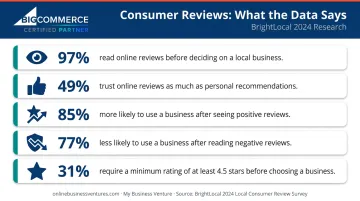
For entrepreneurs building an online store, these numbers carry direct weight. Your customers are running this same mental checklist before they buy — which means your merchant reputation shapes conversions before a single product page even loads.
Where to Find Merchant Reviews Online
Not every review platform carries the same weight. Here's how the major ones compare:
| Platform | Why It's Credible | Business Control Over Reviews |
|---|---|---|
| AI-powered detection; blocked 240M+ policy-violating reviews in 2024 | Businesses cannot delete reviews | |
| BBB | No anonymous reviews; verification may be required | Business can respond, not remove |
| Trustpilot | 100% of submitted reviews pass automated fake-review detection | Businesses flag violations; cannot delete |
| Yelp | Automated recommendation software + human moderation | Businesses report; Yelp decides |
| Sitejabber | Note: FTC charged Sitejabber in 2024 for misrepresenting pre-delivery ratings as post-experience feedback | Use with caution; cross-reference other platforms |
The Google Advantage
In 2024, Google blocked or removed more than 240 million policy-violating reviews and restricted more than 900,000 repeat-offender accounts. Gemini AI now trains models specifically to detect suspicious Business Profile activity. Google Reviews isn't perfect — but faking a reputation there at scale is genuinely difficult.
Cross-Reference, Always
Even with Google's safeguards, no single platform tells the full story. A business might have glowing reviews on one site and unresolved complaints on another. Prioritize platforms where businesses cannot easily remove or filter negative feedback. Treat any platform where a business controls review visibility with extra skepticism.
How Merchant Reviews Help You Determine if a Company Is Legitimate
Signal 1: Volume and Consistency Over Time
A legitimate business accumulates reviews gradually — a steady flow that reflects ongoing customer activity. Two patterns should raise immediate questions:
- A sudden spike of five-star reviews with no prior history
- A company with years in business but very few reviews overall
Neither proves fraud by itself, but both warrant further investigation before committing.
Signal 2: The Balance of Positive and Negative Reviews
No business earns five stars from every customer, and a review profile with zero negative feedback is often more suspicious than reassuring. The more telling signal is how a business responds to criticism.
Companies that acknowledge complaints professionally, take ownership where appropriate, and offer a clear path to resolution demonstrate accountability that praise alone cannot. BrightLocal's research found that 80% of consumers are more likely to use a business that responds to every review, while 42% are unlikely to use one that ignores reviews entirely.
Signal 3: Third-Party Accreditations
Review platforms capture customer sentiment, but third-party accreditations go further — they verify business identity and conduct through independent evaluation.
- BBB Accreditation: Requires at least a B rating, active selling history, licensing compliance, and ongoing adherence to eight ethical standards — including honest advertising, honoring promises, and good-faith dispute handling. An A+ rating is the highest achievable grade and reflects complaint history, transparent practices, and time in business.
- Dun & Bradstreet D-U-N-S Registration: A nine-digit business identifier that requires D&B to authenticate submitted business information. It establishes a verifiable business identity record in the global D&B database.
My Business Venture (MBV), for example, holds a BBB A+ rating and is D&B registered — credentials backed by 30+ years of verifiable operating history since 1992. Neither designation can be obtained quickly. Both require sustained, documented conduct over time.
Signal 4: Read the Content, Not Just the Stars
Credentials tell you a business is accountable. Review content tells you what that accountability looks like in practice. Generic five-star reviews that could describe any company in any industry are worth almost nothing. Look for:
- Reviewer names that feel real and specific
- Mentions of actual consultants, staff members, or departments
- References to specific processes — onboarding timelines, website setup, training sessions
- Concrete outcomes with measurable details
MBV's testimonials, for instance, include clients naming individual consultants like Kurt Higgins, Jason Backer, and Bruce Witkin — describing specific interactions, training topics covered, and measurable milestones like a website going live in under a week. When reviews consistently name real people, reference real processes, and include measurable results, they carry the kind of weight that a wall of anonymous five-stars never can.
Red Flags to Watch for When Reading Merchant Reviews
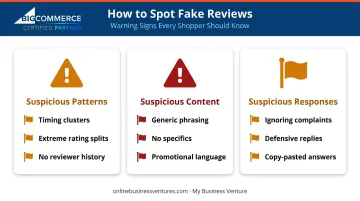
Watch for these warning patterns before trusting a review profile:
Suspicious Review Patterns
- Extreme rating splits: An overwhelming concentration of one-star and five-star reviews with almost nothing in between can suggest manipulation on both ends
- Cluster timing: Multiple reviews appearing within a short window, especially for a business with little prior history
- No reviewer history: Profiles with a single review, no profile photo, and no other activity on the platform
Suspicious Review Content
Per BBB's guidance on spotting fake reviews, additional content-level red flags include:
- Repetitive or nearly identical phrasing across multiple reviews
- Overly promotional language that reads more like marketing copy than customer feedback
- No mention of specific people, processes, or outcomes
- Grammar or spelling inconsistencies that suggest non-native writing at scale
- Possible undisclosed incentives (free products, discounts)
Suspicious Business Responses
How a business responds to reviews tells you as much as the reviews themselves:
- Never responding to any reviews — a sign the business doesn't monitor or value public feedback
- Responding only to positive reviews while ignoring complaints — selective engagement that tells you something
- Dismissive or defensive responses to complaints, which signal a poor accountability culture
When a business denies responsibility, attacks the reviewer, or pastes a generic non-answer under a critical review, that response is its own data point. You're seeing how it handles problems — and that's worth more than any five-star rating on the page.
Best Practices for Businesses: Building a Trustworthy Merchant Review Profile
Start With the Experience, Not the Ask
Authentic reviews come from authentic experiences. No review strategy compensates for broken promises or slow problem resolution. Deliver what you commit to, and make it simple for satisfied customers to share their experience.
How to Request Reviews Ethically
The timing and method of review requests matter:
- Post-purchase confirmation pages — Google Customer Reviews integrates an opt-in directly at checkout, so opted-in buyers may receive a survey around the expected delivery date
- Post-delivery follow-up emails — A brief, neutral message asking customers to share their experience, sent after a product or service is received
- Milestone-based outreach — For service businesses, reaching out after a key milestone (store launch, training completion) captures feedback at peak satisfaction
One important note on platform-specific rules: Yelp explicitly instructs businesses not to ask customers for reviews at all. Trustpilot requires invitations to be fair, neutral, and unbiased — discounts, gifts, or refunds in exchange for reviews violate their guidelines. Follow the rules of each platform you're building a presence on.
Respond to Everything
Responding to every review — positive and negative — builds credibility in ways that rating volume alone cannot. Keep responses:
- Short and specific for positive reviews — acknowledge what the customer actually mentioned
- Fast and accountable for negative reviews — own what's yours and offer a clear path forward
- Never copy-pasted: BrightLocal found 50% of consumers are deterred by generic responses
Don't Game the System
The FTC's Consumer Review Rule, which took effect in October 2024, prohibits buying fake reviews, conditioning incentives on positive sentiment, and selectively soliciting only favorable feedback. Google's AI systems are designed to detect and penalize these patterns aggressively. Violations can result in new review functionality being blocked, ratings being unpublished, or a public warning appearing on your business profile. That warning tells every potential customer that your rating can't be trusted — which is harder to recover from than a low score.
What a Strong Merchant Review Profile Looks Like
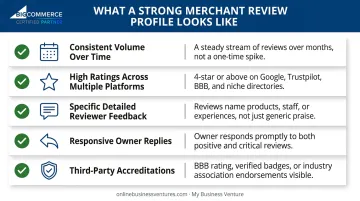
A well-established merchant review profile combines several elements that are hard to manufacture individually — and nearly impossible to manufacture together:
- Consistent volume over many years — not clustered, not sparse
- High aggregate ratings across multiple independent platforms
- Specific, detailed reviewer feedback mentioning real people, real processes, real outcomes
- Responsive owner or team replies to both praise and criticism
- Third-party accreditations that align with the claimed reputation
My Business Venture illustrates what this looks like in practice. Founded in 1992, the company carries a BBB A+ rating and D&B registration — credentials verified by independent third parties, not self-reported.
Client reviews go further, naming specific consultants across different service areas:
- Tris T. describes Bruce Witkin getting their site operational in under a week
- Mitra K. details her MBV University coaching sessions with Kurt Higgins
- Gilbert K. recounts a one-week onboarding with Jason Backer covering both website launch and marketing strategy
These aren't generic endorsements. They're verifiable, specific, and span years of consistent client engagement.
For entrepreneurs evaluating a business partner or platform, a review profile with this level of depth — combined with credentials that require independent verification — signals something generic marketing copy can't replicate: a sustained track record of actually delivering on what was sold.
Frequently Asked Questions
What are merchant reviews?
Merchant reviews are ratings and written feedback submitted by customers about their overall experience with a business — covering service quality, reliability, delivery, and post-sale support. They evaluate the company itself, not a specific product, which makes them useful when sizing up a business before committing.
How can merchant reviews help me determine if a company is legitimate?
Look for consistent review volume built over time, specific details in review content (consultant names, concrete outcomes, realistic timelines), and professional responses to criticism. Check third-party credentials like BBB ratings too — those require independent verification and a track record of ethical conduct to earn.
What platforms are best for finding merchant reviews?
Google Reviews, the Better Business Bureau, and Trustpilot are the most credible starting points. Each uses independent moderation and automated detection systems that make it harder for businesses to manipulate what appears. Always check more than one platform — a complete picture requires cross-referencing.
What are red flags to watch for in merchant reviews?
Watch for extreme splits between one-star and five-star reviews, clusters of reviews appearing in a short period, vague praise with no specific details, reviewer profiles with no other activity, and businesses that ignore negative feedback entirely or respond defensively rather than constructively.
How can a business collect more authentic merchant reviews?
Post-purchase email follow-ups, checkout opt-in tools (like Google Customer Reviews), and timely follow-ups after service is complete are the most effective ethical approaches. Always follow platform-specific rules — Yelp prohibits asking for reviews directly, while Trustpilot prohibits incentivizing them.
Are all merchant reviews trustworthy?
Cross-reference multiple platforms, prioritize specific review content over star ratings alone, and verify third-party credentials independently. No moderation system catches everything — a business with strong reviews on one platform and unresolved complaints on another deserves a closer look before you commit.