The reality depends on two things: what you mean by "branded products" and how you source them. Reselling established name-brand products through dropshipping is genuinely possible, but it comes with legal boundaries, platform rules, and supplier requirements that most beginners overlook. Building your own brand identity around dropshipped products is a separate path with its own advantages.
This article breaks down both options — what's legal, what's profitable, what can get your account suspended, and how to set up a store that operates on the right side of all of it.
Key Takeaways
- Reselling authentic brand-name products through dropshipping is legal under the first sale doctrine — as long as you source legitimately
- Selling counterfeit or misrepresented goods is a serious trademark violation — authenticity of sourcing is the deciding factor
- Amazon requires dropshippers to be the seller of record; eBay prohibits retail arbitrage fulfillment
- Unusually low wholesale prices for name-brand items are a major red flag for gray-market or counterfeit goods
- Building your own store brand typically yields better margins and less competition than reselling crowded brand-name categories
What "Selling Branded Products" Means in Dropshipping
The term gets used two different ways, and confusing them leads to serious mistakes.
There are two distinct approaches:
- Reselling established brand-name products: You act as a retailer selling genuine goods from recognized manufacturers — Nike sneakers, Sony electronics, Hasbro toys. You don't manufacture anything; you source and sell authentic products, and your supplier ships directly to the buyer.
- Building your own brand around dropshipped products: You apply your own logo, store name, and brand identity to products your supplier fulfills. Sometimes called private label dropshipping, the product itself may be generic or white-label — but your brand owns the customer relationship.
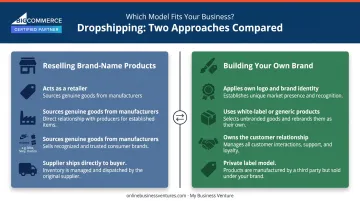
The rules governing each path are completely different.
My Business Venture (MBV), for example, takes the first approach, connecting store owners with access to over one million products from brand-name manufacturers through its dropship partner network. Store owners operate under their own brand identity, with shipments going out under their company name rather than the supplier's.
Is It Legal to Dropship Brand-Name Products?
Yes — with important conditions.
The First Sale Doctrine
U.S. law (17 USC Section 109(a)) allows the owner of a lawfully purchased item to resell it without needing permission from the original rights holder. In trademark law, a similar principle — trademark exhaustion — generally means a brand's control over a product ends after the first authorized sale. You can legally resell a genuine product you lawfully acquired.
The operative word is genuine. Selling authentic products = legal. Selling counterfeits = a serious trademark violation with real legal exposure.
What You Cannot Do
Even when reselling genuine goods, these actions cross the line:
- Use phrases like "Official Store" or "Authorized Dealer" when you're not — 15 USC 1125(a) prohibits false affiliation claims
- Sell goods "materially different" from authorized versions (missing warranties, altered packaging) — the Beltronics case established these lose first-sale protection
- Sell counterfeits — the legal consequences are categorically more severe than gray-market violations and can include criminal liability
Platform-Specific Rules
General law sets the floor. Marketplace policies often go further:
| Platform | Key Requirement |
|---|---|
| Amazon | Must be the seller of record; your name (not your supplier's) must appear on all packing slips, invoices, and packaging |
| eBay | Wholesale supplier fulfillment is permitted; buying from another retailer post-sale and shipping directly to the customer is a policy violation |
The one habit that covers you across all platforms: keep supplier invoices on file for every order. If a brand or marketplace ever questions a product's authenticity, documentation is your first — and strongest — defense.
The Benefits and Risks of Branded Dropshipping
Why Branded Products Have Real Advantages
Established brands carry built-in consumer trust. NielsenIQ reported that 95% of consumers consider trusting the brand they buy from very or somewhat important — a decisive factor when shoppers are choosing between your store and a competitor's.
Beyond trust, brand-name products benefit from existing demand. Shoppers already know what they want; you're not educating the market, you're intercepting demand that's already there.
Fashion leads the broader dropshipping market with 37.4% of 2025 revenue and a projected 16.7% CAGR, according to Grand View Research — a strong signal that recognizable product categories drive significant volume.
Those advantages come with real tradeoffs, though. Here's where branded dropshipping gets complicated.
The Risks You Can't Ignore
Supplier access risk. Not every supplier can legally provide authentic brand-name products. Sourcing from unverified sellers or random marketplace listings without proper documentation increases your exposure to counterfeit goods — which can mean account bans, refund demands, and potential legal liability. Amazon disposed of more than 15 million counterfeit products in 2024, while eBay suspended over 37,000 accounts for IP and restricted-item violations that same year.
Margin and competition risk. Many branded categories are saturated. Competing solely on price in a saturated market erodes margins until the business stops making sense. Niche selection and value-added service — not just price — determine whether branded dropshipping is actually profitable.
Platform enforcement risk. A single authenticity complaint can pull your listings or suspend your account. Treat compliance as a prerequisite, not a problem to solve after something goes wrong.
How to Source Branded Products the Right Way
The Safest Sourcing Channels
Authorized distributors and vetted B2B wholesale networks are the only sourcing paths worth trusting for brand-name products. These channels provide:
- Purchase invoices and authenticity documentation
- Stable inventory availability
- Defined returns processes
- Accurate shipping timeframes
- Packaging controls that let you appear as the seller of record
MBV's e-commerce platform connects store owners with a pre-loaded catalog of brand-name products through established supplier partners like Doba. Doba's supplier agreement requires that branded items be authentic and prohibits unauthorized branded goods — providing a compliance floor that unvetted marketplace sourcing simply cannot match.
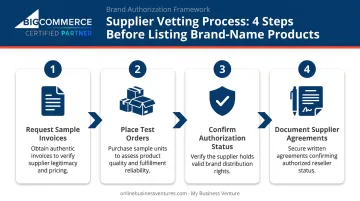
Key Vetting Steps Before Listing Any Product
- Request sample invoices — confirm the supplier can provide documentation that satisfies platform authenticity requirements before listing a single product
- Place test orders — verify what your customer actually receives, including packaging quality and accuracy
- Confirm authorization status — ask directly whether the supplier is an authorized distribution channel for the specific brand, not just a reseller of resellers
- Document all supplier agreements in writing — verbal assurances don't hold up in a platform dispute
The Clearest Red Flag
Unusually low wholesale prices for name-brand items signal risk, not a margin opportunity — and that's exactly where vetting falls apart most often. The U.S. Chamber's Shop Smart guidance specifically flags prices that appear too good to be true as a primary indicator of counterfeit or gray-market goods. If the margin looks implausibly wide, dig into why before listing anything.
How to Set Up and Run Your Branded Dropshipping Store
Storefront Essentials
A compliant, professional branded store requires more than just loading products. Before driving any traffic:
- Pick a focused niche rather than listing every available product — curated selection builds authority and reduces the overwhelm that kills conversions
- Write unique product descriptions — never copy manufacturer text verbatim. BigCommerce recommends writing descriptions around accurate features, benefits, and sizing rather than quoting exact manufacturer content
- Publish clear policies — shipping timelines, return processes, and contact information must be visible before a customer reaches checkout. Baymard's research shows that 19% of shoppers abandon checkout because they don't trust the site with their credit card, and 15% cite an unsatisfactory return policy
Product Page Best Practices
- Include accurate model information and realistic delivery windows
- Avoid language like "Official Store" or "Authorized Dealer" unless you can document that status
- Never imply a brand partnership that doesn't exist — vague or misleading pages increase refund rates and create takedown exposure
Getting product pages right is the baseline. The real competitive advantage comes from how you present your store as a whole.
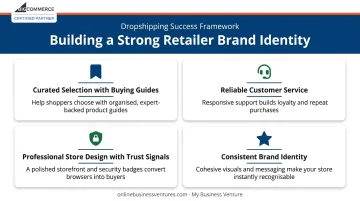
Build a Retailer Brand, Not a Brand Impersonator
Successful branded dropshipping stores build their own reputation around the products they carry — not a lookalike of the brands themselves. That means:
- Curated selection with buying guides and product comparisons
- Reliable customer service that responds quickly
- A professional store design with trust signals (SSL, clear policies, real contact information)
- Consistent brand identity across the storefront and every customer touchpoint
MBV's turn-key solution handles the technical foundation: a BigCommerce-powered storefront, blind dropshipping (so shipments go out under your brand, not the supplier's), SSL security, and 24/7 uptime. That lets store owners focus on marketing and customer experience rather than infrastructure.
Frequently Asked Questions
Can I dropship branded products?
Yes. You can dropship genuine brand-name products as a reseller, provided you source from legitimate wholesale channels, maintain supplier documentation, and comply with platform-specific policies — including Amazon's seller-of-record requirement and eBay's prohibition on retail arbitrage fulfillment.
Is branded dropshipping profitable?
It can be, when you source correctly and choose a focused niche. Established brands bring built-in demand and trust, but margin discipline matters — saturated categories with too many price-competing sellers can compress profits quickly.
Do I need permission from a brand to sell their products?
In most cases, no — reselling authentic products you lawfully acquired is protected under the first sale doctrine. That said, you must source from legitimate wholesale channels, avoid implying official brand affiliation, and follow each marketplace's dropshipping policies.
What types of branded products sell well through dropshipping?
Strong-performing categories include fashion and apparel, mobile and tech accessories, fitness equipment, home goods, toys and games, and pet supplies. The best choices combine proven brand demand, manageable shipping logistics, and a supplier who can document product authenticity.
How do I find authorized suppliers for brand-name products?
Look for authorized distributors and vetted B2B wholesale networks that can provide invoices. Place test orders before going live. Avoid sourcing from random marketplace listings that cannot verify product origin — if a supplier can't produce documentation, that's your answer.