
Introduction
Most business owners hit a growth ceiling eventually. They've optimized their product, built a loyal customer base, and squeezed every bit of value from their current market — but the numbers have stopped moving. The instinct at that point is often to build something new. A new product, a new service, a new offering from scratch.
That's usually the harder path.
Market development takes a different approach. Instead of asking "what can we build next?" it asks "who else could benefit from what we already have?" Same product, new opportunity. Few growth strategies match it for capital efficiency — and for small business owners and entrepreneurs in particular, it can be the difference between stagnation and genuine scale.
This article covers exactly that: what market development strategy is, where it fits in the broader growth framework, which approaches work best, a step-by-step implementation process, and real-world examples to learn from.
Key Takeaways
- Takes your existing product into new markets — new geographies, demographics, or use cases
- Sits in the moderate-risk zone of the Ansoff Matrix, below diversification and new product development
- Geographic expansion, new demographics, new use cases, and distribution partnerships are the four core approaches
- Research comes first — skipping validation is the most common reason market entries fail
- Digital tools — e-commerce, marketplaces, social media — make geographic expansion more accessible for small businesses
What Is a Market Development Strategy?
Market development is a growth strategy where a business introduces its existing products or services to new markets. The product stays largely the same — what changes is the audience, the geography, or the context in which that product is used.
This is distinct from product development, where a company creates new offerings for its current customers. With market development, you're not reinventing what you sell. You're expanding who you sell it to.
Two Primary Levers
Market development strategies fall into one of two categories:
- Geographic expansion — selling the same product in new regions, states, or countries
- New customer segments — targeting a different demographic, industry, or buyer type with the existing offering
Both can run in parallel, but starting with one gives you cleaner data on what's working before you compound the variables.
Why It Works
Businesses that have already proven product-market fit in one context have a real structural advantage when expanding. They're not starting from zero — they have an established product, operational infrastructure, and a track record that speaks for itself in new markets. The incremental cost to enter a new market is typically far lower than the cost of developing a new product line.
That cost advantage compounds across the board:
- Expanded customer base without R&D investment
- Additional revenue streams from new segments
- Stronger brand visibility across more markets
- Less vulnerability when a single market slows or shifts
Where Market Development Fits: The Ansoff Matrix
Igor Ansoff introduced his product-market framework in a 1957 Harvard Business Review article, and it remains a go-to framework for evaluating growth options. The Ansoff Matrix maps four strategies across two axes — products and markets.
| Strategy | Product | Market | Risk Level |
|---|---|---|---|
| Market Penetration | Existing | Existing | Lowest |
| Market Development | Existing | New | Moderate |
| Product Development | New | Existing | Moderate-High |
| Diversification | New | New | Highest |
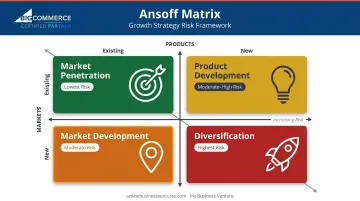
Market development sits in the moderate-risk zone. You're working with a proven product, which eliminates much of the uncertainty tied to diversification or new product launches. The risk comes from the new market itself — customers who don't know you yet, different competitive pressures, and messaging that may need reworking.
When to Choose Market Development
This strategy makes the most sense when:
- Growth in the current market has plateaued
- The product has broader appeal than the current audience captures
- New product development costs outweigh the opportunity
- A clear adjacent segment or geography has been identified
If the current market is still growing and demand is strong, market penetration (selling more to existing customers) is usually the better first move. Market development earns its place when you've maxed out what your current market can return — and a new one is waiting.
Key Approaches to Market Development
Market development isn't a single tactic. There are several distinct paths, and the right one depends on your business model, available resources, and where the opportunity is clearest.
Geographic Expansion
This involves entering new regions, states, or countries with an existing product. For physical businesses, this means new storefronts or distribution agreements. For digital-first businesses, the barrier is far lower.
An e-commerce store can serve customers nationwide — or globally — from day one. There's no need for a physical location in every new market. This is a structural advantage that small business owners can use right now, without heavy overhead.
MBV's turn-key e-commerce platform, for example, is built specifically for this: clients get a fully hosted, branded storefront on BigCommerce that goes live within days and is accessible to buyers across the entire United States from the moment it launches. No warehousing, no regional logistics — just an online store with immediate nationwide reach.
Targeting New Demographics
A product built for one audience can often serve another with minimal modification. The product itself doesn't change — the positioning does.
Consider a fitness supplement brand originally marketed to competitive athletes. The same formula, repackaged with messaging around energy and convenience, could resonate with time-pressed professionals who don't identify as athletes but share the same core need. Same product, different story — and a completely new buyer pool.
This kind of demographic repositioning works best when there's genuine overlap in the underlying need, even if the lifestyle and language of the two segments look different on the surface.
New Use Cases and Applications
Sometimes a product solves a problem its creators didn't originally design for. Finding that secondary use case — and building marketing around it — opens an entirely new buyer pool without any product redesign.
A basic example: a cleaning tool designed for commercial kitchens gets picked up by home cooks who want professional-grade results. The product is the same. The context is new.
Strategic Partnerships and Distribution Channels
Entering a new market alone means building trust, awareness, and distribution from scratch. Partnering with an established player in that market — a distributor, platform, or complementary brand — lets you borrow their reach and credibility instead.
This approach is particularly valuable for geographic expansion. Local knowledge and existing customer relationships can cut months off the time to first sale — advantages that are nearly impossible to replicate by going it alone.
Partnerships worth exploring include:
- Regional distributors with existing buyer networks
- Complementary brands serving the same audience
- Established platforms that already have your target customer's trust
How to Build a Market Development Strategy Step by Step
Skipping steps here — especially the research phase — is the most common reason market development initiatives fail. McKinsey's foundational market-entry analysis found roughly four market entries fail for every one that succeeds, with biased forecasting and underestimating incumbents among the leading causes.
Step 1 — Conduct Market Research and Segment Identification
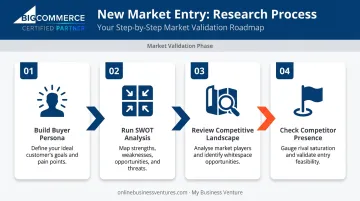
Before committing resources, validate that the new market actually wants what you're selling. This means:
- Building a buyer persona for the new segment — demographics, motivations, pain points, purchasing behavior
- Running a SWOT analysis for the new market context (your strengths may differ here from your current market)
- Reviewing the competitive landscape — who's already there, how they're positioned, and whether there's a gap you can fill
- Checking whether competitors have already moved into this space — if they have, that's both a signal of opportunity and a warning about barriers to entry
Don't skip this step. A small pilot campaign or survey can validate assumptions before any significant spend is committed.
Step 2 — Set SMART Goals
Clear benchmarks prevent the launch from drifting. Use the SMART framework: Specific, Measurable, Achievable, Relevant, and Time-bound.
Two examples:
- Acquire 200 new customers in the Pacific Northwest region within 90 days of launch, with a customer acquisition cost below $35
- Generate $15,000 in revenue from the 35–50 age bracket within the first quarter of the repositioned campaign
These aren't arbitrary numbers — they're commitments that let you evaluate whether the strategy is working and when to adjust.
Step 3 — Craft a Value Proposition for the New Market
The core product may stay the same, but the messaging must be rebuilt for the new audience. What worked for your current customers won't automatically resonate here.
The process:
- Identify the new segment's primary pain points and language
- Map which elements of your existing value proposition overlap with those needs
- Adjust the framing, imagery, and tone — not the product itself
- Test messaging through a small ad campaign or landing page before a full launch
The product's core function stays the same. The story told about it changes.
Step 4 — Choose Distribution Channels and Plan the Launch
With your value proposition defined for the new segment, the next decision is where to reach them. Go where your new market shops and consumes content — not where your existing customers do.
Options include:
- Social media platforms — different demographics live on different platforms (TikTok, LinkedIn, Pinterest, Facebook)
- E-commerce marketplaces — Amazon and eBay extend reach to buyers who aren't searching for your brand specifically
- Direct-to-consumer website — a branded storefront gives you full control over the customer experience
- Retail partnerships — for physical products, getting onto a regional retailer's shelf accelerates local discovery
For entrepreneurs expanding into a new geographic market online, a fast, professionally built storefront is the distribution channel — and it needs to be ready before traffic arrives. My Business Venture's turn-key e-commerce packages are designed for exactly this scenario: a branded store with products already loaded, SEO tools configured, and social media integration in place, so the focus stays on reaching the new audience rather than building infrastructure from scratch.
Step 5 — Execute, Monitor, and Iterate
Start small. A phased rollout — one region, one sub-segment — lets you test before scaling.
Track these KPIs from day one:
- Customer acquisition cost (CAC)
- Conversion rate by channel
- Revenue growth week over week
- Customer retention and repeat purchase rate
Most platforms — including the BigCommerce-based stores MBV sets up for clients — include built-in analytics dashboards that show how new audiences are engaging, which channels convert, and where drop-off happens. Gather that data early, identify what's working, and refine before expanding further. Market development rarely gets everything right on the first attempt. The ones that succeed treat the first launch as a test, not a final answer.
Real-World Market Development Examples
Large Brand Example: Netflix
On January 6, 2016, Netflix launched into 130+ new countries simultaneously, expanding from roughly 60 countries to more than 190 overnight. It also added Arabic, Korean, Simplified Chinese, and Traditional Chinese at launch — acknowledging that geographic expansion without language and content adaptation would only go so far.
Netflix also invested in region-specific original productions to drive local engagement. Paid membership growth across every reported region from 2023 to 2024 reflects the results:
- UCAN: 80M → 89.6M
- EMEA: 88.8M → 101.1M
- Latin America: 46M → 53.3M
- Asia-Pacific: 45.3M → 57.5M
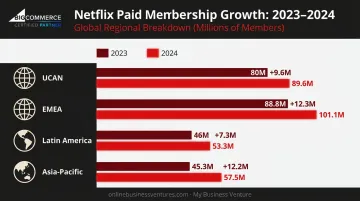
The company's 2024 Form 10-K confirms these increases without attributing them solely to geographic entry — but the trajectory is clear.
Small Business / Entrepreneur Example
Consider a home-based business owner who sells pet accessories — beds, toys, feeders — to customers in their local area through word of mouth and a few local listings.
With a nationwide e-commerce presence, that same product line reaches pet owners across the country. The products don't change. The distribution does.
MBV's catalog includes pet items among its featured categories, with access to over 2 million products through its dropship network. A store owner can list thousands of pet-related products on a branded storefront and set their own pricing within a 35–200% margin range.
Every order fulfills through blind drop shipping — the package arrives under the store owner's company name, not a supplier's. No inventory, no warehouse, no regional shipping limits. The pet accessories business that once served a single zip code now serves the entire country.
Common Pitfalls to Avoid
Three mistakes derail more market development efforts than any others:
Skipping validation. Entering a market based on assumptions rather than research is expensive. Run a small pilot — a test ad campaign, a soft launch to a single city or sub-segment — before committing full budget. A $500 test costs far less than a failed full-scale launch.
Using one-size-fits-all messaging. The value proposition that works for your current customers won't automatically land with a new audience. Different segments have different language, different pain points, and different triggers. Tailoring your messaging isn't optional — it's the work.
Pursuing too many markets at once. Spreading resources across three new geographies or four new demographics simultaneously rarely ends well. Pick one new market, prove the model, then use early profits and learnings to fund the next expansion. Sequential beats simultaneous almost every time.
Frequently Asked Questions
What is a market development strategy?
Market development is a growth approach where a business takes its existing products or services into new markets — such as new geographies, customer demographics, or use cases — to expand its customer base and revenue without creating new products.
What are the 4 market growth strategies?
The Ansoff Matrix defines four: market penetration (existing product, existing market), product development (new product, existing market), market development (existing product, new market), and diversification (new product, new market). Each carries a different level of risk.
What is an example of a market development strategy?
A local pet accessories retailer launching an e-commerce store to serve buyers nationwide is a clear example — same products, new geographic market. A software tool originally built for accountants expanding to target small business owners with the same platform is another.
How is market development different from market penetration?
Market penetration focuses on selling more of an existing product to an existing market — through promotions, pricing, or broader marketing reach. Market development targets an entirely new audience or geography with that same product.
What are the biggest risks of a market development strategy?
The main risks are poor market fit from insufficient research, messaging that misses the new audience, and overextension from pursuing too many markets simultaneously. Starting with one new market — and validating it before expanding further — keeps each of these in check.