
Introduction
You have a product idea, a business concept, or a side hustle waiting to happen — but no clear plan for where to launch it or how to reach your first customers. That gap between idea and execution is where most businesses lose money, time, or both.
According to CB Insights' analysis of 431 failed startups, 43% cited poor product-market fit as a reason for shutting down, and 70% ran out of capital. Many of those failures trace back to one common root: entering a market without a strategy.
A market entry strategy solves both problems. It gives you a defined method, a target customer, and a realistic path to revenue — before you commit serious resources.
This guide covers what a market entry strategy is, the five main types, how to choose the right one, and how to build yours — whether you're launching a new product, testing a new channel, or starting an online business for the first time.
Key Takeaways:
- A market entry strategy defines how and where you reach customers — not just what you're selling
- Five entry modes exist, each carrying different capital requirements and risk levels
- E-commerce is one of the most accessible entry strategies for first-time entrepreneurs
- Skipping market research is the most common and costly mistake new businesses make
- Treat your strategy as a living document — update it as you learn
What Is a Market Entry Strategy?
A market entry strategy is a planned approach a business uses to introduce its products or services to a new market. It covers the method of entry, the target customer, distribution channels, timeline, and resources required to establish a presence and generate revenue.
This is distinct from a general business plan. A business plan describes what you're selling and why it has value. A market entry strategy answers the harder questions: how do you reach buyers, and where do you start?
Where Market Entry Strategies Apply
Most people associate market entry with large corporations expanding internationally. The same strategic thinking applies at any scale:
- A small business launching an online store for the first time
- An entrepreneur testing a new product category
- A local service business moving into a new geographic region
- A brand expanding from direct sales into a new distribution channel
The entry strategy you need depends on your situation — not your company size. A first-time founder launching a dropship store and a retailer expanding into a new state are asking the same core question: how do I reach buyers, and where do I begin? The sections below break down exactly how to answer that.
Why Your Market Entry Strategy Matters
Without a deliberate plan, businesses risk entering markets where demand is insufficient, competition is too entrenched, or their model doesn't fit how buyers actually behave. That mismatch burns cash fast.
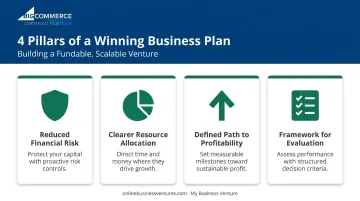
A well-built market entry strategy delivers four concrete benefits:
- Reduced financial risk — you commit resources after validating assumptions, not before
- Clearer resource allocation — you know where to spend and what to defer
- A defined path to profitability — pricing, channels, and customer targets are decided in advance
- A framework for evaluation — you can measure whether the entry is working or needs adjustment
BLS data shows only 50.6% of U.S. establishments reach their five-year mark — and the ones that do tend to share one trait: they entered with a plan and adjusted early. Getting the strategy right before committing budget is what separates a calculated market entry from an expensive lesson.
The 5 Main Types of Market Entry Strategies
The right entry mode depends on your capital, risk tolerance, desired speed, and how much control you need over the customer experience. Each approach involves real trade-offs — there is no universally correct answer.
Exporting
Exporting means selling products from your existing base into a new market — either directly to end customers or through local distributors. It requires no physical presence in the new market, which keeps costs low and risk manageable.
The trade-off: you have limited control over the customer experience, and factors like shipping costs or trade regulations can affect competitiveness.
For context, the SBA reports that 97% of identified U.S. exporters are small businesses — though only about 9% of small businesses export at all, meaning most haven't explored this channel yet.
Licensing and Franchising
Licensing gives a third party the right to use your intellectual property — a brand name, patent, or process — in exchange for royalties. Franchising goes further, allowing an operator to run a full business under your brand using your systems.
Both approaches enable faster expansion with less capital outlay, but they require strong systems and brand guidelines to maintain consistency across operators. The IFA projects U.S. franchise establishments will reach roughly 845,000 in 2026, reflecting this model's continued appeal.
Joint Ventures and Strategic Partnerships
A joint venture is a co-owned entity formed with a local partner to share resources, market knowledge, and risk. A strategic alliance is a looser collaboration — shared goals without a jointly owned structure.
These work best when entering unfamiliar or complex markets where local insight provides a genuine competitive edge. Research from HBR indicates that joint ventures which continue to evolve — shifting strategy, reallocating resources, entering new business lines — consistently outperform those that stay static.
Acquisitions
Acquisition-based entry means purchasing an existing business in the target market to gain immediate access to its customers, distribution network, and local expertise. The speed and control advantages are real.
So is the cost. BizBuySell reported a median sale price of $350,000 for small business transactions in Q1 2026, and integration challenges frequently slow the returns. Acquisition makes sense when you need immediate market presence and have the capital to support it — not as a first move for early-stage entrepreneurs.
Direct Online / E-Commerce Entry
For many modern entrepreneurs — especially first-time founders and home-based business owners — establishing a direct online sales channel is the most accessible and scalable entry strategy available. U.S. retail e-commerce sales reached $326.7 billion in Q1 2026, representing 16.9% of total retail, and the channel continues to grow.
Peer-reviewed research explicitly recognizes cross-border e-commerce as a foreign-market entry mode for SMEs. For domestic launches, the barriers are even lower:
- No physical storefront required
- No inventory to stock through dropshipping fulfillment
- Fast deployment — many stores go live within days
If you want a structured starting point, My Business Venture (MBV) offers all-in-one startup packages ($3,995–$5,995, one-time) built around this model. You get a professionally built BigCommerce store pre-loaded with 2,500+ curated products, dropship fulfillment through Doba, built-in marketing tools, and one-on-one coaching through MBV University.
How to Choose the Right Market Entry Strategy
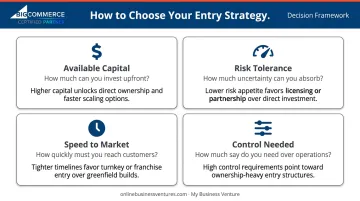
Strategy selection starts with an honest assessment of four variables:
| Factor | What to Ask |
|---|---|
| Available capital | How much can you commit upfront — and lose if the entry fails? |
| Risk tolerance | Can you absorb a slow start, or do you need early cash flow? |
| Speed to market | Do you need to move fast, or can you take time to build? |
| Control needed | How important is brand consistency and customer experience? |
The Risk-vs-Control Spectrum
Low-commitment modes — exporting, e-commerce, distribution partnerships — are faster and cheaper to launch but give you less direct control over the customer relationship. High-commitment modes — acquisitions, wholly-owned operations — give you full control but require significantly more capital and time.
For most early-stage businesses, starting lower on that spectrum is the smarter move. Test demand, build market familiarity, then deepen your investment once you've validated that the opportunity is real.
Match Entry Mode to Market Knowledge
If you don't fully understand the target market — its buyer behavior, regulations, and competitive dynamics — a partnership or joint venture helps bridge that gap with local expertise. If you know the market well and have a clear customer profile, direct entry through e-commerce or exporting is usually faster.
Consider Your Product Type
Once you've assessed your market familiarity, your product type further narrows the right entry mode:
- Consumer goods, digital products, and standard merchandise — fit naturally with online channels and distribution partners, where speed and low overhead matter most
- Complex or technical products — typically need local teams or a physical presence to demo, sell, and support effectively
- Service-intensive offerings — often require in-market staff who can manage client relationships and customize delivery
No entry strategy is locked in. Most businesses treat their first mode as a test — gathering real market data before deciding how much further to invest.
How to Develop a Market Entry Strategy: Step-by-Step
Step 1 — Define Your Objectives
Every entry strategy must begin with clear, measurable goals. Vague targets like "grow sales" don't hold up when you're making real decisions about channels and budgets.
Define upfront:
- Revenue targets (month 3, month 6, month 12)
- Customer acquisition numbers
- Market share benchmarks or traffic milestones
These objectives anchor every downstream decision — pricing, channel selection, marketing spend, and when to pivot.
Step 2 — Conduct Market Research
Before committing resources, you need to understand:
- Market size and growth rate
- Competitive landscape (who's already there, and how entrenched are they?)
- Buyer behavior and purchasing triggers
- Regulatory requirements if entering a new geography
The cost of skipping this step is high. The same CB Insights data referenced earlier — 43% of failed startups citing poor product-market fit — reflects what happens when entrepreneurs assume demand rather than verify it. The SBA frames market research as the tool that confirms your business idea, identifies your real customers, and reduces entry risk before you spend.
Step 3 — Identify and Profile Your Target Customer
Market entry requires narrowing down who your ideal early customer actually is. Not "everyone who might want this" — a specific profile:
- Demographics (age, income, location)
- Pain points your product addresses
- Where they discover and buy products (online, in-store, social media)
- What triggers a purchase decision
This profile shapes your distribution choices, your messaging, and your marketing channels. Get this wrong, and every channel decision that follows is built on assumptions — not evidence.
Step 4 — Select Your Entry Mode and Build Your Plan
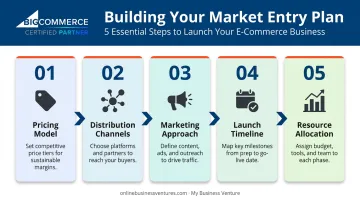
Start by committing to an entry mode — direct sales, marketplace, distributor, or a platform-based model — then translate that choice into a concrete roadmap:
- Pricing model — decide whether you're pricing on cost, perceived value, or competitive positioning
- Distribution channels — choose how customers will find and buy from you (direct site, marketplace, distributor, or retail)
- Marketing approach — identify which channels reach your target customer and allocate budget accordingly
- Launch timeline — set specific milestones with named owners and fixed dates
- Resource allocation — map your budget to each component so spending has a clear purpose
For online businesses, this step includes choosing your e-commerce platform, setting up product listings, and activating your initial marketing campaigns. MBV clients, for example, move through this phase quickly because the platform, products, and fulfillment infrastructure are already in place — leaving them free to focus on marketing and customer acquisition from day one.
Step 5 — Launch, Monitor, and Adjust
Once you launch, the strategy only holds if you're tracking clear KPIs from the start:
- Traffic — sessions, unique visitors, traffic sources
- Conversion rate — orders divided by sessions
- Customer acquisition cost (CAC) — what you're spending to land each customer
- Average order value (AOV)
- Revenue — actual and against target
These are among the core e-commerce performance metrics that BigCommerce recommends tracking from day one. Review them weekly in the early stages. Your strategy is a working document — real market feedback should drive your adjustments, not the assumptions you made before launch.
Common Market Entry Strategy Mistakes to Avoid
Skipping or underinvesting in market research
Entering a market without validating demand first burns budget fast. Businesses land in saturated or mismatched markets and run out of runway before finding traction. A competitor analysis and a few customer interviews before launch can surface deal-breaking problems that would otherwise cost thousands to uncover post-launch.
Choosing the wrong entry mode for your stage
First-time entrepreneurs sometimes overcommit — attempting high-investment entry modes like physical retail or acquisition before proving product-market fit. A lower-risk channel, like e-commerce or a distribution partnership, allows for faster learning with less financial exposure. Prove the concept first, then scale the investment.
Neglecting to define success metrics before launch
Without pre-established KPIs, you can't objectively evaluate whether your market entry is working. "Grow sales" is not a metric. A defined conversion rate target, a customer acquisition cost ceiling, and a revenue milestone are. Set them before you launch.
Frequently Asked Questions
What is a market entry strategy?
A market entry strategy is a structured plan businesses use to introduce their products or services into a new market. It covers the method of entry, target audience, distribution channel, and resources required to establish a presence and generate revenue.
What are the five market entry strategies?
The five core strategies are exporting, licensing and franchising, joint ventures and partnerships, acquisitions, and direct/online selling. The best choice depends on the business's goals, capital availability, and how much control it needs over the customer experience.
How do I choose the right market entry strategy for my business?
Four factors drive the decision: available capital, risk tolerance, speed-to-market needs, and familiarity with the target market. Lower-commitment options like e-commerce or distribution partnerships let early-stage businesses validate demand before scaling investment.
What are the biggest risks in a market entry strategy?
The three most common risks are:
- Insufficient market research leading to misaligned positioning
- Underestimating existing competition
- Committing too many resources before validating that demand exists
Can e-commerce be used as a market entry strategy?
Yes. Peer-reviewed research formally recognizes e-commerce as a market entry mode for SMEs. It offers national or global reach with minimal upfront investment, making it one of the most accessible options for first-time entrepreneurs.