Introduction
Imagine listing a custom-designed t-shirt online this morning and having a customer order it by afternoon — without ever touching a box, buying fabric, or renting warehouse space. That's the appeal of Shopify print on demand, and it's why thousands of first-time entrepreneurs treat it as their entry point into e-commerce.
This guide is written for aspiring entrepreneurs, side hustlers, and small business owners who want to understand how POD actually works before committing to it. Knowing the mechanics — not just the concept — is what separates stores that gain real traction from ones that stall after the first few sales.
Here's what we'll cover: what Shopify POD is, why Shopify dominates this space, the full end-to-end process, what drives results, and the honest limitations most guides gloss over.
The market opportunity is real. According to Grand View Research's 2026 industry report, the global print on demand market was valued at $10.8 billion in 2025 and is projected to grow at a 23.6% CAGR through 2033, reaching $57.5 billion. Strong market growth, however, doesn't guarantee individual seller success. What you do with the model matters more than the trend behind it.
Key Takeaways
- POD is a fulfillment model where products are printed and shipped by a third party only after a customer orders — no inventory required
- Shopify is the storefront; a POD app (Printful, Printify, Gelato) handles printing, packing, and shipping automatically
- Profit = retail price minus supplier base cost, Shopify fees, and marketing spend
- Niche clarity, design quality, and active marketing drive results — app selection is the least deciding factor
- Expect lower margins and less operational control compared to bulk manufacturing
What Is Shopify Print on Demand?
Shopify print on demand is a business model where a seller creates custom designs and lists products on a Shopify store. When a customer buys, the order routes automatically to a third-party printer who produces, packages, and ships the item directly to the customer under the seller's brand.
How It Differs from Other E-Commerce Models
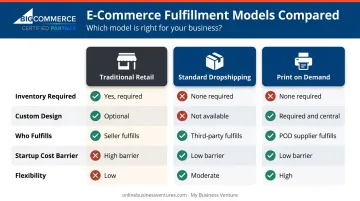
| Model | Inventory Required | Custom Design | Who Fulfills |
|---|---|---|---|
| Traditional retail | Yes (upfront) | Optional | Seller |
| Standard dropshipping | No | No | Third-party supplier |
| Print on demand | No | Yes | POD supplier |
Standard dropshipping sells existing wholesale products. POD adds a creative layer — every item is produced only after a specific order arrives, with the seller's artwork on it. That separation gives sellers real control over brand identity and pricing that generic dropshipping simply can't match.
Common POD Product Categories
- Apparel: T-shirts, hoodies, tank tops, hats
- Accessories: Tote bags, phone cases, socks
- Home goods: Mugs, wall art, throw pillows, blankets
- Stationery: Journals, greeting cards, posters
That breadth means first-time sellers can build a focused niche store — pet lovers, fitness fans, local pride — without committing to inventory upfront.
Why Entrepreneurs Choose Shopify for Print on Demand
According to BuiltWith, approximately 6.97 million live websites currently use Shopify — making it the default platform for online sellers worldwide. That adoption rate isn't accidental. Shopify removes nearly every technical barrier between an idea and a live store, which matters a lot when you're launching a POD business with limited time or budget.
Built-In Advantages for POD Sellers
Shopify's App Store includes dedicated integrations for every major POD provider, so order routing to your supplier happens automatically, with no manual forwarding or spreadsheets required. Beyond that:
- Customizable themes: Professional storefronts with no coding required
- Integrated payments: Shopify Payments, PayPal, and other gateways built in
- Multi-channel selling: List products on Instagram, Facebook, and marketplaces from one dashboard
- Built-in analytics: Track conversion rates, traffic sources, and revenue without third-party tools
These advantages are real — but so is the cost. Before committing to a plan, it's worth understanding exactly what you'll pay each month and how that affects your margins.
Shopify's Pricing Structure
Current Shopify pricing as of 2026:
| Plan | Monthly Billing | Annual Billing (effective/month) |
|---|---|---|
| Basic | $39/month | $29/month |
| Grow | $105/month | $79/month |
| Advanced | $399/month | $299/month |
Most POD sellers start on the Basic plan. Factor the subscription fee into your margin calculations from day one — it's a fixed overhead cost regardless of how many orders you process.
How Shopify Print on Demand Works: Step by Step
Here's the full flow at a glance: you design a product → list it on Shopify → a customer orders → the order auto-routes to your POD supplier → they print, pack, and ship directly to the customer → you collect the margin between what the customer paid and what the supplier charged. Six steps, and after setup, most of them are automatic.
Step 1: Choose a Niche and Define Your Target Audience
Before uploading a single design, identify who you're selling to. A niche could be dog rescue advocates, weightlifters, true crime fans, or vintage camper owners. The more specific, the better.
A clearly defined audience shapes every decision that follows: which products to offer, what design style resonates, and where to find buyers. Broad stores that try to appeal to everyone rarely outperform focused ones that speak directly to a specific group.
Step 2: Select a POD App and Connect It to Shopify
Install a POD app from the Shopify App Store, connect your store account, and you gain immediate access to that supplier's product catalog and design tools. Once connected, orders placed in your Shopify store route to the supplier automatically.
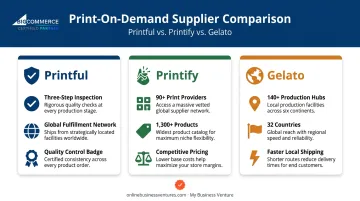
The three most widely used options:
- Printful: Known for quality control (three-step inspection process) and reliable global fulfillment
- Printify: Offers 90+ print providers and 1,300+ customizable products, with competitive pricing
- Gelato: Operates 140+ production hubs in 32 countries, supporting faster local shipping
Compare providers on product range, print quality, fulfillment speed, and pricing before committing. Your supplier choice directly affects customer experience.
Step 3: Create Designs and Build Product Listings
Upload artwork as PNG or JPEG files at 300 DPI , using the POD app's built-in design editor or mockup generator. Preview the design on the product before publishing.
Then write product listings: compelling descriptions, accurate size charts, and high-quality mockup images. These details directly affect conversion rates. A mediocre design with a polished listing will usually outperform a great design with a vague one.
Step 4: Customer Orders and Pays
The customer browses your Shopify store, adds a product to their cart, and checks out using Shopify Payments, PayPal, or another gateway. They pay your retail price. Payment clears on your end before you're charged anything by the supplier.
Step 5: Order Routes Automatically to the POD Supplier
The Shopify-POD integration captures all order details (product, design, size, shipping address) and forwards them to the supplier's fulfillment system. The supplier then charges you their base production and shipping cost. No manual intervention required once the integration is properly configured.
Step 6: Supplier Prints, Packs, and Ships
The POD provider prints your design using direct-to-garment (DTG), sublimation, embroidery, or another method. The item ships in white-label or blind packaging, so your brand is the only name the customer sees.
Production timelines vary: Printful averages 2–5 business days for most techniques; Printify estimates most orders ship within 2–7 business days after submission. Note that shipping transit time is separate from production time. Set accurate delivery expectations upfront, or you'll field avoidable customer complaints.
Key Factors That Affect Your Shopify POD Business
Profit Margins and Pricing
Profit in POD = retail price − base production cost − shipping − Shopify fees − marketing spend.
POD has a higher per-unit cost than bulk manufacturing because every item is produced individually. According to Printful, 20–40% is considered a solid POD profit margin, with some categories like stickers reaching 40–60% and others like mugs typically falling in the 10–30% range.
A practical pricing approach:
- Find your supplier's base cost for the product
- Research what competitors charge for similar items
- Add shipping (if not absorbing it into the price)
- Factor in Shopify's transaction fees and your marketing budget
- Set a retail price that covers all costs and leaves a viable margin
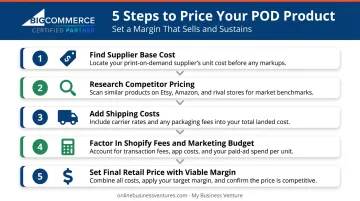
The goal is a price point that holds margin without scaring off buyers — which usually means knowing your competitors' prices before you set yours.
Design Quality and Product Selection
The design is the product. Generic clip-art or trends copied from other stores won't build repeat customers — original, niche-relevant artwork is what separates stores that grow from those that stagnate.
Product-audience fit matters just as much. Premium apparel works for fashion-forward niches; novelty mugs suit gift shoppers. Pairing the wrong product with a niche leads to low average order values regardless of how strong the design is.
Supplier Reliability and Shipping Expectations
Once an order routes to your supplier, you have no control over what happens next. This is the POD model's most significant risk. Evaluate suppliers on:
- Average fulfillment speed (not best-case, but typical)
- Shipping carrier options and tracking
- International availability
- Consistency of print quality across batches
One supplier miss — a delayed shipment, a print defect — becomes your customer's complaint to resolve. The accountability falls on you, even when the supplier caused the problem.
Marketing and Traffic Generation
A live Shopify store generates zero traffic on its own. The POD model removes inventory risk, but promotion is still your responsibility. Visitors come from:
- Social media content and organic reach
- SEO targeting niche-specific search terms
- Email marketing to repeat buyers
- Paid ads on Meta or Google
- Influencer partnerships in your niche
The advantage of a tight niche is that marketing becomes cheaper and more precise. A store for vintage motorcycle enthusiasts has a clearly targetable audience. A store for "funny gifts" does not.
What to Expect: Pros, Cons, and Common Misconceptions
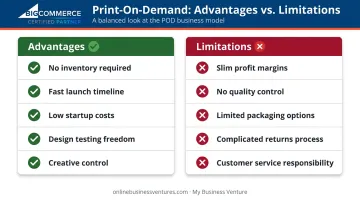
The Genuine Advantages
- No inventory: No upfront stock purchases, no storage costs, no unsold goods collecting dust
- Fast launch: A store can be live and selling within days of starting
- Low startup costs: Shopify Basic starts at $39/month; most POD apps are free to install
- Design testing: Try multiple products and ideas without financial risk
- Creative control: Sell products that reflect your brand, not someone else's wholesale catalog
The Real Limitations
- Slim margins: Higher per-unit costs leave less room after fees and marketing
- No quality control: You can't inspect items before they reach customers
- Limited packaging options: Most POD fulfillment uses generic or lightly branded packaging
- Returns are complicated: Managing quality complaints when production is outsourced requires clear policies and supplier communication
- Customer service falls on you: Even when the supplier causes the problem
Common Misconceptions
Three myths trip up new POD sellers more than almost anything else:
- "POD is passive income" — A live store demands ongoing design testing, marketing, customer service, and optimization. Stores that coast stall fast.
- "All POD apps are interchangeable" — Supplier selection matters. Product catalog, print technique, fulfillment speed, and international capability vary widely, and picking the wrong fit is a common reason POD stores underperform.
- "More products = more sales" — A focused catalog of 10–20 well-designed products in a specific niche typically converts better than a sprawling store with hundreds of generic designs.
When POD May Not Be the Right Fit
POD works best as a low-risk entry point, not necessarily as a permanent long-term strategy. Consider alternatives if:
- Your niche requires product customization beyond what POD suppliers offer
- Your customers expect same-day or next-day shipping
- Your order volume has grown to the point where bulk manufacturing becomes significantly more cost-effective
At scale, traditional manufacturing's per-unit economics often win out. POD is a proven way to test concepts and build an audience — once demand is established, revisiting your fulfillment model is worth the math.
Conclusion
Shopify print on demand is a genuine low-barrier path into e-commerce. By connecting a Shopify storefront to a third-party POD supplier, sellers can offer custom-designed products worldwide without holding a single unit of inventory. But the business succeeds or fails on niche focus, design quality, pricing discipline, and active marketing — not just on which app you install.
Understanding the process honestly — including where control ends and supplier dependency begins — is what allows entrepreneurs to make smarter decisions from the start.
That same decision-making lens applies if you're weighing other low-risk e-commerce models. My Business Venture (MBV) offers a different entry point worth knowing: rather than custom-printed products, MBV's dropship model connects entrepreneurs to over one million products across general merchandise categories through a pre-built BigCommerce store.
Packages include:
- One-on-one business consulting and personalized training through MBV University
- A live product feed with no inventory required
- Store setup completed within days
- 30+ years in business and an A+ BBB rating
Learn more at onlinebusinessventures.com or call 1-800-639-6644.
Frequently Asked Questions
How much does Shopify print-on-demand cost?
Shopify's Basic plan starts at $39/month (or $29/month billed annually). On top of that, each order carries a per-item production and shipping cost charged by your POD supplier — which varies by product and provider. Most POD apps (Printful, Printify, Gelato) offer free base plans, with optional paid tiers for discounts. There are no upfront inventory costs.
Do I need to hold inventory for a Shopify print on demand store?
No. Products are made only when an order is placed and shipped directly from the POD supplier to your customer. You never purchase, store, or ship physical goods — that's the core difference between POD and traditional retail.
How long does print-on-demand fulfillment take on Shopify?
Production typically takes 2–7 business days, depending on provider and product, before shipping begins. Factor both into delivery estimates you communicate to customers. Specialty items like embroidered products or all-over print apparel may take longer.
Can I make real money with a Shopify print on demand business?
Yes, though margins are slimmer than bulk manufacturing. Profitability depends on niche selection, pricing strategy, design quality, and marketing effectiveness. Sellers who build a focused audience and invest in original designs tend to outperform those who launch generic stores and expect organic traffic to follow.
Is print on demand the same as dropshipping on Shopify?
Both are inventory-free models that rely on third-party fulfillment, but POD adds a custom design layer. Products are printed with your artwork only after an order is placed, while standard dropshipping sells pre-existing wholesale products. POD is a specialized subset of the dropshipping category.
What are the best print-on-demand apps for Shopify?
The three most widely used options are Printful (quality control and global fulfillment), Printify (90+ suppliers, competitive pricing), and Gelato (local production in 32 countries for faster shipping). Compare based on your product needs, target market, and required fulfillment speed before committing.