

Many new entrepreneurs treat branding as a finishing touch, something to figure out after the "real" work is done. That instinct costs them. A weak or inconsistent brand makes it harder to build trust, attract the right customers, and justify your pricing in a competitive market.
This guide walks through how to build a brand from the ground up — from defining your audience and mission to creating a visual identity and maintaining consistency across every channel. Whether you're launching a business for the first time or sharpening an existing identity, these steps give you a practical framework to follow.
Key Takeaways
- Branding covers your mission, values, voice, and visual identity — not just your logo
- Know your target audience before building any brand asset
- Consistency across every customer touchpoint builds recognition and trust
- Document brand guidelines early to keep your identity cohesive as you grow
- Brand building is ongoing — treat it as a continuous process, not a one-time launch
What Is Business Branding and Why Does It Matter?
Branding is the strategic process of shaping how your target audience perceives your business. It includes your name, logo, colors, voice, values, and the overall experience customers have when they interact with you.
Branding is who you are; marketing is how you communicate it. The American Marketing Association defines a brand as the features that identify one seller's offering, while marketing refers to the activities that communicate and sell it. Get your brand wrong, and no amount of marketing spend fixes the problem.
What a Strong Brand Actually Does
Strong branding produces measurable business outcomes:
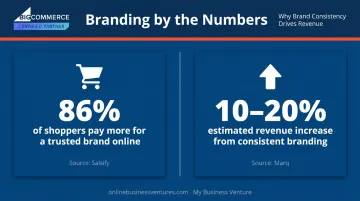
- 86% of shoppers will pay more online for a brand they trust, per Salsify's survey of 1,800+ consumers
- Customers buy on value, not just price, when they recognize and trust a brand — supporting premium pricing
- Loyalty comes from consistent, positive brand experiences, not one-off transactions
- A clear identity gives customers something specific to talk about and recommend
Respondents in Marq's brand consistency report estimated that consistent branding could increase revenue by 10–20%. Brand professionals overwhelmingly tie consistency to revenue growth, and the number reinforces why getting your brand foundation right matters early.
What a Brand Is NOT
A brand is not a logo. A logo without a defined strategy behind it is just a graphic. Without documented values, a clear voice, and a consistent customer experience, visual elements alone produce a fragmented identity that fails to resonate with anyone in particular.
How to Brand Your Business: Step-by-Step
Step 1: Identify Your Target Audience and Research Competitors
Branding begins with knowing exactly who you're building for. Before choosing a name, picking colors, or writing a tagline, answer these questions:
Build a basic buyer persona:
- Who is your ideal customer? (age, income, lifestyle, occupation)
- What problem are they trying to solve?
- What do they already buy, and why?
- Where do they spend time online?
Once you understand your audience, study your competitors. Look at their logos, messaging, tone, and customer reviews. You're not looking for inspiration to copy — you're identifying gaps. Where are they generic? Where do they fall short? That's where your brand can differentiate.
One practical step many entrepreneurs skip: check trademark databases and domain availability early. The USPTO trademark search tool lets you search for conflicting marks before you invest in a name or logo. Separately check domain registrars like GoDaddy or Namecheap for availability. Do both — trademark clearance and domain availability are separate processes.
With your audience and competitive landscape mapped, you're ready to define what your brand actually stands for.
Step 2: Define Your Mission, Core Values, and Unique Value Proposition
Three things must exist before any visual or creative work begins:
| Element | What It Answers | Length |
|---|---|---|
| Mission Statement | Why does your business exist? | 1–2 sentences |
| Core Values | What principles guide how you operate? | 3–5 values |
| Unique Value Proposition (UVP) | What makes you better or different for your specific audience? | 1–2 sentences |
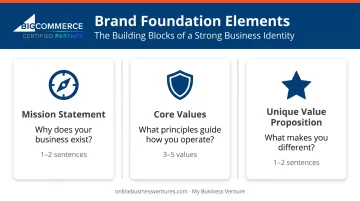
These aren't marketing slogans. They're internal operating documents. Your mission informs your tone of voice. Your values shape your visual personality. Your UVP drives every headline you write.
McKinsey research found that while 82% of employees considered organizational purpose important, only 42% said their company's purpose statement had real impact. A written mission statement means nothing if it doesn't guide actual decisions — from how you handle customer complaints to how you price your products.
Write each element in plain language that any team member could reference. Avoid corporate jargon. If you can't explain your UVP in a single sentence, it needs more work.
Once your mission, values, and UVP are locked, your name and tagline have something real to express.
Step 3: Choose Your Business Name and Write Your Tagline
A strong business name is:
- Memorable — easy to say, spell, and recall
- Available — as a domain, trademark, and across social platforms
- Scalable — broad enough to grow with the business without limiting you
- Free of unintended meanings — check for negative connotations in other languages if you plan to expand
Three naming approaches worth considering:
- Invented word — George Eastman coined "Kodak" in 1888 specifically because it had no prior meaning — favoring K as a strong, incisive letter — and it became one of history's most recognizable brand names
- Adapted concept — Google reframed "googol" (the number 1 followed by 100 zeros) to signal organizing vast amounts of information
- Descriptive combination — pairing your niche with a location or modifier (e.g., "HamptonsHobbyShop") creates instant relevance
Your tagline should distill your UVP into a short, memorable phrase that speaks directly to what your customer cares about. It's not a clever wordplay exercise — it's a promise. Write it after your UVP is locked, not before.
Name and tagline in hand, the next step is making your brand visible.
Step 4: Build Your Visual Brand Identity
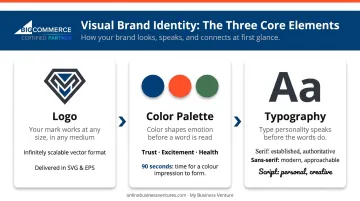
Three core elements form your visual brand:
Logo Your logo is your primary brand mark. It must work at any size — on a website favicon and on a billboard. Use vector artwork (SVG or EPS formats) so it scales without losing quality. A logo that only works at one size isn't a finished logo.
Color Palette Colors influence how customers perceive your brand personality before they read a single word. Research published in Management Decision found that people form initial assessments within 90 seconds, with 62–90% of that assessment potentially based on color alone. Blue signals competence and trust; red evokes excitement; green suggests health or sustainability. Choose 2–3 primary colors and stick with them.
Typography Serif reads as traditional and authoritative; sans-serif as modern and clean; script as personal. Choose one or two typefaces that match your brand character and use them consistently across every customer-facing touchpoint.
For entrepreneurs launching an online store, this consistency carries extra weight — without a physical storefront, your visual identity does the work of establishing credibility. My Business Venture (MBV) includes custom logo design in all of its turn-key e-commerce packages, so new store owners launch with a professionally designed brand identity in place rather than retrofitting one later.
Visual identity handles how your brand looks. Brand voice handles how it sounds.
Step 5: Develop Your Brand Voice and Consistent Messaging
Brand voice is the consistent personality your business uses in all written and verbal communications. It should be defined in 3–5 descriptive words derived directly from your values and audience.
Examples of brand voice descriptors:
- Friendly, approachable, clear
- Authoritative, direct, data-driven
- Playful, bold, irreverent
Every piece of content — website copy, social captions, email campaigns, product descriptions — should sound like it comes from the same source.
Inconsistency in tone erodes trust fast. It signals that no one is really steering the brand experience.
A practical test: pull three pieces of content from your brand without labels. Do they sound like the same voice? If not, your guidelines aren't specific enough.
What Makes a Strong Brand Identity: Key Elements
Create a Brand Style Guide
Once the foundational work is done, document everything in a brand style guide. This is a reference document — not a creative manifesto — that captures:
- Logo usage rules (clear space, minimum size, approved variations)
- Color codes (HEX and RGB values for digital; CMYK for print)
- Approved typefaces and their hierarchy
- Brand voice guidelines with example phrases and phrases to avoid
- Approved imagery style and photography direction
Marq's survey of 400+ brand-management experts found 85% of organizations had brand guidelines, but only 30% consistently enforced them. The document only creates value when people actually use it.
Apply Your Brand Across Every Touchpoint
Your brand should appear consistently across:
- Website (header, footer, product pages, checkout)
- Social media profiles (profile images, cover photos, bio language)
- Email marketing (headers, signatures, tone)
- Packaging and fulfillment materials
- Customer service interactions
Salesforce's research of 14,300 global consumers found 79% expect consistent interactions across departments. Customers don't separate "marketing brand" from "customer service brand" — it's all one experience to them.
For e-commerce businesses, this extends beyond your website. Fulfillment materials, order confirmation emails, and even the unboxing experience should all reflect your brand — not your supplier's. Platforms like BigCommerce also let you customize storefronts and integrate social profiles, so your identity stays consistent from the first ad impression through to delivery.
Track Whether Your Branding Is Working
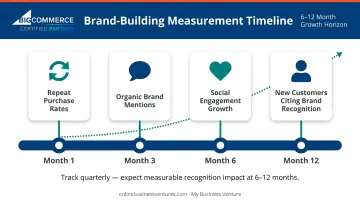
Look for these signals over time:
- Repeat purchase rates increasing — customers return because they recognize and trust you
- Organic brand mentions — customers referencing your brand name without being prompted
- Social engagement growth — followers engaging with content because they identify with your brand
- New customers citing brand recognition as a reason for choosing you
None of these signals appear overnight. Most brands need 6–12 months of consistent execution before recognition measurably affects purchase behavior. Track these metrics quarterly, not weekly — and resist changing brand elements too early if results feel slow.
Common Branding Mistakes to Avoid
Skipping the Foundation
Many new business owners jump straight to logo design without defining their audience, mission, or UVP first. The result is visual assets that look fine in isolation but don't connect to any meaningful brand story. Start with your strategy — the logo follows from it, not the other way around.
Inconsistent Presentation Across Platforms
Using different logos, color variations, or tones across your website, social channels, and email fragments your brand identity. Recognition requires repetition, and repetition requires consistency. Marq's brand consistency research found that 77% of companies dealt with off-brand content — a real obstacle to building recognition over time.
Copying Competitors Instead of Differentiating
Studying competitors is useful for identifying gaps. Copying their visual style or messaging defeats the purpose of branding entirely. If your brand looks like everyone else in your category, customers have no reason to choose you specifically.
Treating Branding as a One-Time Project
Brands must evolve as businesses grow, markets shift, and customer needs change. That doesn't mean redesigning everything whenever something feels stale. Make deliberate, strategic updates — and when you do refresh, keep changes gradual enough that existing customers still recognize the brand they trusted.
Frequently Asked Questions
What are common branding mistakes to avoid?
The most damaging mistakes are skipping audience research before building brand assets, prioritizing a logo over a broader brand strategy, and being inconsistent across platforms. All three undermine the recognition and trust your brand needs to drive customer decisions.
What are the 5 C's of branding?
The 5 C's are:
- Clarity — a defined identity and message
- Consistency — uniform presence across every touchpoint
- Content — relevant, on-brand communication
- Connection — emotional resonance with your audience
- Credibility — trust built through reliability and authenticity
What is the 3-7-27 rule of branding?
The 3-7-27 rule is a practitioner heuristic suggesting it takes roughly 3 impressions to recognize a brand, 7 to remember it, and 27 to build loyalty. No published empirical study underpins the specific numbers, but the core idea holds: brand-building requires repeated, consistent exposure over time.
What is the difference between a brand and a logo?
A logo is one visual element within a brand. A brand is the complete identity of a business: its values, voice, customer experience, and reputation. The logo gets you recognized. The brand determines what customers actually feel and think about you.
How long does it take to build a brand?
Foundational branding work — name, logo, guidelines — can realistically be completed in weeks. Building genuine market recognition and customer trust typically takes consistent effort over months to years, depending on how competitive your category is and how consistently you show up.
How much does it cost to brand a small business?
Costs vary widely. DIY tools handle basics for a few hundred dollars. Freelance logo design typically runs $500–$3,000; a full brand identity system (logo, guidelines, website design) often reaches $3,000–$10,000 or more with professional help. My Business Venture's turn-key e-commerce packages ($3,995–$5,995) bundle custom logo design and a professionally built storefront into a single investment.