
This confusion is more common than you'd think, and it's expensive. Entrepreneurs who conflate branding with web design often end up paying for the wrong thing first, then rebuilding both when the gaps become obvious.
These are two distinct disciplines. One defines who your business is. The other shows that identity to the world online. Understanding the difference — before you invest in either — is one of the most practical things you can do before launching an e-commerce store.
Key Takeaways
- Branding defines your business identity: values, personality, and how customers perceive you
- Web design applies that identity online through structure, layout, and functionality
- Your website is built on top of your brand — get branding right first, then build the site around it
- Strong branding builds trust; good web design converts that trust into purchases
- Bundled packages that cover both branding and web design let you launch a cohesive store without piecing it together yourself
What Is Branding?
Think of your business as a person. Branding is that person's personality, reputation, and the impression they leave after every interaction. It goes far deeper than a logo — it's the complete emotional and strategic identity behind everything your business does.
The American Marketing Association defines a brand as any distinctive feature — name, design, symbol — that identifies goods or services. But AIGA goes further, noting that brand extends beyond the graphic identity system to include the quality and value of relationships built over time. In other words, branding is what people feel about your business, not just what they see.
The Core Elements of a Brand
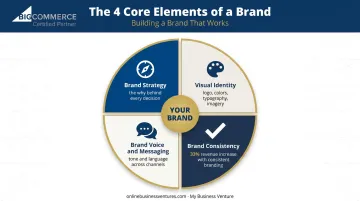
Brand strategy starts with the "why" behind every visual decision. It covers your target audience, what sets you apart from competitors, and the core message you want to own in your market. Without it, visual choices are just guesses.
Visual identity is what most people think of when they hear "branding." It includes:
- Logo design
- Color palette
- Typography
- Graphic elements and imagery
These elements should work together consistently across every customer touchpoint — your website, social media, packaging, email, even how your team communicates.
Brand voice and messaging shapes how your business speaks. Whether your tone is professional and authoritative, friendly and conversational, or bold and energetic, consistency matters. Customers notice when a brand sounds different on Instagram than it does at checkout.
Brand consistency ties it all together. Research from Lucidpress found that companies with consistent branding can see up to a 33% increase in revenue, based on respondents' own estimates. Recognition and trust accumulate through repetition — and each consistent touchpoint deepens the impression customers carry forward.
What Is Web Design?
Web design is the process of planning, structuring, and building the visual layout and user experience of your website. If branding defines who you are, web design is how you show up when someone finds you online.
Critically, web design applies your brand — it doesn't create it. A web designer works with existing brand assets (logo, colors, fonts, messaging) and builds an environment where those assets come to life.
The Core Elements of Web Design
Site structure and navigation determines how visitors move through your store. A well-designed site guides users effortlessly from landing page to product page to checkout — without confusion or friction.
User experience (UX) and performance has a direct impact on revenue. A Google and Deloitte study across 37 brands and 30 million mobile sessions found that a 0.1-second improvement in mobile load speed was associated with an 8.4% increase in retail conversions. Page speed is a conversion factor, not a background detail.
Mobile responsiveness carries equal weight. Shopify reported that 77% of global e-commerce site traffic in 2025 came from mobile devices. A site that doesn't work on a phone loses the majority of potential customers before they see a single product.
The visual design layer applies your brand assets to pages, banners, product displays, and navigation. The web designer implements your brand; they don't invent it. That distinction shapes who you hire and in what order.
Technical and SEO considerations include:
- SSL security (protects customer data and signals trustworthiness)
- Search engine optimization setup for organic visibility
- Integration of payment processors and product catalogs
- Accessibility standards and site speed optimization
For an e-commerce store, these aren't background details — they directly affect whether customers can find you and whether they trust you enough to buy.
Key Differences Between Branding and Web Design
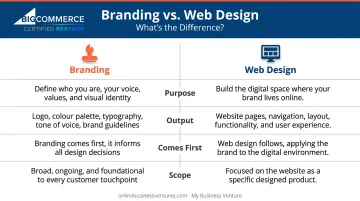
The simplest way to separate them: branding is about identity, web design is about experience.
| Dimension | Branding | Web Design |
|---|---|---|
| Purpose | Define who you are and how you're perceived | Build the online space where that identity lives |
| Output | Logo, color palette, brand voice, guidelines | Website pages, navigation, UX, tech integrations |
| Comes first? | Yes — always | Second — built on top of brand |
| Scope | All touchpoints: packaging, social, in-store | Digital/online channel only |
The Most Common Misconception
New entrepreneurs often assume that getting a logo is branding, or that a well-designed website is a brand. Neither is accurate:
- A logo is one visual element within a broader identity system
- A website is the digital application of that identity
Neither alone constitutes a brand. A brand is the accumulated perception customers form across every interaction with your business.
The Overlap That Creates Confusion
Web designers frequently offer "light-touch branding" as part of their service — choosing colors and fonts that work for a website. That's not brand strategy. It's visual selection for a single digital channel, and it may not translate to packaging, social media, or any other touchpoint.
Before engaging a designer, ask directly: "Are you building my brand, or applying brand assets I bring you?" The answer determines what you actually need — and whether you're skipping a critical step.
Why Branding Should Always Come First
Your website is built on top of your brand. That's not a philosophical statement — it's a practical workflow reality. A web designer needs your logo, colors, fonts, and messaging before they can make meaningful design decisions. Without those inputs, they're guessing.
Launch a store without clear branding and the problems show up fast:
- Your homepage feels generic, with no clear identity
- Product pages lack a consistent voice or tone
- Color choices reflect whoever built the site, not your target audience
- When you finally develop your brand, the website needs rebuilding too
That's wasted time and money — and it's avoidable.
The Trust Factor
Peer-reviewed research shows that visual aesthetic judgments happen within 50 milliseconds of landing on a website — and that those snap judgments are highly consistent with longer evaluations. Visitors aren't consciously analyzing your design; they're forming an impression before they've read a word.
Stanford's web credibility study found that 46.1% of credibility comments from users concerned visual design — making it the single largest factor in how people evaluated whether a website was trustworthy.
Strong branding, applied consistently across your web design, lets that trust form in seconds. Without it, even a technically functional site can feel forgettable or unprofessional — and first impressions in e-commerce are rarely a second chance.
How Branding and Web Design Work Together for E-Commerce Success
For online store owners, the website is the storefront. There's no physical space, no staff interaction, no product you can pick up and examine. Your brand and your website have to do everything a brick-and-mortar experience does — communicate professionalism, build trust, and guide someone through a purchasing decision.
When both are aligned, the results compound. Brand colors set an emotional tone before a visitor reads anything. Typography signals whether your business is premium or playful. A recognizable logo builds familiarity across repeat visits. And the web design layout guides that visitor from product discovery through checkout without friction.
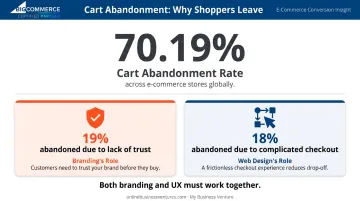
Baymard's research shows a cart abandonment rate of 70.19%, with 19% of abandoned carts attributed to visitors not trusting the site with their card information and another 18% due to checkout being too long or complicated. Branding influences the trust dimension; web design handles the UX dimension. Both need to work.
That dual requirement — strong branding and solid UX — is exactly what My Business Venture's turn-key e-commerce packages are built to deliver together. Rather than forcing entrepreneurs to source a logo designer, find a web developer, set up hosting, and keep it all visually consistent, MBV bundles custom logo design and BigCommerce storefronts built by certified developers into a single package.
All three tiers include both: Enterprise ($3,995), Premier ($4,995), and Millennium ($5,995). Clients report going live in less than a week, with brand and website cohesive from day one rather than pieced together later.
Frequently Asked Questions
Should branding come before web design?
Yes, always. Your brand identity — logo, colors, fonts, messaging — gives the web designer the foundation they need to build a site that accurately reflects your business. Designing a website without established branding leads to visual inconsistency that typically requires a costly redo.
What is the difference between a logo and a brand?
A logo is one visual asset within a larger identity system. A brand encompasses your values, personality, messaging, color palette, typography, and the overall emotional impression your business creates across every customer interaction.
Can I launch my e-commerce store without professional branding?
Technically, yes — but a generic or inconsistent store makes it harder to build trust, stand out from competitors, and convert visitors into buyers. First impressions form in milliseconds, and an unpolished appearance signals unprofessionalism before a visitor reads a single word.
What does a web designer actually deliver?
A web designer delivers a structured, mobile-responsive website with functional pages, navigation, calls-to-action, and integrated brand assets — along with SSL security, SEO setup, and third-party integrations like payment processors.
Do I need separate professionals for branding and web design?
Not necessarily. Some professionals specialize in one discipline, others offer both — and bundled solutions like MBV's packages combine custom logo design and professional web design in one place, keeping everything consistent without the hassle of managing multiple vendors.
How long does it take to develop branding before building a website?
Agency guidance typically places a comprehensive brand identity project at 8–12 weeks, depending on scope and revision cycles. Finalizing brand assets before web design begins speeds up the site build — designers can move faster when they're not waiting on logo approvals or resolving color choices mid-project.