Introduction
You've launched your online store. Traffic is trickling in. But visitors browse, leave, and never come back — and you're not sure why. Sound familiar?
This is precisely the problem a marketing funnel solves. Rather than hoping the right people stumble across your store at the right moment, a funnel gives you a structured system for guiding strangers through a deliberate journey — from first hearing about your brand, to buying, to coming back again.
This guide covers everything a first-time entrepreneur needs to know: what a marketing funnel is, the stages it includes, strategies that actually move people forward, and how to measure whether it's working. No fluff, no jargon — just a practical framework you can apply to your own store.
Key Takeaways:
- A marketing funnel maps the full customer journey — from stranger to loyal buyer
- Each funnel stage requires different content, messaging, and tactics
- Retaining existing customers costs significantly less than acquiring new ones
- Starting simple works: awareness and conversion are enough to build on day one
- Tracking stage-specific metrics tells you exactly where your funnel is leaking
What Is a Marketing Funnel?
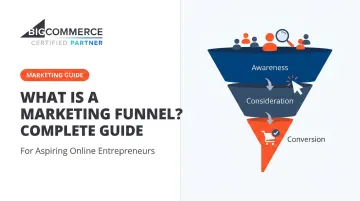
A marketing funnel is a model that maps the journey a potential customer takes — from first discovering your brand all the way through making a purchase and becoming a repeat buyer. The "funnel" shape is intentional: a large number of prospects enter at the top, and a smaller group makes it all the way to a purchase at the bottom.
But it's more than a diagram. For a business owner, the funnel answers three practical questions:
- Where am I losing people? (so you fix the right problem)
- What should I be saying at each stage? (so messaging feels relevant, not pushy)
- How do I build a repeatable system? (so growth doesn't depend on luck)
A Brief History
The concept traces back to AIDA — Awareness, Interest, Desire, Action — attributed to advertising pioneer E. St. Elmo Lewis around 1898, though later historical research disputes the idea that one person created the complete model at that date. Either way, the core idea has shaped marketing strategy for over a century.
Today's funnels extend well beyond that original four-step sequence. Modern frameworks — including Shopify's 2026 six-stage model — include retention and advocacy stages after the initial purchase, reflecting a shift toward long-term customer value over one-time transactions.
The Stages of the Marketing Funnel Explained
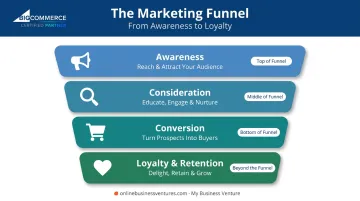
Most modern marketing funnels use four core stages. Some frameworks expand this to five or six (separating Interest, Intent, and Action as distinct phases), but these four cover the full customer journey effectively.
Awareness — Top of Funnel (ToFu)
This is the widest stage. The goal is simple: get in front of as many potential customers as possible and make them aware your brand exists. At this point, the prospect is essentially a stranger — they may not even know they need what you offer yet.
Effective ToFu tactics:
- Blog posts optimized for search (SEO)
- Short-form social media videos
- Paid display or social ads
- Influencer mentions
- YouTube content
At this stage, conversion isn't the goal — visibility is. Reach broadly and let the funnel do the filtering.
Consideration — Middle of Funnel (MoFu)
Prospects in this stage know they have a problem and are actively comparing solutions. They're researching you alongside competitors. Your job is to build trust and differentiate your offer before they make a decision.
Effective MoFu tactics:
- Product comparison guides
- Customer reviews and testimonials
- Detailed product descriptions
- Email nurture sequences
- Educational content that addresses common buyer objections
Conversion — Bottom of Funnel (BoFu)
This is the moment of decision. The prospect is ready to buy — they just need a final push. Reducing friction and building confidence matters more here than anywhere else in the funnel.
Effective BoFu tactics:
- Strong, focused product landing pages
- Money-back guarantees
- Limited-time offers or discount codes
- Retargeting ads for visitors who browsed but didn't buy
- Smooth, secure checkout experience
A slow or confusing checkout will kill BoFu conversions regardless of how well the earlier stages performed. Baymard Institute's analysis of 50 studies puts the average cart abandonment rate at 70.22% — meaning most people who add something to their cart don't complete the purchase. Checkout friction is a primary reason why.
Loyalty and Retention — Beyond the Funnel
The funnel doesn't end at purchase. According to HBR, acquiring a new customer can cost 5 to 25 times more than retaining an existing one — and a 5% increase in retention can raise profits by 25% to 95%.
That gap makes a compelling case for treating post-purchase marketing as seriously as pre-purchase.
Effective retention tactics:
- Post-purchase email sequences
- Loyalty and rewards programs
- Personalized product recommendations
- Requests for reviews or referrals
- Gift card promotions to encourage repeat visits
The numbers back this up: Gorgias data from 10,000+ merchants found that repeat customers represent just 21% of a store's customer base — but generate 44% of revenue. A minority of buyers driving nearly half of all sales is a strong argument for building a retention strategy from day one.
Proven Strategies to Move Customers Through Each Funnel Stage
Match Content to Stage
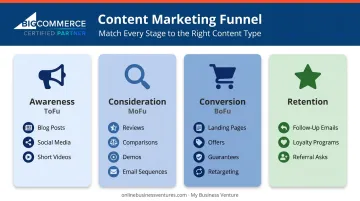
The most common funnel mistake is pushing "buy now" messaging too early. Prospects who've just discovered your brand aren't ready to purchase — they need information first. The right content at each stage:
| Funnel Stage | Content Type |
|---|---|
| Awareness (ToFu) | Blog posts, social media, short videos |
| Consideration (MoFu) | Reviews, comparisons, demos, email sequences |
| Conversion (BoFu) | Landing pages, offers, guarantees, retargeting |
| Retention | Follow-up emails, loyalty programs, referral asks |
Use Email as the Thread That Connects Everything
Email marketing works across every funnel stage — not just one. A ToFu lead who subscribes to your newsletter can be moved toward conversion through automated sequences that deliver progressively more specific content over time.
A practical example: a prospect adds a product to their cart but doesn't check out. An abandoned cart email — or a retargeting ad with a small discount — brings them back. Omnisend's 2025 data shows that nearly 4 in 10 people who click an abandoned cart email go on to complete a purchase.
Activate Social Media at Both Ends of the Funnel
Social platforms do two different jobs depending on where someone is in the funnel:
- At the top: they help new audiences discover your brand. GWI's research found that 30% of consumers discover brands through social media ads, and 23% through social recommendations.
- At the bottom (loyalty stage): they keep existing customers engaged post-purchase through continued content, promotions, and community.
For entrepreneurs managing their own stores, consistent posting and active channel management are what turn social media from a passive presence into an actual traffic driver.
Invest in a Conversion-Ready Store
Once a shopper reaches your store, the store itself does the selling. A slow, confusing, or visually untrustworthy checkout experience undermines everything that came before it.
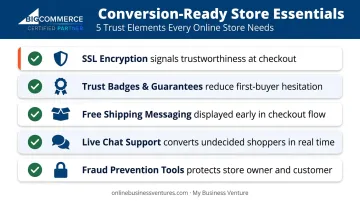
A conversion-ready store typically includes:
- SSL encryption and secure checkout to signal trustworthiness at a glance
- Trust badges and guarantees to reduce hesitation for first-time buyers
- Free shipping messaging displayed early in the checkout flow
- Live chat support to catch and convert undecided shoppers in real time
- Fraud prevention tools that protect both the store owner and the customer
These aren't nice-to-haves — they're the floor. Shoppers who reach checkout with unresolved doubts abandon. Stores built on platforms like BigCommerce can be configured with most of these features out of the box, which is why platform choice matters as much as marketing strategy.
Key Metrics to Track at Every Funnel Stage
Tracking the right data is how you find where your funnel is leaking — and fix the right thing.
Metrics by Stage
| Stage | Metrics to Watch |
|---|---|
| Awareness (ToFu) | Website traffic, impressions, social reach, click-through rate |
| Consideration (MoFu) | Time on page, email open rates, bounce rate, review ratings |
| Conversion (BoFu) | Conversion rate, cart abandonment rate, cost per acquisition, average order value |
| Retention | Repeat purchase rate, customer lifetime value, referral rate |
Understanding Conversion Rate
Conversion rate is the percentage of people who complete a desired action at a given stage. For example: if 1,000 visitors land on your store and 20 complete a purchase, your conversion rate is 2% — which is actually close to the current industry benchmark. IRP Commerce has measured average e-commerce conversion rates consistently near 2%, a useful baseline when benchmarking your own store performance.
That number might sound low, but it means your funnel needs volume at the top and optimization throughout — not just a better product.
Why Customer Lifetime Value Changes Everything
Knowing how much a customer is worth over time changes how you think about marketing spend. If a customer averages three purchases per year, you can justify spending more to acquire them — and even more to retain them.
Shopify's retention data puts the average online retailer repeat-customer rate at 28.2%. That segment consistently drives a disproportionate share of revenue — meaning a funnel that stops at conversion leaves the highest-margin customer relationships underworked. The post-purchase phase isn't an afterthought; it's where long-term profitability is built.
How to Start Building Your First Marketing Funnel
You don't need to build a perfect funnel on day one. Starting with just the awareness and conversion stages is a completely valid approach — and far better than doing nothing while waiting for a complex system to come together.
Three Foundational Steps
Define your target customer — Who are they? What problem do they have? Where do they spend time online? You can't build a funnel without knowing who you're funneling.
Map your touchpoints — Decide what content or channel you'll use at each stage. One social platform for awareness. One email sequence for nurturing. One optimized product page for conversion. Start narrow.
Set up the essential tools — At minimum: a professional website or store, an email marketing tool, and at least one active social media channel.
Test one channel at a time before scaling. Running three platforms poorly produces worse results than running one well.
You Don't Have to Figure This Out Alone
For first-time entrepreneurs managing marketing, e-commerce, and operations simultaneously, the learning curve is steep. Working with a coach or consultant can compress that timeline considerably.
MBV University coaches work one-on-one with new store owners to build marketing strategies that actually generate traffic and sales. Senior consultants like Jason Backer focus on:
- Developing a marketing plan tailored to your store and goals
- Understanding how to drive traffic through organic and paid channels
- Converting visitors into paying customers — not just getting the site live
Frequently Asked Questions
What is the marketing funnel?
A marketing funnel is a model representing the customer journey from first becoming aware of a brand through to making a purchase and becoming a loyal repeat buyer. It's shaped like a funnel because the number of prospects narrows at each stage as some disengage or choose a competitor.
What are the 5 stages of the marketing funnel?
The five stages are: Awareness, Interest, Consideration, Intent/Action, and Purchase/Loyalty. Terminology varies by framework, but the underlying journey — unknown prospect to paying, returning customer — stays consistent.
What is the 3-3-3 rule in marketing?
The 3-3-3 rule is a practitioner heuristic — not a formally validated framework — suggesting prospects respond better to messages delivered across multiple formats, channels, and touchpoints. The core idea (repeated exposure builds familiarity) is grounded in consumer psychology, though the specific numbers are more rule-of-thumb than science.
What is the difference between a marketing funnel and a sales funnel?
A marketing funnel covers the entire customer journey from awareness through loyalty. A sales funnel focuses on the narrower, later stages — converting qualified leads into paying customers. In practice, especially for small businesses, the terms are often used interchangeably.
How do I know if my marketing funnel is working?
Track stage-specific metrics: traffic at the top, email open rates and time-on-page in the middle, conversion rate and cart abandonment at the bottom. If traffic is high but conversions are low, the BoFu stage needs attention. If traffic itself is low, start with awareness.
What type of content works best at each stage of the funnel?
Content needs shift as prospects move through the funnel:
- Top: Blog posts, social media, and short videos build awareness
- Middle: Comparison guides, testimonials, and demos build consideration
- Bottom: Landing pages, direct offers, and trust signals (reviews, guarantees, security badges) close the sale