
Introduction
Picture this: you've just launched your online store. You've run Facebook ads, set up email campaigns, and started posting on Instagram. A few weeks in, you've got customers — but no idea whether you spent $20 or $200 to get each one. You don't know if any of it was worth it.
That's exactly the problem Customer Acquisition Cost solves.
CAC tells you, in plain dollar terms, how much your business spends to win one new customer. It turns vague marketing spend into a concrete number you can measure, benchmark, and act on.
This article covers everything you need to know: what CAC is, the exact formula, what costs to include, a step-by-step worked example, and concrete strategies to bring it down.
Key Takeaways
- CAC is the average cost to acquire one new customer: Total Sales & Marketing Expenses ÷ New Customers Acquired
- Include every cost in your calculation — ad spend, salaries, software, agency fees, and overhead
- Pair CAC with Customer Lifetime Value (LTV) — CAC alone doesn't tell the whole story
- The widely cited LTV:CAC benchmark is 3:1, meaning $3 earned for every $1 spent acquiring a customer
- Lower CAC by tightening your funnel, growing organic channels, and improving customer retention
What Is Customer Acquisition Cost (CAC)?
HubSpot defines CAC as the total expense required to secure a new customer — every dollar spent on marketing, advertising, and sales divided by the number of customers gained during a specified period.
The key word is normalized. CAC converts raw marketing spend into a per-customer figure, which means you can compare it across months, campaigns, and channels. Knowing you spent $15,000 on marketing last quarter is a raw dollar figure. Knowing you spent $75 per customer acquired — that's actionable.
What CAC Does and Doesn't Tell You
CAC measures acquisition efficiency — what it actually costs your business to win each new customer. A $75 CAC could be excellent or catastrophic depending on what that customer is worth to you over time.
That's why CAC is typically paired with Customer Lifetime Value (LTV) — the total revenue a customer generates across their entire relationship with your business. Together, they answer the question that matters: are you spending the right amount to acquire the customers you're getting?
Three things CAC tells you at a glance:
- Efficiency: How much of your marketing and sales spend is converting into actual customers
- Benchmarking: Whether your acquisition costs are improving or eroding over time
- LTV alignment: Whether what you spend to acquire a customer is justified by what they're worth
CAC is also a period metric, not a campaign-level one. It reflects how efficiently your entire sales and marketing operation performed during a given timeframe — not just a single ad or promotion.
How to Calculate CAC: Formula + Step-by-Step Example
The formula is straightforward:
CAC = Total Sales & Marketing Costs ÷ Number of New Customers Acquired
Both numbers must cover the same time period. Using Q1 costs with Q2 customer counts produces a meaningless figure.
Step-by-Step Calculation
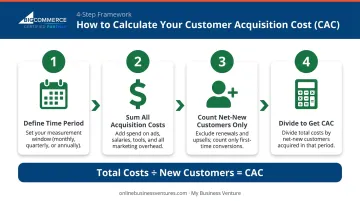
Follow these four steps to calculate your CAC accurately:
- Define your time period — Choose a consistent window: one month, one quarter, or one year. Shorter periods catch trends faster; longer periods smooth out seasonal swings.
- Sum all acquisition-related costs — Add every dollar spent on marketing and sales during that period (more on what qualifies in the next section).
- Count only net-new customers — Do not include existing customers who made a repeat purchase. Count only customers who bought from you for the first time during that period.
- Divide — Total costs ÷ new customers = your CAC.
Worked example:
An online home goods store tracks the following costs for one month:
| Cost Item | Amount |
|---|---|
| Paid social and Google ads | $5,000 |
| Freelance marketing specialist | $2,000 |
| Email marketing software | $500 |
| Total | $7,500 |
During that same month, the store acquired 75 new customers.
CAC = $7,500 ÷ 75 = $100 per customer
That $100 figure is now a benchmark. If ad spend rises the following month but new customer count stays flat, CAC climbs — and you know exactly where to look first.
New CAC vs. Blended CAC
These two versions of CAC answer different questions:
- New CAC isolates only brand-new acquisition costs and customers, giving you the clearest read on whether your outreach is actually working.
- Blended CAC folds in revenue from existing customers (upsells, cross-sells) and can look flattering when retention is strong, but it can hide weak new customer acquisition behind those numbers.
For most early-stage businesses, New CAC is the number to watch. Once you have it, the next question is which costs should actually count toward it.
What Costs to Include in Your CAC Calculation
Under-counting costs produces a falsely low CAC — and a false sense of profitability. Here are the cost categories that belong in your calculation:
- Paid advertising — Google Ads, Meta Ads, display, sponsored content
- Content creation and SEO — blog writing, video production, link-building
- Sales team salaries and commissions — compensation for anyone directly involved in acquiring customers
- Marketing software and CRM tools — email platforms, automation tools, analytics subscriptions
- Agency and freelancer fees — retainers and project fees for any external acquisition help
- Event and trade show costs — booth fees, travel, and materials if used for acquisition
- Proportional overhead — a share of office or hosting costs attributable to marketing and sales (for a fully-loaded CAC)
Two Mistakes That Distort Your Number
Mistake 1: Counting only ad spend is the most common error. Ad spend is one input among many — ignoring the salary of the person managing those ads, the tools they use, and the agency they hired leaves your CAC understated by a wide margin.
Mistake 2: Pulling in post-acquisition costs — things like customer support, fulfillment, and loyalty program management — inflates your number artificially. These expenses serve customers you've already won, not the ones you're trying to acquire.
Consistency matters more than perfection. Use the same cost categories every period so your CAC figures are comparable over time.
Why CAC Matters for Your Business
The LTV:CAC Ratio
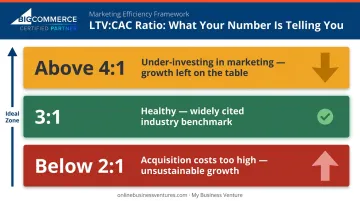
CAC becomes truly useful when compared to Customer Lifetime Value. The LTV:CAC ratio tells you how much revenue you generate for every dollar spent acquiring a customer.
According to HubSpot's 2024 guidance, a 3:1 ratio is the widely cited benchmark — meaning a business earns $3 in lifetime value for every $1 spent on acquisition. Andreessen Horowitz (a16z) describes 3x as a rough investor benchmark for consumer companies.
| LTV:CAC Ratio | What It Signals |
|---|---|
| Below 2:1 | Acquisition costs are too high relative to value; growth may be unsustainable |
| 3:1 | Healthy — the commonly cited target for most businesses |
| Above 4:1 | Potentially under-investing in marketing; leaving growth on the table |
CAC Payback Period
The payback period measures how many months it takes to recover your acquisition cost through customer revenue. Stripe identifies 12 months or less as typically healthy for SaaS and a practical B2C benchmark as well. Bessemer Venture Partners targets vary by segment: under 12 months for SMB, under 18 for mid-market, and under 24 for enterprise deals.
A long payback period strains cash flow. You're waiting months to recoup what you spent upfront before each customer becomes profitable.
How CAC Shapes Business Decisions
Tracking CAC doesn't just measure marketing performance — it forces clearer thinking across pricing, growth, and fundraising:
- Pricing: If your CAC is $150 but each customer generates only $120 in gross margin, the business model is structurally unprofitable. Every new customer costs you money. Pricing decisions need to account for acquisition costs, not just product margins.
- Investor credibility: Investors use CAC alongside LTV to assess whether a business can scale without burning through capital. A consistently improving CAC signals that your growth is getting more efficient — something any investor or acquirer will scrutinize.
How to Reduce Your Customer Acquisition Cost
Optimize Your Marketing Funnel
More conversions from the same traffic means more customers without more spend. Focus on:
- Improving landing page copy and design
- Simplifying checkout flows to reduce cart abandonment
- A/B testing calls-to-action and offers
- Fixing drop-off points using analytics data
A 20% improvement in conversion rate effectively reduces your CAC by 20% — without touching your ad budget.
Invest in Organic and Content-Driven Channels
Paid ads scale with spend; organic channels compound over time. SEO, email marketing, and consistent social media presence build customer reach without proportional cost increases. A healthy mix of paid and organic channels lowers your blended CAC and reduces your vulnerability to rising ad costs.
Build Retention to Reduce Acquisition Pressure
When existing customers stay longer, buy more, and refer others, the pressure on new acquisition decreases. Referral programs, in particular, deliver outsized returns — a peer-reviewed study of a German bank's referral program found that referred customers were worth at least 16% more than comparable non-referred customers over a 33-month period.
Loyalty incentives and post-purchase email sequences are low-cost tools that protect LTV without increasing acquisition spend.

For entrepreneurs launching their first online store, the fastest path to a lower CAC is avoiding the trial-and-error phase entirely. My Business Venture's e-commerce packages include built-in SEO tools, social media integration, a Google Analytics dashboard, and one-on-one consulting — so new store owners start with a marketing foundation rather than building one from scratch. MBV's consultants also give clients a guide covering 100 ways to market their store, 70 of which cost nothing but time to implement. That's a real head start for anyone trying to keep early acquisition costs under control.
Frequently Asked Questions
What is customer acquisition cost?
Customer Acquisition Cost (CAC) is the average amount a business spends to acquire one new customer. You calculate it by dividing total sales and marketing expenses by the number of new customers gained during the same period.
How is CAC calculated?
Use this formula: CAC = Total Sales & Marketing Costs ÷ Number of New Customers Acquired. Both figures must cover the same time window. Include all acquisition-related costs — ad spend, salaries, software, and agency fees — not just media spend.
What is an example of a customer acquisition cost?
If a business spends $10,000 on marketing and sales in a month and gains 200 new customers, the CAC is $50 per customer. Compare that figure to the customer's lifetime value to determine whether the acquisition was profitable.
What is a good customer acquisition cost?
There is no universal dollar target; "good" CAC depends on what a customer is worth to your business. The standard benchmark is an LTV:CAC ratio of at least 3:1, meaning each customer generates at least three times what it cost to acquire them.
What is the difference between CAC and LTV?
CAC measures what it costs to acquire a customer. LTV (Lifetime Value) measures the total revenue that customer generates over their entire relationship with your business. Comparing the two determines whether your acquisition spending is sustainable and profitable.
How can I lower my customer acquisition cost?
Three levers move the needle most:
- Optimize your marketing funnel to convert more of your existing traffic
- Invest in organic channels (SEO, email, social) that build reach without proportional cost increases
- Use referral programs and retention strategies to reduce dependence on expensive paid acquisition