Introduction
The most successful companies growing right now aren't doing it through aggressive cold calling or expensive ad campaigns. They're growing because their product does the selling for them.
That's the core idea behind product-led growth (PLG) — a strategy where the product itself drives customer acquisition, conversion, and retention. Users try before they buy, experience genuine value early, and naturally bring others along with them.
For entrepreneurs and small business owners, this matters more than ever. According to Paddle's ProfitWell research covering nearly 700 subscription businesses, B2B and B2C customer acquisition costs rose roughly 60% over a five-year period.
That cost pressure is compounded by a shift in buyer behavior: 77% of technology buyers now conduct their own research first before speaking to a salesperson — up from 43% who relied on vendor reps just a year prior.
Buyers want to discover and evaluate products on their own terms. PLG is how companies are built to meet that expectation.
This guide breaks down what PLG actually is, how it differs from traditional growth models, the four pillars that make it work, and how entrepreneurs can apply these principles to grow faster with less friction.
Key Takeaways
- PLG uses the product itself to attract, convert, and retain customers — reducing reliance on sales teams
- The four core pillars are self-service access, fast time-to-value, value before monetization, and built-in network effects
- PLG companies typically enjoy lower acquisition costs and stronger retention than sales-led competitors
- Slack, Dropbox, Shopify, and Calendly prove PLG works across industries and business sizes
- Any business can apply PLG principles to reduce friction and accelerate customer value
What Is Product-Led Growth?
Product-led growth is a go-to-market methodology where the product serves as the primary vehicle for attracting, converting, and retaining customers — with minimal reliance on direct sales intervention.
OpenView Partners, who coined the term through partner Blake Bartlett in 2016, define it as a strategy where the product is the primary driver of acquisition, retention, and expansion.
Remove purchase risk by letting users experience genuine value before committing financially. This "try before you buy" model aligns with how modern buyers actually behave.
Why PLG Has Surged in Popularity
That shift in buyer behavior didn't happen in isolation. Three forces have pushed PLG from niche strategy to mainstream approach:
- Rising acquisition costs — paid channels on Google, Facebook, and LinkedIn have gotten far more expensive as competition intensifies
- Self-educated buyers — 40% of technology buyers now use a free trial or free version during their purchase process before any sales contact
- Shift in expectations — buyers expect to experience a product, not just hear a pitch about it
When buyers can validate a product themselves before purchasing, sales conversations start much further down the funnel — with prospects who are already convinced.
PLG vs. Sales-Led vs. Marketing-Led Growth
PLG doesn't exist in a vacuum. It's most useful when you understand how it compares to the two models that came before it.
Sales-Led Growth
The traditional model. Human interaction drives conversion: demos, account executives, negotiation cycles. This works for complex, high-value enterprise products where customization and trust-building justify the cost. The downside: high customer acquisition costs and slow scalability. To enter a new market, you hire new reps.
Marketing-Led Growth
Demand is generated through content, advertising, and brand campaigns. Marketing qualifies leads before handing them to sales. This model struggles when products are similar and differentiation relies purely on messaging — the product never gets to speak for itself.
Product-Led Growth
The product experience replaces or significantly supplements sales and marketing activity. Critically, PLG companies don't eliminate sales or marketing — they make those functions more efficient by ensuring the product proves its value first.
The key distinction: in sales-led models, engagement follows monetization. In PLG, it comes before. By the time a PLG user speaks with a salesperson, they've already hit usage milestones, experienced the product's core value, and in many cases run into a paywall on their own.
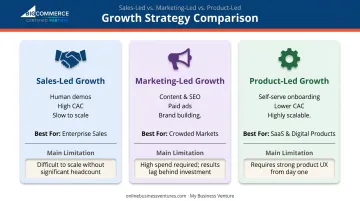
Here's how the three models compare at a glance:
| Model | Primary Driver | Best For | Main Limitation |
|---|---|---|---|
| Sales-Led | Human relationships | Complex, high-value enterprise deals | High CAC, slow to scale |
| Marketing-Led | Content, ads, brand | Crowded markets needing awareness | Product never differentiates itself |
| Product-Led | The product itself | Scalable, self-serve adoption | Requires strong product-market fit upfront |
The 4 Core Pillars of a Product-Led Growth Strategy
A successful PLG strategy rests on four interconnected pillars. A gap in any one of them can stall signups, hurt retention, or limit how far the product can grow on its own.
Self-Service Access
Self-service is the entry point for PLG. Users must be able to sign up, explore, and begin using the product without requiring human assistance.
In practice, this means:
- Frictionless signup flows (no lengthy forms, no required credit card)
- In-app tutorials and contextual guidance
- Accessible knowledge bases and documentation
- Automated email onboarding sequences
The trend supports this approach. McKinsey's 2024 B2B Pulse survey found roughly one-third of decision-makers prefer digital self-service at each stage of the buying process. TrustRadius data shows sales rep usage among tech buyers fell from 43% to 25% in a single year as buyers shifted toward independent evaluation.
If your onboarding requires a human walkthrough to make sense, the product isn't doing enough of the selling — and that's where PLG breaks down.
Fast Time-to-Value (The "Aha Moment")
Time-to-value (TTV) is the window between when a user signs up and when they first experience a meaningful outcome. The faster a user reaches their "aha moment," the more likely they are to convert and stay.
This isn't just a software concept. A Harvard Business School case study on Bow & Drape — a fashion company that let shoppers personalize products at in-store design stations — identified the moment customers saw their customized item as the brand's "Eureka" moment: an immediate emotional connection that drove loyalty. The principle applies whether you're selling software or physical goods.
Canva nails this in seconds: a new user drags in a template, changes a headline, and sees something polished. That moment — before any payment, before any tutorial — is what turns a casual signup into a committed user.
Value Before Monetization (Freemium and Free Trials)
This is the mechanism that makes PLG work. By giving users access to core value before charging them, companies remove purchase risk and let the product make the case for itself.
Two common models:
| Model | How It Works | Best For |
|---|---|---|
| Freemium | Ongoing free tier with premium upgrades | Products with fast, obvious value that improve with usage |
| Free Trial | Time-limited full access | Products that require exploration to demonstrate full value |
The choice depends on how quickly your product delivers value and what user behavior looks like in your target segment. Freemium works when a limited version is genuinely useful. Free trials work when users need full access to understand what they'd be paying for.
Built-In Network Effects and Virality
PLG products are often designed so that using the product naturally creates exposure for new potential users.
Examples:
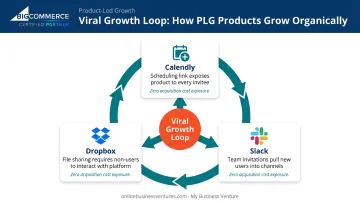
- Sharing a Calendly link introduces the product to every meeting invitee at zero acquisition cost
- Dropbox file sharing required non-users to interact with the platform to access shared content
- Slack team invitations pulled new users into channels organically
These viral loops compound growth over time without paid acquisition. Every user who experiences the product through a peer's action is a warm lead — they've already seen the product work.
Key Benefits of Product-Led Growth
Lower Customer Acquisition Costs
By reducing dependence on large sales teams and paid campaigns, PLG companies significantly reduce their CAC. When satisfied users become organic advocates, word-of-mouth referrals bring in high-quality leads who convert at higher rates.
OpenView's research shows PLG companies allocate a far higher share of spend toward R&D than sales and marketing — the inverse of traditional SaaS peers — prioritizing product improvement over labor-intensive acquisition.
Faster Growth and Scalability
Free and freemium models widen the top of the funnel substantially, capturing potential customers earlier in their decision journey. While sales-led companies must hire new reps to enter new markets, PLG companies scale by improving onboarding.
OpenView's 2023 product benchmarks found leading PLG companies growing at 50% year-over-year versus 21% for traditional SaaS peers. Their 2022 report showed PLG companies were more than 2x as likely to achieve 100% annual revenue growth.
Stronger Products Built on Real User Behavior
PLG forces product teams to focus on actual usage data rather than relying on sales presentations to cover product gaps. When thousands of users interact with your product daily, behavioral signals reveal what they truly value — not just what they say they want in a focus group.
The result is a self-reinforcing cycle: better products drive stronger retention, which generates richer data, which drives further product improvement.
Higher Retention Through Genuine Value
PLG drives retention by ensuring users reach genuine value before and after conversion. In sales-led models, users who never fully experience product value carry high churn risk — they committed to a purchase before the product had a chance to prove itself.
The distinction matters at scale. Key retention advantages PLG companies hold include:
- Users self-qualify before converting, arriving with realistic expectations
- Onboarding is optimized for activation, not just account creation
- Ongoing product improvements reinforce the value that drove conversion
Real-World Product-Led Growth Examples
Slack
Slack's PLG approach was refreshingly simple: teams could start immediately with no IT approval or complex setup. The freemium model let individuals invite colleagues to channels, with communication improvements making value obvious within days.
The viral mechanism was the invite itself — every new channel member experienced the product and understood its value. This drove organic expansion from small teams to enterprise-wide adoption. By September 2019, Slack officially reported more than 12 million daily active users and more than 6 million paid seats — growth driven predominantly through bottom-up product adoption rather than top-down enterprise sales.
Dropbox
Dropbox built virality directly into its core function. When a user shared a folder, recipients had to interact with Dropbox to access the content — exposing them to the product and demonstrating its value in a single interaction.
The referral program amplified this loop further. As documented in Drew Houston's 2010 "Startup Lessons Learned" presentation, the two-sided referral program (free storage for both parties) permanently increased signups by 60%. User growth went from 100,000 in September 2008 to 4 million by January 2010.
Shopify and Calendly
Shopify made it exceptionally easy for non-technical entrepreneurs to launch online stores independently — a self-service path to value that drove massive adoption. The company priced its 2015 IPO at $17 per share, with shares surging 69% on the first day of trading, validating the PLG approach's impact on business value.
Calendly takes a different angle: its scheduling link is itself the growth mechanism. Every meeting invitation sent exposes a new potential user to the product — at no acquisition cost whatsoever. The company currently reports 20 million professionals using the platform, with TechCrunch documenting 1,180% usage growth in a single year during 2020-2021.
What These Examples Have in Common
Each of these companies built growth into the product itself — not into the sales team. A few patterns stand out across all four:
- Immediate value: Users reached their "aha moment" within the first interaction, not after a sales call
- Built-in virality: Normal product use (sharing a folder, sending a calendar link, inviting a teammate) naturally exposed new users to the product
- Low friction entry: Free tiers, self-service setup, and no IT gatekeeping removed the barriers that kill early adoption
- Organic expansion: Growth compounded from individual users outward to teams and organizations — without a traditional top-down sales motion
How to Build and Measure Your PLG Strategy
Implementation Steps
Reduce friction at the entry point — Identify every barrier between a new customer and their first meaningful experience with your product or service, then eliminate those barriers. Simplify signup, speed up onboarding, and build self-service resources.
Define your "aha moment" — Identify the specific action or outcome that signals a customer has experienced genuine value. Build your entire onboarding flow to get every new user there as quickly as possible.
Align your whole team around user success — PLG is not a product team initiative. Marketing, sales, customer success, and operations must all measure success by whether users achieve meaningful outcomes — not just whether deals close.
Track behavior and improve based on what you find — Study how users actually move through your product using analytics tools. Focus improvements on reducing the time it takes users to see real value (time-to-value) and keeping them engaged — not on adding features they haven't asked for.
Key PLG Metrics to Track
| Metric | What It Measures |
|---|---|
| Activation Rate | Percentage of new users who reach a defined first-use milestone. OpenView's 2023 benchmarks show an average of 34% across PLG companies |
| Time-to-Value (TTV) | Average time from signup to first meaningful outcome — set product-specific thresholds |
| Retention Rate | Percentage of users who return and continue engaging over time |
| Product-Qualified Leads (PQLs) | Users whose behavioral data signals buying intent — more predictive than marketing-qualified leads |
| Expansion Revenue | Additional revenue from existing users through upgrades or add-ons |
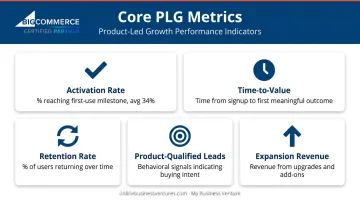
Tracking these metrics shifts your focus from deal volume to actual user outcomes — which is where sustainable growth comes from.
Frequently Asked Questions
What companies use a product-led growth strategy?
PLG companies include Slack, Dropbox, Zoom, Calendly, Notion, HubSpot, Shopify, and Atlassian. PLG is most common in SaaS, but its principles apply to any business that can deliver demonstrable value early in the customer relationship.
What are examples of product-led growth?
Three of the clearest examples: Slack's viral team invitations, Dropbox's share-to-discover model (new recipients must use the product to access shared files), and Calendly's scheduling link, which introduces the tool to every meeting invitee. Each turns normal product usage into a distribution channel.
What are the 4 growth strategies?
The four Ansoff growth strategies are market penetration, product development, market development, and diversification. Product-led growth is a go-to-market execution methodology rather than a strategic direction — it can support any of these strategies, particularly market penetration and product development.
What is the difference between product-led and sales-led growth?
In sales-led growth, a salesperson convinces a prospect to buy before they've experienced the product. In product-led growth, users experience genuine value first, and conversion becomes a natural next step — resulting in shorter cycles, lower acquisition costs, and higher-quality customer relationships.
What metrics should you track for product-led growth?
The five essential PLG metrics are activation rate, time-to-value, retention rate, product-qualified leads (PQLs), and expansion revenue. Unlike traditional sales metrics, these measure whether users are achieving value — not just whether pipeline is moving.
Can small businesses and e-commerce brands use a product-led growth strategy?
PLG principles apply well beyond software. Any business can reduce friction in the buying experience, deliver value quickly, and build referral mechanisms that turn existing customers into a growth channel. For e-commerce sellers, that means prioritizing seamless store experiences, fast onboarding, and product quality that earns repeat purchases and word-of-mouth.