At its core, eBay dropshipping is a fulfillment model where you list a supplier's products on eBay, and when a sale occurs, the supplier ships directly to your buyer. You profit from the difference between the supplier's price and what the buyer paid, minus eBay's fees.
This guide is for first-time sellers and aspiring entrepreneurs evaluating whether eBay is the right starting point. It covers exactly how the process works, what eBay actually permits, what it costs, and what alternatives deserve serious consideration before you commit.
Key Takeaways
- eBay dropshipping lets you sell without inventory — you earn the margin between supplier cost and sale price, after fees
- Only wholesale supplier sourcing is permitted; buying from Amazon or Walmart after a sale violates eBay policy and risks suspension
- Final value fees run 13.6% for most categories (as of February 2025), plus a per-order fee — margins get thin fast
- New accounts face listing and selling limits; account health depends on consistent performance, not listing volume
- Owning your own branded store offers higher margins, full brand control, and customer data ownership — worth evaluating before going all-in on eBay
How eBay Dropshipping Works: A Step-by-Step Breakdown
The transaction flow is straightforward once you understand who does what:
- You list a supplier's product on eBay at a marked-up price
- A buyer purchases the item
- You place the order with your supplier using the buyer's shipping address
- The supplier ships directly to the buyer
- You keep the profit margin after eBay fees
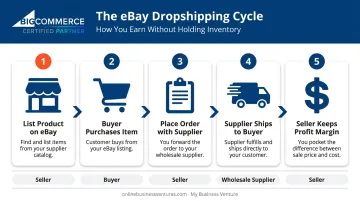
You never touch the product. Three parties are involved: you (the seller), the buyer (eBay customer), and the wholesale supplier.
Step 1: Set Up an eBay Seller Account
Register at eBay as either a personal or business seller, connect payment processing, and configure your business policies — shipping timeframes, return terms, and handling times. New accounts come with selling limits (both item count and total listed value), which eBay reviews monthly and adjusts based on performance.
Build account trust gradually. Listing at high volume right away won't accelerate growth — it's more likely to trigger a review or temporary restriction.
Step 2: Find Products and a Reliable Supplier
Research demand using eBay Seller Hub, eBay's bestseller categories, and Google Trends. Source only from wholesale suppliers — never by purchasing from retail stores or marketplaces once an order comes in.
A trustworthy supplier should meet all of these criteria:
- Consistent stock availability
- Fast, reliable shipping
- Responsive customer support
- Competitive wholesale pricing
- Quality products with accurate descriptions
Step 3: Create Listings and Price for Profit
Build listings with optimized titles, accurate item specifics, quality images, and a clear return policy. eBay's search algorithm rewards completeness and relevance.
Pricing requires accounting for every cost layer:
- Wholesale supplier cost
- eBay final value fee (13.6% for most categories)
- Per-order fee ($0.40 for orders over $10)
- Insertion fee (after 250 free listings: $0.35 each)
- A profit buffer for returns or issues
Thin margins are the most common beginner mistake. A $50 sale with a $30 supplier cost leaves roughly $12.80 in actual profit — before returns, refunds, or any advertising costs.
Step 4: Fulfill Orders and Manage Customer Experience
After a sale, place the order with your supplier immediately using the buyer's address. Once the supplier provides tracking, update the eBay order record and notify the buyer.
As the seller of record, you are fully responsible for the outcome — even when delays or quality issues are entirely the supplier's fault. Missed delivery windows and unresolved complaints generate defects on your account, which can lead to selling restrictions or suspension.
eBay's Dropshipping Policies and Fees
What eBay Allows and Prohibits
eBay's official dropshipping policy permits dropshipping only when you either own the items before listing them or have a prior agreement with a wholesale supplier to fulfill those specific listings.
What eBay explicitly prohibits:
- Purchasing from any retailer or marketplace (Amazon, Walmart, Target) after a sale occurs
- Using another retailer's user agreement as justification for fulfillment
- Selling items you have no right to sell
Violations are detectable. eBay's consequences include listing removal, search demotion, lower seller ratings, buying/selling restrictions, and account suspension — and related fees are not refunded.
VeRO (Verified Rights Owner Program): Brand owners can report unauthorized use of trademarks, copyrights, or patented content. Repeated violations — even unintentional ones — can lead to account strikes or permanent suspension; if you receive a VeRO notice, contact the rights owner directly or eBay at vero@ebay.com.
What eBay Dropshipping Actually Costs
The policy risks above are only part of the equation. According to eBay's current fee schedule, the platform's costs also compress margins significantly — here's what sellers pay:
| Fee Type | Rate |
|---|---|
| Insertion fee | Free for first 250/month; $0.35 after |
| Per-order fee (over $10) | $0.40 |
| Final value fee — most categories | 13.6% (raised Feb 14, 2025) |
| Final value fee — books, movies, music | 15.3% |
| Final value fee — jewelry, handbags | 15% |
| Final value fee — guitars/basses | 6.7% |
| Promoted Listings (optional) | 2–100% of sale amount, cost-per-sale |
eBay Store subscriptions reduce insertion fees and, for Basic tier and above, lower final value fee rates:
| Tier | Monthly (annual) | Free Listings/Month |
|---|---|---|
| Starter | $4.95 | 250 |
| Basic | $21.95 | 1,000 fixed-price |
| Premium | $59.95 | 10,000 fixed-price |
| Anchor | $299.95 | 25,000 fixed-price |
For most new sellers, a subscription isn't worth it until monthly fee savings consistently exceed the plan cost — typically at $1,500+ in monthly sales for the Basic tier.
Worked example — $50 sale, $30 supplier cost, most-categories item:
| Component | Amount |
|---|---|
| Sale amount | $50.00 |
| Supplier cost | -$30.00 |
| Final value fee (13.6%) | -$6.80 |
| Per-order fee | -$0.40 |
| Actual profit | $12.80 |
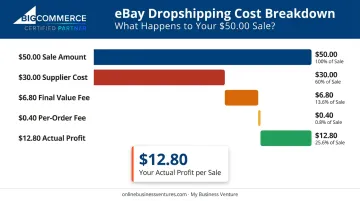
Add a $0.35 insertion fee if you've exceeded 250 listings, and profit drops to $12.45. A 2% Promoted Listings rate cuts another $1.00, bringing take-home closer to $11.45 on that same sale.
Pros and Cons of eBay Dropshipping
Advantages
- Built-in audience: eBay had 136 million active buyers as of Q1 2026 and 2.5 billion live listings — organic traffic comes with the platform
- Low startup cost: No inventory purchase required; you only pay the supplier when you make a sale
- 250 free listings monthly: Test products without immediate fee exposure
- Established buyer trust: Buyers already feel secure transacting on eBay, reducing conversion friction for new sellers
The advantages are real — but so are the structural limits that trip up most new sellers.
Disadvantages
- Fee compression: The 13.6% final value fee plus per-order charges eat into every sale — low-priced items can yield near-zero margins
- High competition: Millions of listings mean price wars are constant in popular categories
- Selling limits for new accounts: eBay caps item count and total listed value; limits lift gradually as you build a track record, regardless of how fast you want to scale
- No brand ownership: All buyers transact within eBay's platform. You cannot market to them outside the platform, collect their email addresses, or build a customer database
- Supplier dependency: Slow shipping, stock errors, or quality problems damage your seller rating — even though the failure is entirely outside your control
Common Challenges and Misconceptions
Common Challenges and Misconceptions
The Retail Arbitrage Myth
Many beginners assume any dropshipping source is acceptable. It isn't. Buying from Amazon or Walmart after an eBay sale — retail arbitrage — is explicitly prohibited and actively detected by eBay. This ban covers any retailer or marketplace, not just the obvious names.
The Margin Squeeze
Starting with a low-priced item ($15–$20 range) often produces negative margins. The fees stack up fast:
- 13.6% final value fee on the total sale price
- $0.40 per-order transaction fee
- Insertion fees on listings above your monthly free allotment
Plan your pricing from the fee structure outward, not the other way around.
The Volume Misconception
New sellers sometimes list hundreds of products immediately, expecting faster growth. eBay's algorithm doesn't reward raw listing count — it rewards consistent on-time shipping, low defect rates (under 2%), and positive feedback.
eBay evaluates performance monthly. A spike of late shipments or unresolved cases can drop your account below standard faster than any volume increase helps.
Alternatives to eBay Dropshipping
eBay's built-in audience is genuinely valuable, but its fees, policy constraints, competition, and zero brand ownership aren't the right fit for every entrepreneur. The best channel depends on what you're building toward.
Your Own Branded E-Commerce Store
Owning your storefront changes the economics entirely. No final value fee on every transaction. No platform deciding who sees your listings. Full control over pricing, customer data, and brand identity.
This is where solutions like My Business Venture (MBV) offer a clear alternative. MBV provides turn-key e-commerce stores built on BigCommerce, pre-loaded with 2,500+ curated products from a catalog of 1M+ items, with blind dropshipping fulfilled under your brand name. Profit margins run 35–200% on most products — and because there's no marketplace fee structure cutting into every sale, more of that margin stays with you.
MBV packages (from $3,995 one-time) include:
- One-on-one business coaching and MBV University training
- SEO and digital marketing tools
- Automated inventory syncing and merchant account setup
- Full ownership of your customer data for email lists and repeat promotions
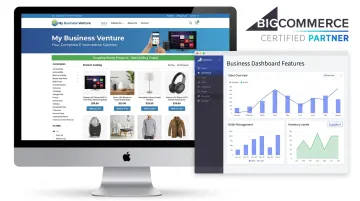
That last point matters most. On eBay, the customer belongs to the platform. With your own store, you build relationships — and equity — that compound over time.
Amazon and Other Marketplace Alternatives
Amazon offers larger traffic volume and Prime eligibility, but referral fees vary sharply by category:
- Consumer electronics: 8%
- Home and kitchen: 15%
- Amazon device accessories: up to 45%
FBA fulfillment adds another cost layer on top. Etsy suits handmade, vintage, or artisan products well — 6.5% transaction fee plus $0.20 per listing — but it's a narrow, highly specific audience.
All marketplaces share the same structural limitation: you're building traffic for the platform, not yourself.
Multichannel Selling
That limitation is exactly why experienced sellers often run an eBay store for audience access while simultaneously building their own branded storefront for margin and equity. Selling across channels protects you against marketplace policy changes, fee increases, and account risks. MBV explicitly supports this — clients can sell on eBay and Amazon alongside their branded store, and MBV provides a Selling Resources Guide to help. Free shipping, however, applies only to orders through your MBV store, so pricing on external channels needs to account for that.
This multichannel approach is a more advanced strategy, best pursued once you've validated your product niche and understand your customer base.
Frequently Asked Questions
Is dropshipping on eBay worth it?
For sellers who identify a strong niche, maintain reliable supplier relationships, and price carefully around the fee structure, eBay can generate consistent income. The challenge is that margins are thin and competition is heavy — it works best when you treat it as one channel, not your entire business.
How much can you earn per month dropshipping on eBay?
Earnings vary too widely for a reliable benchmark. Listing volume, product selection, fee management, and account health all move the needle significantly. Part-time sellers in competitive categories often struggle to clear meaningful profit; those in tighter niches with optimized listings tend to do considerably better.
What does eBay allow and prohibit for dropshipping?
eBay allows dropshipping when you have a prior agreement with a wholesale supplier. It prohibits purchasing from any retailer or marketplace after a sale occurs. Violations can result in listing removal, account restrictions, or permanent suspension.
What fees should eBay dropshippers expect?
Plan for the 13.6% final value fee on most categories, a $0.40 per-order fee (orders over $10), and insertion fees of $0.35 per listing beyond the 250 free monthly allotment. Store subscriptions and Promoted Listings are additional optional costs.
Can I dropship from Amazon or Walmart to eBay?
No. This is explicitly prohibited under eBay's policy. Purchasing from a retailer after a sale constitutes retail arbitrage, which eBay detects and penalizes with account restrictions or suspension.
What are the best alternatives to eBay dropshipping?
Your own branded e-commerce store offers the highest margin potential and full customer ownership. Amazon reaches more buyers but carries higher complexity and fees. A multichannel approach — your own store plus marketplace listings — gives you both audience access and long-term brand equity.