Introduction
Picture this: you've decided to start an online business. You know you want to sell something, but which products? To whom? Against which competitors? These questions all lead back to one foundational concept — the product market you're entering.
Many aspiring entrepreneurs skip this step entirely, then wonder why sales are flat or margins are thin. Understanding the product market you're targeting is what separates a calculated launch from a costly guess.
This article covers everything you need to know: the economic definition of a product market, the four main types, real-world examples across major industries, and why this knowledge matters before you spend a single dollar on inventory or ads.
Worth clarifying upfront: product market and product marketing are not the same thing. A product market is an economic space where goods and services are bought and sold. Product marketing is a business discipline focused on positioning and launching products within that space. This article covers both — and where they overlap.
Key Takeaways
- A product market is the economic environment where buyers and sellers exchange final goods or services.
- The four market types — perfect competition, monopolistic competition, oligopoly, and monopoly — each carry different pricing and competitive implications.
- Every product market shares four core components: target audience, competing sellers, product features, and pricing dynamics — understanding each helps you compete smarter.
- Identifying your product market before launching helps you spot demand gaps and avoid oversaturated spaces.
- Platforms like My Business Venture let entrepreneurs enter established product markets quickly — with a fully stocked store ready to sell, no product development required.
What Is a Product Market? Definition and Meaning
A product market is the economic marketplace where finished goods and services are traded between suppliers (businesses) and buyers (consumers). It's not a physical location — it's the commercial environment surrounding a specific category of products or services within an economy.
As OpenStax defines it, firms sell what they produce in this market, and households buy it. Supply and demand do the heavy lifting: businesses set prices based on market conditions, while consumers decide what to buy based on need, price, and value. That interaction determines what gets produced, at what price, and in what quantity.
Product Market vs. Factor Market
These two market types form the backbone of any economy's circular flow:
| Market Type | What's Exchanged | Who Sells | Who Buys |
|---|---|---|---|
| Product market | Finished goods and services | Businesses | Consumers |
| Factor market | Labor, land, and capital | Households | Businesses |
In simple terms: factor markets supply the inputs; product markets distribute the outputs.
The Role of Regulation
Product markets exist on a spectrum of regulatory oversight. Where a product falls on that spectrum changes everything about how a business operates:
- Lightly regulated (for example, general retail): Businesses mainly need state and local licenses to operate.
- Heavily regulated (for example, pharmaceuticals): New drugs require FDA approval before they can be sold. Nuclear energy requires NRC licensing before a reactor goes online.
Regulation shapes how businesses enter a market, how they price products, and who they can sell to — all of which affect competitive dynamics.
Product Market vs. Product Marketing
These terms get mixed up often. Here's the distinction:
- Product market = economic concept describing where goods are bought and sold
- Product marketing = business function focused on positioning, messaging, and launching a product within that market
For entrepreneurs, the sequence matters: you need to understand the product market you're entering before you can make smart decisions about how to position or promote what you're selling.
What Are the 4 Types of Product Markets?
Product markets differ based on how many sellers exist, how similar their products are, and how much pricing power any single seller holds. Identifying which type your business operates in shapes every strategic decision you'll make.
Perfect Competition
In a perfectly competitive market, many sellers offer identical or nearly identical products. No single seller can influence the price — they're all "price takers." Competition drives prices down to the cost of production.
Example: Wholesale agricultural commodities like wheat and corn approximate this structure. One farmer's wheat is indistinguishable from another's, and no individual grower controls the market price.
Monopolistic Competition
Here, many sellers compete but offer differentiated products — similar in category, distinct in brand, quality, or features. Sellers have some pricing power because consumers perceive differences between offerings.
Example: The restaurant industry, clothing market, and consumer accessories market. Your favorite coffee shop and the one next door sell coffee, but their atmosphere, branding, and recipes differ enough that customers make active choices between them.
Oligopoly
An oligopoly is dominated by a small number of large sellers. Each firm's decisions directly affect the others, and high barriers to entry limit new competition. When one player moves on price or strategy, the others respond — pricing behavior is inherently interdependent.
Example: The U.S. airline industry. According to the Department of Justice, American, Delta, Southwest, and United control approximately 75% of the domestic market. The GAO documents their scale advantages in airport access and loyalty programs as significant entry barriers for smaller carriers.
Monopoly
A monopoly exists when a single seller controls the supply of a product with no close substitutes. That seller holds significant pricing power. Monopolies typically arise from patents, government regulation, or control of a critical resource.
Example: A regional utility provider often holds a government-sanctioned monopoly within its service territory. Patent protections create similar conditions for pharmaceutical manufacturers, giving a drug maker exclusive pricing control until the patent expires and generics enter the market.
How the Four Types Compare
| Market Type | Number of Sellers | Product Differentiation | Pricing Power | Entry Barriers |
|---|---|---|---|---|
| Perfect Competition | Many | None (identical) | None | Very low |
| Monopolistic Competition | Many | High (brand, quality) | Limited | Low |
| Oligopoly | Few | Varies | Significant | High |
| Monopoly | One | No substitutes | Full | Very high (or regulatory) |
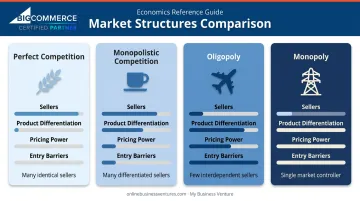
Most e-commerce businesses — including dropship retailers and branded online stores — operate in monopolistic competition. Products are widely available elsewhere, so differentiation through branding, customer experience, and niche selection is what determines who wins.
Real-World Examples of Product Markets
The Consumer Electronics Market
Consumer electronics — smartphones, laptops, tablets — represent monopolistic competition edging toward oligopoly in key submarkets. IDC data from Q1 2026 shows Samsung at 21.2% and Apple at 21.0% of global smartphone shipments, with Xiaomi, OPPO, and Vivo trailing. Five brands account for over 70% of the market.
Competition runs on features, design, and ecosystem lock-in rather than price alone. Apple spent $34.55 billion on R&D in FY2025 — roughly 8% of its $416 billion in net sales — illustrating the scale newcomers would need to match just to compete meaningfully on innovation.
The Online Retail Market
E-commerce is one of the most accessible product markets for first-time entrepreneurs today. U.S. Census data shows seasonally adjusted retail e-commerce sales hit $326.7 billion in Q1 2026, up 9.8% year over year, representing 16.9% of all retail sales.
The market spans categories from home goods to apparel to electronics, traded through digital storefronts at every scale. Entry barriers are lower than in traditional retail:
- No physical storefront costs or lease commitments
- No warehousing requirements under a dropship model
- Turnkey platforms (like MyBusinessVenture) let entrepreneurs launch fully stocked stores within days
Platform dependence, search visibility, and trust-building remain real challenges — but the structural cost advantages over brick-and-mortar retail are substantial.
The Pharmaceutical Market
The pharmaceutical market is heavily regulated and segmented into distinct sub-markets with different competitive dynamics:
- Branded drugs: Patent protection creates temporary pricing power; heavy R&D investment required
- Generics: Generics account for 9 of every 10 prescriptions filled, competing primarily on price
- OTC products: Different regulatory pathway, broader consumer access, price-sensitive competition
U.S. net medicine spending reached $606 billion in 2025, up 10.6% from the prior year. Branded drugs, generics, and OTC products all operate under this one umbrella — each with entirely different cost structures, competitive pressures, and pricing power.
The Food and Beverage Market
Few markets illustrate the range of competitive structures better than food. Total U.S. food spending reached $2.51 trillion in 2025 — $1.10 trillion at home and $1.41 trillion away from home.
Within that single figure:
- Bulk commodity grains operate close to perfect competition (price-taking farmers, identical products)
- Organic produce, specialty beverages, and premium food brands operate under monopolistic competition (differentiated products, brand loyalty, premium pricing)
- Organic retail sales alone reached an estimated $65.4 billion in 2024
Consumer trends continuously reshape sub-market boundaries. Health consciousness and sustainability aren't just preferences — they're forces that shift which products sell, at what price, and through which channels.
Key Components of a Product Market
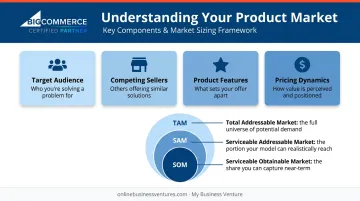
Every product market, regardless of industry, shares four defining components:
- Target audience — Who the buyers are, what drives their decisions, and how they evaluate options
- Competing sellers — How many rivals exist, how they differentiate, and what their pricing looks like
- Product features — What attributes define offerings in this market and what buyers actually value
- Pricing dynamics — How prices are set, what consumers will pay, and how competitive pressure compresses or expands margins
Assessing Market Size Before You Enter
Beyond these four components, market size and growth potential determine whether there's room for a new entrant to thrive. A useful framework from Wharton professor Karl T. Ulrich breaks this down:
| Layer | What It Measures |
|---|---|
| TAM (Total Addressable Market) | The full value of the opportunity if you served every potential buyer |
| SAM (Serviceable Addressable Market) | The portion you can realistically reach with your model |
| SOM (Serviceable Obtainable Market) | What you can actually capture in the next 24–36 months |
The SBA recommends assessing demand, customer count, market saturation, and competing prices as part of any pre-launch market evaluation.
External Forces That Reshape Markets
Markets shift — sometimes quickly — when external forces intervene:
- Regulation changes — FDA approval requirements, trade policy, or emissions standards can open or close markets overnight
- Technology shifts — Global EV sales exceeded 20 million in 2025, up 20% year over year, driven by battery economics, government incentives, and changing consumer attitudes
- Consumer trends evolve — Health, sustainability, and convenience reshape what buyers want and what they'll pay for it
The EV market is a good example: entrepreneurs who tracked battery cost curves and policy incentives early had years to position before mainstream adoption made the opportunity obvious.
Why Product Markets Matter for Entrepreneurs
Understanding your product market isn't optional research — it's foundational due diligence. Without it, you risk entering an oversaturated space, pricing incorrectly, or building something consumers don't actually want.
Among VC-backed startups that shut down since 2023, CB Insights found that 43% of those failures were attributed to poor product-market fit — meaning the product didn't match genuine market demand. While that figure applies specifically to venture-backed companies, the underlying principle holds for any new business.
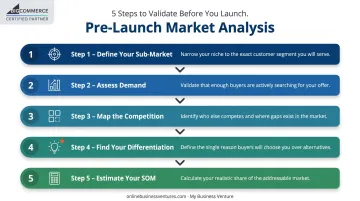
A Practical Market Analysis Process for Beginners
Before launching, work through these steps:
- Define your sub-market — "E-commerce" is too broad. "Home office accessories under $100" is actionable.
- Assess demand — Are people actively searching for and buying this? Use search data, marketplace listings, and sales rank data.
- Map the competition — Who's already selling this? What do they charge? Where do they fall short?
- Find your differentiation — Price, selection, branding, niche focus, or customer experience. You need at least one real advantage.
- Estimate your SOM — How many buyers can you realistically reach in the first year with your current resources?
How My Business Venture Helps You Skip the Build Phase
Executing all five steps above takes time — and for many first-time entrepreneurs, building the infrastructure to sell comes before they ever reach the marketing stage. That's where having a ready-made entry point changes the equation.
My Business Venture (MBV) has helped aspiring entrepreneurs launch online stores since 1992. Their packages give you a pre-built foundation so you can focus on the market strategy steps above from day one:
- A fully built, BigCommerce-powered online store that goes live within days
- Pre-loaded access to 2,500+ curated products across major consumer categories
- Product margins ranging from 35–200%, with no inventory required
- One-on-one consulting, MBV University training, and ongoing marketing support
Package tiers start at $3,995 (Enterprise), with the Premier ($4,995) and Millennium ($5,995) options adding expanded marketing tools, lifetime SEO submission, and advanced training. If you've identified your sub-market, MBV removes the infrastructure hurdle so you can start reaching buyers faster.
Frequently Asked Questions
What is the meaning of product marketing?
Product marketing is the business discipline of positioning, messaging, and launching a product to its target audience. It's distinct from a "product market," which is the broader economic space where goods and services are bought and sold. One is a function within a company; the other is an external economic environment.
What are the 4 types of product markets?
The four types are: perfect competition (many sellers, identical products, no pricing power), monopolistic competition (many sellers, differentiated products, limited pricing power), oligopoly (few dominant sellers, high barriers to entry), and monopoly (single seller with significant pricing control).
What is an example of a product market?
The online retail market, the smartphone market, and the pharmaceutical market are all product markets — spaces where multiple buyers and sellers exchange goods within a competitive, often regulated environment.
What is the meaning of product concept in marketing?
The product concept is a marketing philosophy where companies believe consumers prefer products offering the best quality, performance, or innovative features. Businesses operating under this concept focus heavily on product improvement as their primary competitive strategy — often at the risk of overlooking what buyers want.