Introduction
Stickers are a genuinely surprising business category. The global custom-printed sticker market was valued at $1.6 billion in 2024 and is projected to reach $2.9 billion by 2030 — a 10.4% compound annual growth rate according to Grand View Research. That growth spans age groups, interests, and use cases — this is a mainstream product category, not a hobbyist corner of the internet.
Print on demand stickers have attracted a wave of entrepreneurs who want a piece of that market without committing to inventory, minimum orders, or upfront production costs. You design it, a supplier prints and ships it, and you never touch a single sticker. The model removes most of the traditional friction of starting a product business.
Margins on individual stickers are thin. Traffic doesn't appear overnight. And "low barrier to entry" means you're competing with thousands of other sellers from day one.
This guide walks through the full picture: what POD stickers actually are, what profitable selling looks like in practice, and how to build a storefront that holds up in 2026.
Key Takeaways
- POD stickers are printed only after a customer orders — no inventory, no upfront production cost
- The broader custom-sticker market is growing at 10.4% annually, reaching a projected $2.9B by 2030
- Margins on single stickers are thin ($1–$3 per sale); bundles and themed packs are where profitability improves
- Etsy gives immediate access to 86.5M active buyers; your own store builds better long-term brand equity
- Long-term success depends on consistent design output, listing optimization, and steady marketing effort
What Are Print on Demand Stickers?
Print on demand stickers are custom-designed stickers produced only when a customer places an order. A third-party supplier handles printing, cutting, and shipping directly to the buyer. You never hold physical inventory or manage fulfillment.
Sticker Types Worth Knowing
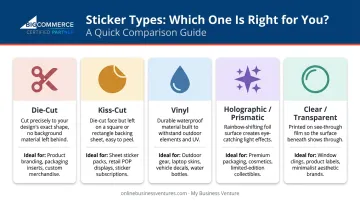
Before you design anything, it helps to know what formats you're working with — each appeals to a different buyer and use case:
- Die-cut stickers — cut precisely to the shape of your design; no border, no wasted backing, sharp edges that follow the design outline
- Kiss-cut stickers — the sticker layer is cut but the backing isn't, leaving a border; easy to peel and often sold as sheets
- Vinyl stickers — durable and weather-resistant; popular for laptops, water bottles, and outdoor use
- Holographic/prismatic stickers — reflective finishes that catch the eye; command premium pricing in fashion and gift niches
- Clear/transparent stickers — blend onto glass, bottles, or packaging seamlessly
Why POD Differs from Traditional Printing
Traditional sticker printing requires bulk orders (typically 100+ units minimum) and upfront payment before you know what sells. With POD, there are no minimums. You can list a design today, remove it next week, and add ten new ones the following month, all without spending a dollar upfront. That's a meaningful difference if you're testing ideas before committing to a product line.
What to Know Before You Start
Realistic expectations prevent early burnout. Here's what the business actually looks like in practice.
Income Timeline
Most new POD sticker sellers don't generate meaningful income in the first 30 to 60 days. Early traction depends on listing volume, Etsy SEO, and the patience to build traffic over months. Sellers who treat the first 90 days as a design and learning phase — not a revenue phase — tend to stick with it long enough to see results.
The Profitability Reality
Per-unit margins on single stickers are slim. Printify's custom sticker catalog starts from $1.21 per unit (pricing varies by product, provider, size, and plan). Printful's sticker catalog runs approximately $2.20–$5.05 depending on size and product type.
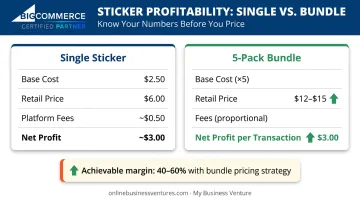
A simple example based on Shopify's illustrative pricing framework:
| Item | Cost |
|---|---|
| POD base cost | $2.50 |
| Retail price | $6.00 |
| Platform/transaction fees | ~$0.50 |
| Estimated profit | ~$3.00 |
Printful's guidance suggests stickers can achieve 40–60% margins with smart pricing — but this is guidance, not a guaranteed average. Bundles and themed packs are where real profitability lives. A 5-pack priced at $12–$15 generates better margin per transaction and higher average order value.
What Running This Business Actually Requires
Margins make more sense once you account for the time investment. This is an active business — day-to-day, you'll be:
- Creating new designs consistently
- Managing listings and updating SEO
- Responding to customer questions
- Analyzing which designs sell and why
You don't need professional design skills to start. Canva handles beginner-friendly design work; Adobe Illustrator and Procreate serve more advanced creators.
How to Make Print on Demand Stickers
Making POD stickers involves two phases: design creation and supplier setup. Getting both right before you list publicly saves significant time later.
Step 1: Choose Your Sticker Type and Material
Match your format to your target buyer:
- Vinyl die-cuts — best starting point for most sellers; durable, clean, suitable for everyday surfaces
- Kiss-cut sheets — well-suited for planner communities and journaling niches
- Holographic finishes — justified for fashion, gift, or premium aesthetic niches where buyers expect to pay more
- Matte finishes — pair well with minimalist, botanical, or desk-accessory aesthetics
- Clear stickers — effective for packaging decoration, bottles, and glass applications
Choose your format first — it shapes both your file setup and your target audience.
Step 2: Design Your Stickers
Core design principles for stickers that sell:
- Keep designs visually simple and bold — stickers are small, detail gets lost
- Use high-contrast colors; avoid muddy or low-saturation palettes
- Minimize text and make sure it's legible at 2 inches wide
- Match your aesthetic to the niche you're targeting, not generic appeal
Technical file requirements (best practices):
- Target 300 DPI — Printify recommends this as best practice, though its minimum for JPEG/PNG is lower; Printful requires at least 300 DPI for sticker files
- Export as PNG for transparent backgrounds
- Maintain adequate bleed per your supplier's specific guidelines — Printful recommends keeping 0.25 inches between objects that will be cut separately
- Always check your specific supplier's product page for SKU-level requirements before uploading
Stickers targeting a specific community — teachers, plant parents, gamers, dog breeds, hiking trails — consistently outperform generic designs. Start with 10–20 focused designs in one niche rather than 100 scattered across categories.
Step 3: Select a Print on Demand Supplier
What to evaluate when choosing a supplier:
- Sticker-specific product options (die-cut, kiss-cut, clear, holographic)
- Print quality and adhesive durability
- Integration with your selling platform
- Production turnaround time
- Pricing structure and per-unit cost
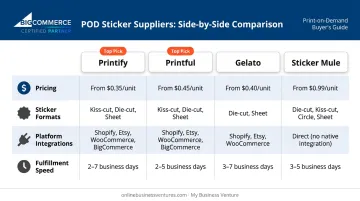
Four suppliers worth considering:
| Supplier | Key Details |
|---|---|
| Printify | From $1.21/unit; die-cut, kiss-cut, sheets, decals; no MOQ; integrates with Etsy, Shopify, WooCommerce; ships within 2–7 business days |
| Printful | ~$2.20–$5.05/unit; kiss-cut, holographic, sheets; no MOQ; integrates with Shopify, Etsy, WooCommerce, Amazon, others; 2–5 day average fulfillment |
| Gelato | Strong global fulfillment network; publicly verified standalone consumer sticker SKUs were limited at time of writing — confirm current catalog before committing |
| Sticker Mule | Core service requires 10-unit minimum per design — not a standard Etsy/Shopify POD integration; its separate Stores program operates within the Sticker Mule marketplace |
Order samples before listing publicly. A $10–$20 sample order reveals color accuracy, adhesive strength, and cut precision. Skipping this step leads to customer complaints that damage your store's reputation.
How to Sell Your Print on Demand Stickers
Production is only half the equation. How you present, price, and promote your stickers determines whether the business generates real income.
Step 4: Choose Your Selling Platform
Marketplaces (Etsy, Redbubble):
- Etsy reported 86.5 million active buyers in 2025 — immediate access to an enormous existing audience
- Fees include a $0.20 listing fee, 6.5% transaction fee, and US payment processing of 3% + $0.25 per transaction
- Limited branding control; heavy competition in sticker categories
- Redbubble calculates artist margin as base price × markup percentage — a 20% markup on a $20 base price yields $4 before account fees
Your own branded store:
- Full control over branding, pricing, and customer relationships
- Shopify integrates directly with Printful and Printify via dedicated apps
- Requires you to build your own traffic — no built-in audience
Entrepreneurs who want a complete branded storefront without stitching together platforms themselves have another option: My Business Venture (MBV) builds fully operational BigCommerce-powered stores in days, including custom logo design, domain setup, and SEO tools — with one-on-one consulting included across all package tiers ($3,995–$5,995 one-time). Call 1-800-639-6644 to discuss which package fits your goals.
The most common path: Start on Etsy to validate which designs actually sell, then build your own store once you have proven products and a recognizable brand identity.
Regardless of platform, optimize your listings:
- Use keyword-rich titles and descriptions based on what buyers actually search
- Include mockup photos showing stickers applied to real surfaces (laptops, water bottles, journals, notebooks)
- Organize designs into clear collections or categories
Step 5: Price for Profit
A simple pricing framework:
POD base cost + estimated shipping component + desired margin = retail price
Targeting 2–3× your base cost as a starting retail price is a reasonable baseline. For a sticker with a $1.50 base cost, that suggests a $4–$5 retail price. At $2.50 base, target $6.
Bundles are where the numbers improve:
- A 5-pack at $12–$15 generates better margin per transaction than five individual sales
- Themed sets (e.g., "Plant Mom Bundle," "Gamer Pack") encourage larger cart sizes
- Specialty finishes — holographic, waterproof-certified — justify higher price points
- Free shipping thresholds (e.g., free shipping on orders over $15) increase average order value
Step 6: Market and Grow
Most effective channels for sticker sellers:
- Pinterest — long-tail organic reach; design-forward content performs well and drives traffic months after posting
- TikTok and Instagram Reels — sticker unboxings, design process videos, and "how I made this" content generate discovery; a 2025 TikTok Shop study found 83% of shoppers discovered a product through the platform
- Etsy SEO — Etsy's search algorithm factors in query matching, listing quality, recency, and customer service history; keyword optimization is the single most impactful activity for new Etsy sellers
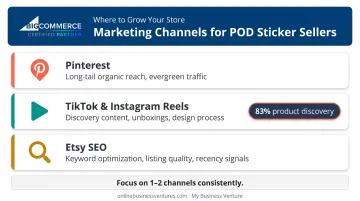
Pick one or two channels and be consistent. Spreading effort across five platforms at once typically means none of them get enough attention to build an audience.
Building repeat business:
- Maintain a consistent visual style across your shop — coherent identity builds recognition faster than variety
- Add a thank-you card or freebie sticker in orders (even a digital insert included in fulfillment notes) as a low-cost retention tool
- Track which designs generate repeat buyers and expand in those directions
Conclusion
Selling print on demand stickers is a an accessible business model — low startup cost, no inventory exposure, and a product category with consistent, growing demand. But accessible doesn't mean automatic. The sellers who build lasting income here treat it like a business: they track what sells, refine based on real feedback, and add to their design library regularly rather than launching once and waiting.
The fundamentals aren't complicated. Find a niche you can serve well, create designs that speak to that community, price with real margins in mind, and show up consistently on the marketing channels where your buyers spend time. Apply that consistently over months, not weeks — and the design library you build today becomes the revenue base that compounds tomorrow.
Frequently Asked Questions
Is selling print-on-demand stickers profitable?
Yes, POD stickers can be profitable — especially when sold as bundles or themed packs rather than individual units. Printful's guidance suggests sticker margins of 40–60% are achievable with smart pricing. Volume and repeat buyers are what drive meaningful income over time.
What kinds of print-on-demand stickers sell best?
Niche-focused designs with a distinctive visual style consistently outperform generic options. Popular categories include cute animals, motivational quotes, hobby-specific designs (plants, gaming, pets, teaching), and seasonal collections. Die-cut vinyl stickers are among the best-selling formats due to their durability and clean presentation.
Is Shopify good for selling print-on-demand stickers?
Shopify integrates directly with POD apps like Printful and Printify and gives full control over branding and pricing — making it ideal for building a long-term brand with proven designs. If you need immediate buyer traffic without building your own audience first, Etsy is the better starting point.
Are there print-on-demand services for stickers?
Yes — several platforms specialize in or offer sticker products. Printify and Printful are the most widely used for Etsy and Shopify sellers, handling printing, cutting, and shipping automatically.
How much does it cost to start a print-on-demand sticker business?
Startup costs can be as low as $0–$50 using free tools like Canva and a free POD account. The main early investment is time for design and listing creation. Budget $10–$20 for sample orders before going live — verifying print quality before your first customer order ships is worth every dollar.
How do I price my print-on-demand stickers for profit?
Start with your POD base cost, add your share of shipping costs, then apply a markup targeting at least 2–3× the base cost. A sticker with a $2.50 base cost should retail around $6 to generate a workable margin after platform fees. Bundles and specialty finishes (holographic, waterproof) are the most reliable ways to improve per-transaction profitability.