This guide gives you a realistic look at how it works, what you'll actually keep after fees, and what separates shops that grow from ones that stall.
Key Takeaways
- Etsy permits POD when designs are original and the production partner is disclosed in listings
- Profit margins typically land between 20–40%, but Etsy's stacked fees eat into that fast
- Generic designs compete on price; niche-specific, personalized products compete on relevance
- SEO-optimized listings, strong imagery, and Pinterest or TikTok traffic drive consistent sales
- Etsy works best as a launchpad — serious sellers eventually benefit from an independent storefront
How Print on Demand Works on Etsy in 2026
The model is simple: you create original designs, list products on Etsy, and a third-party fulfillment partner — Printful, Printify, or Gelato — prints, packages, and ships directly to your customer. You never touch inventory.
All three major platforms offer direct Etsy integrations. When a sale is made, the order routes automatically to your fulfillment partner without any manual work on your end.
Etsy does enforce clear rules about how POD shops operate:
- Products must feature your original designs — not generic wholesale items resold as handmade
- You must disclose your production partner in applicable listings (name, location, and a brief description of the partnership)
- AI-generated designs are permitted if they're based on your original prompts, but must be disclosed in the listing description
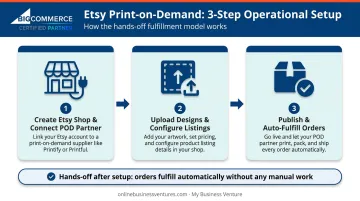
Once you're set up and compliant, the operational flow is largely hands-off:
- Create your Etsy shop and connect your POD partner
- Upload your designs and configure product listings
- Publish — orders trigger automatic fulfillment from that point on
Is Etsy POD Profitable? An Honest 2026 Answer
The short answer is yes — with significant caveats.
CNBC reviewed documents showing one Etsy POD seller generated $220,300 in gross revenue in 2023 using Printify, estimating a net profit of roughly 30% while working about 10 hours per week. A separate seller reported a $100,900 peak month, retaining approximately one-third as net profit. These are real, verified numbers — but they reflect high-performing outliers, not typical results.
So what separates those top earners from shops that barely break even?
What Actually Drives Profitability
Four variables determine whether your shop makes money:
- Niche specificity: Serve a defined audience rather than competing broadly in saturated categories
- Viable margins: Price with all costs factored in before you set a retail number — not after
- A real differentiator: Personalization, niche relevance, or design quality that generic shops can't match
- Reliable fulfillment: A partner whose quality and shipping times won't generate refund requests
A Realistic Margin Example
Using Printful's published Bella+Canvas 3001 production costs, here's what a sale actually looks like:
| Sale Price | Listing Fee | Transaction (6.5%) | Processing (3% + $0.25) | Net Before Production | Net After Production ($14–$24) |
|---|---|---|---|---|---|
| $30.00 | $0.20 | $1.95 | $1.15 | $26.70 | $2.38–$12.48 |
| $35.00 | $0.20 | $2.28 | $1.30 | $31.23 | $6.91–$17.01 |
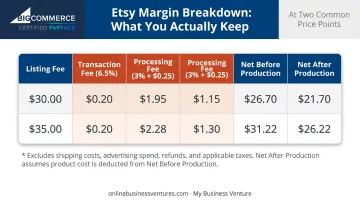
Shipping, ad spend, refunds, and income tax aren't included above. Add those and the margin compresses further — which is exactly why pricing strategy matters so much.
Pros and Cons of Etsy POD
Advantages:
- No inventory risk — zero upfront product cost
- Low barrier to entry; test designs without manufacturing commitments
- Etsy had 86.5 million active buyers as of 2025, providing built-in demand
- Order volume can grow without you managing logistics — your fulfillment partner handles it
Disadvantages:
- Per-item margins are thinner than bulk manufacturing
- No ownership of the customer relationship or email list — Etsy owns that
- Platform risk: algorithm changes and account suspensions are real threats
- Intense competition, especially in broad categories like "funny shirts" or "inspirational quotes"
- Limited control over fulfillment quality and shipping times
Breaking Down Etsy Fees and What They Mean for Your Margins
Fees are the most common profitability blind spot for new POD sellers. Many calculate margins against production cost alone, then discover that Etsy's cut shrinks what's left significantly.
Core fees for US-based sellers in 2026:
- $0.20 listing fee per item — renews every four months or after a sale
- 6.5% transaction fee on the full listing price, including shipping charged to the buyer
- 3% + $0.25 payment processing fee per order, applied to item price, shipping, and tax
Offsite Ads — the fee most sellers don't budget for:
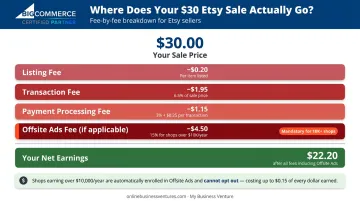
- Shops under $10,000 in annual Etsy revenue: 15% on attributed sales, opt-out available
- Shops at or above $10,000: 12%, mandatory for life, capped at $100 per order
Fee Breakdown on a $30 Sale
| Fee | Amount |
|---|---|
| Listing | $0.20 |
| Transaction (6.5%) | $1.95 |
| Processing (3% + $0.25) | $1.15 |
| Total core fees | $3.30 |
| Net before production | $26.70 |
| With Offsite Ad (15%) | Additional $4.50 = $22.20 before production |
Build every fee, including a potential Offsite Ad, into your retail price before you publish a listing. Sellers who treat fees as post-sale deductions rather than pre-pricing inputs are the ones who sell at volume and still lose money.
How to Make Etsy POD More Profitable in 2026
Niche Down Relentlessly
Broad categories compete on price. Specific niches compete on relevance — and relevance wins on Etsy.
Instead of "funny t-shirts," think:
- Marathon runner humor — a defined community with shared vocabulary and gift-giving occasions
- First-time grandparent gifts — high emotional purchase intent, limited competition versus "grandparent gifts"
- Occupation-specific apparel — ER nurses, school counselors, wildland firefighters — people who rarely find products that speak directly to their role
That specificity drives better SEO, higher conversion rates, and a price premium — because the product actually fits the buyer's identity.
Prioritize Personalization
Approximately 33% of Etsy sales involve personalized or customized products, according to data attributed to LinkMyBooks. That number reflects something real: Etsy buyers are often shopping for gifts, and a personalized product removes the "will this feel generic?" hesitation that kills conversions.
Custom names, dates, roles, and event-specific text all command higher prices and differentiate your listing from every stock-design competitor. All major POD platforms support personalization workflows that integrate directly with Etsy.
Optimize Listings for Etsy SEO
Your titles, tags, and descriptions should reflect how buyers actually search — not how you'd describe the product to a friend.
Lead with the most specific traits first: occasion, recipient, item type. "Personalized Mug for Dog Mom — Custom Name Coffee Cup Gift" outperforms "Cute Dog Mug" because it answers the buyer's specific query. Review your listing analytics regularly and rewrite low-converting listings before adding new ones.
Invest in Lifestyle Imagery
White-background mockups are the baseline. Lifestyle photos showing your product in real context — worn by a real person, displayed in an actual kitchen, held by someone who looks like your buyer — reduce hesitation and justify higher prices.
Order samples. Shoot your own photos. The cost is recoverable in the margin improvement that comes from a listing that converts better and commands a premium.
Build Marketing Beyond Etsy's Algorithm
Relying solely on Etsy search is fragile. Algorithm changes, increased competition, and Etsy's own promoted listings can shift your visibility overnight.
Add one or two external channels:
- Pinterest for gift and home decor discovery — Etsy even recommends pinning as a way to reach new customers
- TikTok for product demos and niche community content
- Email for repeat customer relationships (collect these outside Etsy wherever possible)
Higher conversion from external traffic also signals product quality to Etsy's own search algorithm, which considers click-through and purchase behavior when ranking listings.
Consider a Branded Store as You Scale
Etsy is an excellent place to validate designs and build sales volume with a built-in audience. But as your business grows, the limitations become more visible: you don't own the customer list, you're subject to Etsy's fee structure and policy changes, and your brand lives inside someone else's marketplace.
Sellers ready to move beyond those constraints often transition to an independent e-commerce store — where they own the customer relationship, control the full brand experience, and keep more of every sale. For entrepreneurs at that stage, My Business Venture (MBV) offers turn-key branded e-commerce stores built on BigCommerce, paired with business consulting and structured training through MBV University. MBV stores operate on a dropship model across gifts, home goods, electronics, and more — giving sellers who are ready to own their storefront and customer data a clear path to do exactly that.
Best Print-on-Demand Products to Sell on Etsy in 2026
Consistently Strong Categories
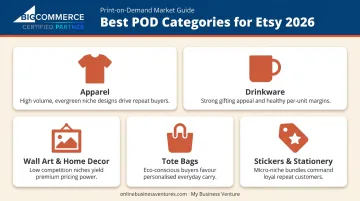
These product types perform reliably across niches when paired with targeted designs:
- Apparel — t-shirts, hoodies, sweatshirts (highest volume, competitive, niche-dependent)
- Drinkware — mugs, tumblers (strong gift appeal, personalization-friendly)
- Wall art and home decor — high visual impact, good margins on canvas prints
- Tote bags — lower price point, useful for testing niche designs quickly
- Stickers and stationery — low production cost, impulse purchase behavior
The product type alone doesn't make a listing succeed. The niche angle and design execution do.
Product + Niche Combinations That Work
Three combinations that convert well:
- Personalized mugs for teachers — milestone gift (end of school year, appreciation week), custom name and subject area, buyers willing to pay $25–$35
- Occupation-specific hoodies — nurse, firefighter, electrician — niche audiences with strong identity attachment and gift-buying occasions
- Pet-themed wall art — dog or cat breed-specific prints with personalized pet names drive emotional purchases and repeat buyers
Emerging Differentiation Opportunities
Two techniques gaining traction in 2026:
- Embroidery — visually distinct from standard DTG printing, commands higher perceived value, and Printful lists embroidered apparel and hats among best-selling Etsy categories
- All-over print (AOP) — bolder visual products that stand out in search results, though base costs are higher
Higher-cost products like premium hoodies and canvas prints can deliver strong absolute dollar profit even when the percentage margin looks similar to cheaper items. The math is simple: the same 30% margin on a $65 hoodie beats the same 30% on a $20 tee every time.
Frequently Asked Questions
Is print-on-demand on Etsy worth it?
Yes, for sellers who approach it seriously — with original niche designs, pricing that accounts for all fees, and consistent effort on listing quality and SEO. For sellers expecting passive income from generic designs, it's unlikely to produce meaningful results.
How much does Etsy take from a $1,000 sale?
For a US-based seller, core fees total $95.45 — covering the 6.5% transaction fee ($65), payment processing ($30.25), and listing fee ($0.20). Sales attributed to Offsite Ads add up to $100 more, bringing the total to $195.45 before production costs.
Can you make $10,000 a month on Etsy?
It's possible, and verified sellers have done it — but $10,000 in revenue is not $10,000 in profit once production costs, Etsy fees, and ad spend are deducted. Getting there requires high volume, strong margins, and a well-established shop reputation.
What are the best-selling print-on-demand products on Etsy?
Personalized mugs, niche-specific apparel, wall art, tote bags, and stickers are top performers. Success within any category comes from targeting a specific audience rather than competing on price across a broad one.
How much can a beginner realistically make with Etsy POD?
Most new sellers earn a few hundred dollars per month initially, with income growing as they add researched listings, improve SEO, and build shop reviews. Starting with that baseline and scaling gradually — rather than banking on full-time income from launch — is what separates sellers who stick with it from those who quit early.