Introduction
You've launched your online store. Traffic is coming in — maybe from a social post, a Google ad, or word of mouth. But the sales aren't following. Or maybe you're getting sales, but the same customers never come back.
This is one of the most common frustrations for new e-commerce entrepreneurs, and it usually comes down to one misunderstanding: mixing up the marketing funnel with the sales funnel.
These two frameworks aren't the same thing. Using the wrong one at the wrong stage wastes ad budget, burns time, and leaves revenue on the table.
Research from Google and Measure Protocol found that 8 in 10 U.S. online purchase journeys involve multiple touchpoints — meaning customers rarely buy on first contact. Which funnel you apply at each stage of that journey determines whether you capture those sales or lose them.
This guide breaks down both funnels side by side, explains where they differ, and shows exactly how they work together — so you can stop guessing and start building a system that converts, especially if you're an e-commerce or home-based business owner starting from scratch.
Key Takeaways
- The marketing funnel covers the full customer journey, from first awareness to repeat loyalty.
- The sales funnel focuses narrowly on converting qualified prospects into paying customers.
- Marketing funnels generate and warm up leads; sales funnels close them.
- Both funnels overlap, and a breakdown in one directly weakens the other.
- For solo e-commerce operators, understanding both helps you spend smarter and convert better.
Sales Funnel vs. Marketing Funnel: Quick Comparison
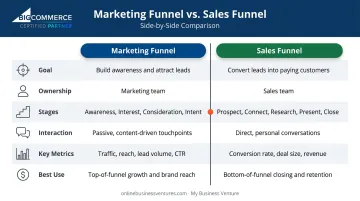
Both funnels serve different masters — here's how they stack up side by side:
| Marketing Funnel | Sales Funnel | |
|---|---|---|
| Primary Goal | Build awareness, generate and nurture leads | Convert prospects into paying customers |
| Who Owns It | Marketing team (content, ads, campaigns) | Sales team or automated conversion tools |
| Stages Covered | Awareness → Consideration → Loyalty | Discovery → Qualification → Conversion |
| Customer Interaction | Passive (content, ads, email exposure) | Direct (product pages, checkout, follow-up) |
| Key Metrics | Traffic, email opens, CTR, lead volume | Conversion rate, cart abandonment, CPA, CLV |
| Best Used For | Demand creation, brand building | Transaction completion, revenue generation |
The Handoff Point
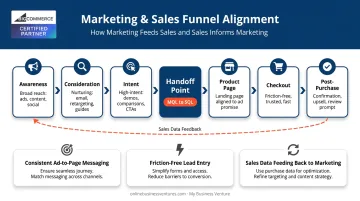
The critical transition happens when a marketing-qualified lead (MQL) becomes a sales-qualified lead (SQL). An MQL is someone engaged with your content but not yet ready to buy. An SQL has shown high-intent behavior — browsing a product page, adding to cart, or initiating checkout. That behavioral shift is the signal for the sales funnel to step in.
In e-commerce, this handoff is typically automated — no human sales rep needed to make it happen.
What Is a Marketing Funnel?
The marketing funnel maps the customer's entire journey — from the first time they hear about your brand to the point where they become loyal repeat buyers. It's broader than the sales funnel, focused on brand building, education, and lead generation rather than direct transaction.
The Core Stages
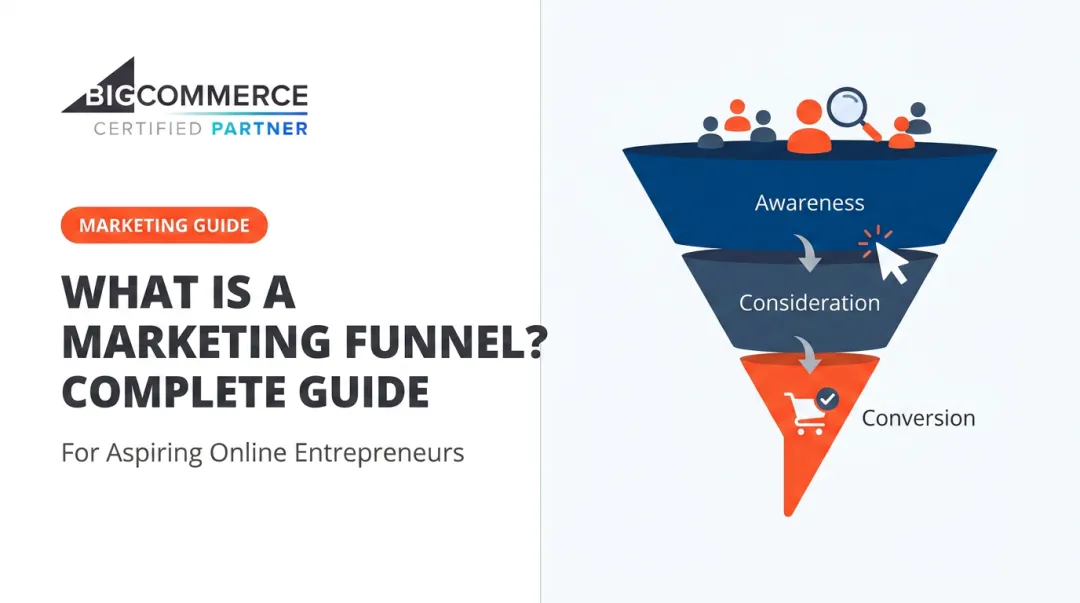
Shopify's marketing funnel model uses a clean three-part structure:
- Top of Funnel (TOFU) — Awareness: The prospect discovers your brand through a social post, search result, YouTube video, or ad. Goal: reach and visibility.
- Middle of Funnel (MOFU) — Consideration: The prospect is now interested — reading reviews, browsing product pages, opening your emails. Goal: education and trust-building.
- Bottom of Funnel (BOFU) — Conversion and Loyalty: The prospect is close to buying, or has already bought and you're working to bring them back. Goal: convert intent and drive repeat purchases.
Buyers rarely move through these stages in a neat sequence. They may jump straight from awareness to purchase, or cycle back from consideration to research. Build your funnel to handle that.
Marketing Funnel Tactics by Stage
| Stage | Tactics |
|---|---|
| Awareness (TOFU) | Paid ads, SEO, social media content, blog posts, YouTube videos |
| Consideration (MOFU) | Email sequences, product comparison guides, reviews, webinars |
| Conversion/Loyalty (BOFU) | Discount emails, loyalty programs, post-purchase campaigns |
Practical Example
A first-time shopper sees a Facebook ad for your online store — that's awareness. She clicks through, browses two product pages, and signs up for your newsletter — that's consideration. Three days later, she receives a 15% discount email and makes her first purchase — that's conversion. Six weeks later, a post-purchase email brings her back for a second order — that's loyalty.
Notice what's missing from that sequence: a salesperson. The marketing funnel handles everything up to — and after — the transaction. The sales funnel takes over at the moment of purchase.
What Is a Sales Funnel?
The sales funnel is narrower and more transactional. It tracks a prospect's journey through the actual buying decision — from first contact with your sales messaging to completed purchase and beyond. The marketing funnel builds the relationship; the sales funnel converts it into revenue.
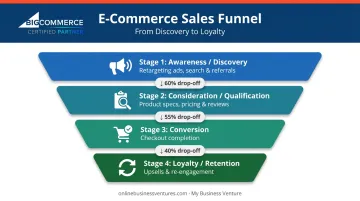
The Key Stages
- Awareness/Discovery: The prospect encounters your store through a retargeting ad, search result, or referral.
- Consideration/Qualification: They're evaluating your product — reading specs, checking shipping details, comparing prices.
- Conversion: They complete a purchase.
- Loyalty/Retention: Post-purchase sequences, upsells, and re-engagement campaigns bring them back.
E-Commerce Is Its Own Sales Team
In a traditional B2B company, the sales funnel is managed by a human sales rep following up with prospects. In e-commerce, that role is played by your store itself — product pages, checkout flow, pricing, CTAs, abandoned cart emails, and trust signals.
Baymard's 2025 meta-analysis of 50 studies puts average cart abandonment at 70.22% — meaning roughly 7 in 10 shoppers who add something to their cart don't complete the purchase. That's a sales funnel problem, not a marketing problem.
Key Sales Funnel Tactics
- Clear, descriptive product pages with specs, images, and pricing
- Prominent CTAs ("Add to Cart," "Buy Now") with no unnecessary steps between intent and checkout
- Abandoned cart email sequences to recover hesitant buyers
- Limited-time offers and discount codes to create urgency
- FAQ sections to resolve objections before checkout
- Post-purchase upsell and cross-sell sequences
A Practical Sales Funnel Scenario
A shopper clicks a retargeting ad for a product she viewed two days ago (top of the sales funnel). She lands on the product page, reads the specs, and adds the item to her cart (middle). She gets distracted and leaves — then receives an abandoned cart email with a 10% discount code (qualification nudge). She returns and completes checkout (conversion).
According to Klaviyo's 2024 analysis of over 143,000 abandoned cart flows, those automated recovery sequences average a 3.33% placed-order rate. Modest on paper — but at scale, those recovered carts add up fast.
Sales Funnel vs. Marketing Funnel: Key Differences Explained
The distinction comes down to four areas: scope, goals, metrics, and ownership.
Scope and Ownership
The marketing funnel is broad and brand-centric, managed through content, ads, SEO, and email campaigns aimed at large audiences. The sales funnel is narrow and transaction-centric — driven by the buying experience itself: product pages, checkout flows, pricing decisions, and follow-up sequences.
For solo e-commerce operators, one person usually manages both — but you still need to know which "hat" you're wearing at each stage. Push urgency and objection handling at someone who just discovered your brand, and you'll lose them. Keep nurturing someone who already has their credit card out, and you'll lose the sale.
Goals
| Funnel | Core Goal |
|---|---|
| Marketing | Generate awareness, build trust, and nurture leads |
| Sales | Convert qualified prospects into buyers and retain them |
Mixing these goals is where strategy falls apart. Running a brand awareness campaign at someone already ready to buy, or trying to "close" someone who just heard of you, both waste resources.
Key Metrics
Marketing funnel metrics:
- Website traffic and traffic source breakdown
- Email open rates — e-commerce industry average is 29.81% (Mailchimp, December 2023)
- Click-through rates — industry average sits at 1.74% for e-commerce emails
- Lead volume and email list growth
Sales funnel metrics:
- Cart abandonment rate — industry benchmark is 70.22% (Baymard, 2025)
- Abandoned cart recovery rate — average 3.33% placed-order rate (Klaviyo, 2024)
- Cost per acquisition (CPA)
- Customer lifetime value (CLV)
When to Prioritize Each
- Start with the marketing funnel when you're building awareness for a new store or entering a new audience segment. Without traffic, there's nothing to convert.
- Shift to sales funnel optimization when you have consistent traffic but conversions are low, or when customers buy once and don't return.
How the Two Funnels Work Together for E-Commerce Success
The marketing funnel and sales funnel aren't competing strategies — they're sequential. The marketing funnel fills the pipeline with aware, interested prospects. The sales funnel takes those prospects and closes the deal. A breakdown in one weakens the other directly.
What Alignment Looks Like in Practice
McKinsey's research found that 71% of consumers expect personalized interactions — and 76% become frustrated when that personalization is absent. That frustration shows up as lost sales. When your ad messaging doesn't match your product page, or your post-purchase email feels disconnected from the experience that brought someone to your store, that's a funnel alignment problem.
Fixing that problem means connecting every touchpoint intentionally. Aligned funnels share three traits:
- The ad that brought a visitor in matches the product page they land on — no messaging gaps
- Leads captured through marketing enter an automated sales sequence without friction or delay
- Sales conversion data (what's selling, where carts are abandoned) feeds back into marketing content and targeting
Building Both Funnels from Launch Day
For new e-commerce entrepreneurs, building both funnels simultaneously — without a dedicated marketing team or sales team — is the real challenge. The BigCommerce-powered storefronts My Business Venture provides come pre-loaded with conversion-ready features: SSL security, fraud prevention, payment gateway, and branded design. That covers the bottom of the sales funnel from day one.
The marketing side is handled through tiered packages that include search engine submission, social media management, YouTube marketing, and email infrastructure — plus one-on-one consulting from business advisors who help clients build a marketing strategy starting from their very first campaign.
The goal is to have both funnels working from the moment a store goes live, not six months after launch.
Conclusion
Neither funnel is optional. The marketing funnel builds the relationship; the sales funnel closes it. Entrepreneurs who treat them as the same thing end up with either plenty of traffic that never converts, or a polished checkout flow that nobody reaches.
Audit your current strategy against both frameworks. If traffic is low, focus on the marketing funnel first — awareness, content, and lead generation. If traffic is strong but conversions lag, dig into the sales funnel — product pages, checkout friction, cart abandonment, and follow-up sequences. Pick the weaker funnel, fix it first, and the other one gets more out of the work you've already done.
Frequently Asked Questions
What are the stages of the sales funnel?
The core stages are Awareness, Interest/Consideration, Decision/Intent, and Conversion — followed by Loyalty and Retention in extended models. The exact number of stages varies by business model; AIDA (Attention, Interest, Desire, Action) is the most widely recognized shorthand.
What is the 3-3-3 rule in sales?
As defined by HubSpot, the 3-3-3 rule is a prospecting framework: spend three minutes researching a prospect, identify three relevant insights, and craft a three-sentence outreach message. It's a B2B outbound tool designed to keep the top of the sales funnel moving.
What is the main difference between a sales funnel and a marketing funnel?
The marketing funnel covers the entire customer journey from awareness to loyalty. The sales funnel focuses specifically on converting qualified prospects into paying customers through direct engagement and transactional touchpoints — product pages, checkout, and follow-up sequences.
Can a small business use both a sales funnel and a marketing funnel?
Yes — and most do. For solo or small e-commerce operators, both funnels are typically managed by the same person or automated through platform tools. Understanding how each stage functions makes that management far more effective.
Which funnel should I focus on first as a new online store owner?
Start with the marketing funnel to build awareness and generate traffic. Without visitors, there's no one to move through the sales funnel. Once traffic is consistent, shift focus to sales funnel optimization — conversion rates, checkout flow, and cart abandonment.
Do sales and marketing funnels have to be separate strategies?
No — many businesses use a unified "conversion funnel" approach. That said, understanding the distinct goals of each prevents misaligned messaging, like running awareness campaigns to someone already ready to buy, or pushing hard-sell tactics to cold traffic.