
Introduction
Most new online stores fail for the same reason: they try to sell everything to everyone. With millions of products competing for attention, a general store has no natural audience, no built-in community, and no reason for buyers to choose it over Amazon.
The businesses that win online do the opposite. They pick a specific person, solve a specific problem, and build everything around that focus.
This post covers 15 real, updated niche market examples for 2026 — spanning eco-living, pet care, gaming, wellness, inclusive fashion, and more. Each one is a genuine business opportunity with an identifiable audience, proven demand, and room for a focused store to compete. You'll also walk away with a practical framework for finding and validating your own niche before you build.
Key Takeaways
- A niche market targets a specific, underserved group — not the broadest possible audience
- Choosing the right niche reduces competition and attracts buyers willing to pay premium prices
- The strongest 2026 niches are driven by sustainability, remote work, wellness, and smart technology
- Real brands have already scaled niche businesses into multi-million dollar companies
- Starting with a turn-key online store cuts the time from niche idea to first sale dramatically
What Is a Niche Market?
A niche market is a clearly defined subset of a broader market — characterized by specific needs, values, or demographics that mass-market brands routinely overlook.
The easiest way to see this: "fitness" is a mass market. "Home fitness" is a segment. "Home fitness equipment for seniors with limited mobility" is a niche. Each layer narrows the audience — and with it, your competition.
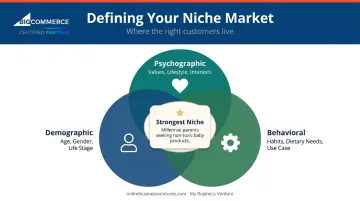
How Businesses Define Their Niche
- Demographic — age, gender, life stage (example: new parents, retirees, college students)
- Psychographic — values, lifestyle, interests (example: eco-conscious consumers, minimalists)
- Behavioral — purchasing habits, dietary needs, use case (example: gluten-free shoppers, home office workers)
The strongest niches combine two or more of these. "Millennial parents who prioritize non-toxic baby products" hits all three — and that overlap means fewer competitors, a clearer brand message, and shoppers who are already looking for what you sell.
For e-commerce entrepreneurs, niche markets offer real structural advantages: your marketing speaks directly to a defined audience, your brand positioning is clear from day one, and you're competing against fewer sellers for customers who are already searching for exactly what you offer.
15 Winning Niche Market Examples for 2026
Each niche below was selected because it represents a scalable, commercially viable business opportunity — not just a trend. These are particularly well-suited to online retail and dropshipping models.
1. Eco-Friendly & Sustainable Living Products
The niche: Consumers actively replacing plastic, disposable, and chemically-treated household items with biodegradable or zero-waste alternatives — think reusable beeswax wraps, bamboo toothbrushes, and refillable cleaning concentrates.
Bee's Wrap built an entire company around plastic-free food storage. Their wraps are reusable, compostable, and made from natural materials — a product line that would have seemed niche five years ago and is now a category.
The demand signal is clear: a McKinsey/NielsenIQ analysis of 600,000 SKUs found products with ESG-related claims averaged 28% cumulative growth versus 20% for comparable products without such claims.
E-commerce opportunity: Strong social sharing behavior, premium pricing tolerance, and repeat purchase cycles (buyers who switch to refillable cleaning concentrates keep buying them) make this niche especially profitable online.
2. Premium & Specialty Pet Products
The niche: Pet owners — particularly Millennials and Gen Z — who treat pets as family members and seek gourmet food, breed-specific accessories, and luxury gear. Chuckit! built its identity entirely around fetch-specific dog toys. The market backs it up: APPA reports $158 billion in 2024 US pet industry expenditure, spanning food, supplies, veterinary care, and services.
E-commerce opportunity: Pet spending is one of the most recession-resistant consumer categories. Buyers in this niche are loyal, emotionally invested, and willing to pay a significant premium for quality. For entrepreneurs building a dropship store, pet products are a natural starting point — high average order values, broad appeal, and a catalog that practically sells itself to emotionally invested owners.
3. Mental Wellness & Digital Detox
The niche: Consumers seeking products that help them reduce stress, improve sleep, and limit screen time — weighted blankets, mindfulness journals, anxiety rings, blue-light glasses, and aromatherapy tools.
Demand accelerated post-pandemic and hasn't softened. The Global Wellness Institute reports mental wellness grew 12.4% annually from 2019 to 2024, with meditation and mindfulness growing at 18.9% annually over the same period.
E-commerce opportunity: Strong repeat purchase behavior across supplements, journals, and aromatherapy products. This niche also has a passionate community that actively shares product recommendations — lowering your customer acquisition cost over time.
4. Remote Work & Home Office Ergonomics
The niche: The tens of millions of remote and hybrid workers optimizing their home workspace — ergonomic chairs, adjustable desks, monitor risers, cable management solutions, and noise-canceling accessories.
The numbers are substantial. The home office furniture market sat at $25 billion in 2024 and is projected to reach $50 billion by 2035, per Market Research Future. Meanwhile, a 2025 NBER working paper confirms that remote work now accounts for one in four paid workdays among American workers.
E-commerce opportunity: This niche has consistent year-round demand, a clearly defined buyer persona, and exceptional upsell potential. A customer who buys a monitor riser often needs a monitor arm next, then a keyboard tray — the catalog builds itself.
5. Specialty & Dietary Food Products
The niche: Consumers managing specific dietary needs — gluten-free, vegan, keto, allergen-free, and plant-based. For buyers managing celiac disease, severe allergies, or metabolic conditions, these products aren't optional — and that medical necessity translates directly into brand loyalty and auto-reorder behavior.
The gluten-free market alone is valued at $8.5 billion in 2025, projected to reach $18.3 billion by 2033 (Grand View Research). Plant-based food is forecast to hit $16.3 billion by 2027 at an 11.7% CAGR.
E-commerce opportunity: Subscription models work exceptionally well here. Buyers who find a product that works for a dietary restriction don't switch brands — they auto-order.
6. Gaming & Esports Accessories
The niche: PC and console gamers seeking high-performance or fully customizable peripherals — mice, keyboards, headsets, and desk setups. Glorious (formerly Glorious PC Gaming Race) built a seven-figure business by targeting PC gamers specifically, rather than gaming broadly.
The gaming peripherals market was valued at $6.2 billion in 2024 and is projected to reach $11.5 billion by 2030 at an 11% CAGR (Grand View Research).

E-commerce opportunity: This niche rewards quality and customization over price alone. Gamers research extensively, share gear recommendations in tight-knit communities (Reddit, Discord, Twitch), and upgrade regularly — creating consistent repeat purchase cycles.
7. Inclusive & Adaptive Fashion
The niche: Clothing and accessories for groups that mainstream fashion largely ignores — plus-size men (Jacamo), LGBTQ+ consumers (TomboyX), and people with disabilities who need functional yet stylish designs.
The plus-size apparel market is valued at $311 billion globally, projected to reach $412 billion by 2030. Yet plus-size models appeared in only 0.8% of runway looks in 2024, per a Vogue Business report cited by Fashion Dive. That disconnect means buyers in these segments are actively searching for brands that design for them — and rewarding those brands with the kind of loyalty that mainstream retailers rarely see.
E-commerce opportunity: Buyers in underserved niches develop intense brand loyalty once they find a company that genuinely designs for them. That loyalty drives organic word-of-mouth growth with minimal ad spend.
8. Eco-Conscious Baby & Parenting Products
The niche: Millennial and Gen Z parents prioritizing organic materials, non-toxic products, and ethically made baby gear. This buyer researches extensively, relies on community recommendations, and values certifications like BPA-free and organic.
The organic baby toiletries market is estimated at $7.93 billion in 2024, growing at a 7.9% CAGR through 2030 (Grand View Research).
E-commerce opportunity: Parents in this niche pay significantly more for safety and sustainability. Subscription formats — diapers, wipes, formula — create predictable recurring revenue that compounds over time.
9. At-Home Fitness Equipment
The niche: Consumers who prefer working out at home, including sub-niches for small-space equipment, specific training styles (yoga, calisthenics, CrossFit), and recovery tools like foam rollers and percussion massagers. Peloton's rise demonstrated what premium positioning can achieve in home fitness.
The at-home fitness equipment market was valued at $8.6 billion in 2023 and is projected to reach $21.4 billion by 2035 at an 8.2% CAGR (Allied Market Research).
E-commerce opportunity: Price range flexibility is unusually wide here — from $10 resistance bands to $500+ smart equipment. Sellers can serve multiple budget tiers within the same niche, making it accessible for new store owners.
10. Solo & Sustainable Travel Gear
The niche: Digital nomads, solo travelers, and eco-conscious adventurers seeking smart, packable, sustainable gear. Nomatic built its brand specifically around the remote worker and traveler identity — not "travel bags" generically.
Solo travel demand is rising fast: Forbes reported in 2024 that 76% of surveyed Millennials and Gen Z planned a solo trip in 2025, citing American Express travel research.
E-commerce opportunity: Travel gear is highly giftable, has strong visual marketing appeal on Instagram, and lends itself well to product bundles — all strong structural fits for an e-commerce store.
11. Clean Beauty & Ethical Skincare
The niche: Consumers seeking cruelty-free, vegan, or chemical-free cosmetics formulated for specific concerns — hormonal acne, melanin-rich skin, perimenopausal changes. Lush built its global identity around handmade, cruelty-free cosmetics before "clean beauty" was a mainstream category.
The clean beauty market is valued at $10.5 billion in 2025 and is projected to reach $35.3 billion by 2033 at a 16.8% CAGR (Grand View Research).
E-commerce opportunity: Skincare buyers are highly engaged on Instagram and TikTok, where organic content drives discovery. Lower content marketing costs make this niche especially accessible for bootstrapped stores.
12. Left-Handed & Underrepresented Demographic Products
The niche: Lefty's, a San Francisco store selling exclusively left-handed products, is the textbook example. Approximately 10.6% of the global population is left-handed (per APA-cited research), yet almost no mainstream brand designs for them.
This principle extends to any overlooked demographic: redheads with specialized SPF needs, tall people with clothing proportions, adults who need large-print accessories.
E-commerce opportunity: Niche-demographic stores often dominate search results because so few competitors target the same long-tail keywords. Once a buyer finds you, they purchase broadly across your catalog — because alternatives are scarce.
13. Senior Active Living & Healthy Aging
The niche: The growing 55+ population seeking products that help them stay active and independent — ergonomic fitness tools, health monitoring wearables, large-print tech accessories, and travel experiences designed for their needs.
AARP research shows 79% of adults 50+ use e-commerce retailers, and 91% own a smartphone. This is not a demographic that avoids online shopping.
E-commerce opportunity: Seniors are the fastest-growing e-commerce demographic with high disposable income. Products solving mobility, comfort, or cognitive wellness challenges command premium pricing and generate strong word-of-mouth referrals.
14. DIY, Crafts & Maker Culture
The niche: Hobbyists pursuing woodworking, embroidery, candle-making, resin art, and sourdough baking. The Hand Tool School built an entire training business around hand-tool woodworking specifically — not woodworking broadly. That specificity is the model.
The craft supplies market is estimated at $41 billion in 2024 at a 4.25% CAGR (Market Research Future).
E-commerce opportunity: Craft niches support multiple revenue streams — physical supplies, digital patterns, community memberships. Supply consumables (yarn, resin, candle wax) drive repeat purchases without requiring constant customer acquisition.
15. AI-Powered & Smart Home Lifestyle Products
The niche: Everyday consumers adopting AI-enabled gadgets for home convenience — smart displays, voice-activated assistants, AI journaling apps, and smart kitchen appliances. August identified a new pain point created by Airbnb hosting and built smart-lock bundles specifically for that audience. That's early-mover niche thinking.
The smart home market is valued at $162.8 billion in 2025 and projected to reach $537 billion by 2030 at a 27% CAGR (Grand View Research).
E-commerce opportunity: Early movers face minimal competition on long-tail search terms. As consumer adoption grows, the addressable market expands — meaning lower ad costs today and a larger potential customer base tomorrow.
What the Best Niche Businesses Have in Common
Across all 15 examples, three patterns repeat:
They target a specific someone — not a broad everyone. TomboyX targets gender-inclusive buyers. Chuckit! targets fetch-focused dog owners. Lefty's targets left-handed people.
They solve a real, often overlooked problem — or serve an underrepresented need. The best niche businesses didn't invent demand; they found demand that nobody was serving well.
They build brand identity around the niche — not just the products. UNTUCKit didn't sell shirts; they sold the idea of a shirt designed to look good untucked. That positioning came first.
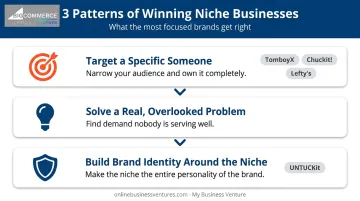
Behind all three patterns is a shared mindset shift. The most successful niche businesses don't start by asking "what can I sell?" They start by asking "who is being ignored, and what do they need?" That question separates businesses with loyal repeat customers from generic stores competing on price alone.
Niche businesses also scale by going deeper before going broader. UNTUCKit dominated men's untucked casual shirts before adding women's clothing. Peace Collective owned Toronto before expanding to new Canadian cities. The niche is the foundation — not the ceiling.
How to Find and Launch Your Own Niche Market
Step 1: Start With What You Know
Begin with your own interests, skills, or frustrations. The best niche businesses often come from founders who experienced the problem firsthand. Left-handed scissors that cut backwards. Baby products with ingredients you can't pronounce. Travel bags designed for laptop users who also hike.
Personal knowledge gives you an authentic edge when building brand voice and connecting with buyers who share your experience.
Step 2: Validate Demand
Before investing, confirm that people are actively searching for and discussing this problem:
- Google Trends — track search interest over time and by region
- Keyword research tools — identify search volume and competition levels for niche terms
- Reddit and community research — Reddit's own 2025 research found that 42% of internet users find a Reddit recommendation the most influential factor in a purchase decision. If your niche has active subreddits, you have a built-in marketing channel.
Step 3: Confirm Commercial Viability
A passionate audience isn't enough. Verify:
- Are there buyers willing to pay for solutions?
- Can products be sourced or dropshipped at healthy margins?
- Is the market large enough to sustain a business, but specific enough to own?
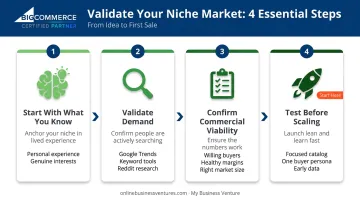
Once your niche clears these three checkpoints, it's time to build.
Step 4: Test Before Scaling
Start with a focused product catalog and define one buyer persona clearly. Drive targeted traffic through the channels your niche uses most — Instagram for clean beauty, Reddit for gaming, Pinterest for DIY. Use early sales data to guide what to add or remove before expanding.
My Business Venture has spent over 30 years helping aspiring entrepreneurs take this exact path — from niche idea to live e-commerce store, with access to 1M+ products, custom branding, and one-on-one consulting included.
Conclusion
Every business in this list succeeded not by trying to serve everyone, but by choosing to serve someone specific — exceptionally well. The niche you choose becomes your competitive advantage. It shapes your products, your messaging, and your ability to build a customer base that keeps coming back.
Pick one niche from this list that genuinely interests you, validate it with the steps above, and take action. My Business Venture has helped thousands of entrepreneurs launch fully operational online stores — complete with a dropship-powered catalog drawn from 1M+ products, one-on-one consulting, and a storefront that goes live in days.
Reach the team at 1-800-639-6644 (Monday–Friday, 9am–6pm EST) or visit MyBusinessVenture to learn more.
Frequently Asked Questions
What is an example of a niche market in business?
Lefty's sells exclusively to left-handed consumers — scissors, kitchenware, and school supplies designed for a demographic that mainstream brands ignore. Drybar is another example: a hair salon that offers only blowouts, not cuts or color. Both businesses succeed by serving one specific group exceptionally well.
What is a niche market business?
A niche market business focuses its products, services, and marketing on a specific, well-defined customer segment rather than the general public. This focus typically results in lower competition, stronger brand recognition within the audience, and higher customer loyalty compared to general retailers.
What are the most profitable niche markets for e-commerce in 2026?
Eco-friendly products, health and wellness, specialty food, pet care, and clean beauty consistently rank among the highest-performing niches. Profitability depends on three variables: margin potential, repeat purchase frequency, and how underserved the audience is. Assess all three before committing to a niche.
How do I find the right niche market for my online store?
Start by identifying an underserved problem or demographic you understand personally. Validate demand using Google Trends, keyword tools, and Reddit forums where your target audience is already talking. Then confirm the niche has enough buyers, commercially sourceable products, and viable margins to sustain a real business.
What is the difference between a niche market and a mass market?
A mass market targets the broadest possible audience with broadly appealing products — think a general grocery store. A niche market targets a specific group with tailored offerings, often at a premium price point because the fit is specialized and alternatives are limited.
Can a first-time entrepreneur succeed in a niche market?
Niche markets are well-suited for first-time entrepreneurs. Lower competition makes it easier to rank in search results, build brand authority, and attract loyal customers. Starting with a focused product catalog and a clearly defined audience reduces complexity and accelerates early momentum.