Introduction
The U.S. online resale market surpassed $80 billion in 2024, and it hasn't slowed down. Millions of Americans are turning secondhand goods, wholesale products, and niche inventory into real income streams — but the platform they choose can make or break their margins before they ever ship a single order.
Here's the mistake most new resellers make: picking a platform based on name recognition rather than fit. The wrong choice means fees that shrink your margins on every transaction, listings buried under thousands of competitors, and a buyer pool that was never interested in what you're selling.
This guide breaks down the top reselling platforms for 2026 — their fees, ideal use cases, and the key differences between selling on a marketplace versus building your own branded storefront. Whether you're just starting out or ready to scale, the right fit comes down to what you're selling, how you want to operate, and what kind of income you're building toward.
Key Takeaways
- The best reselling platform depends on what you sell, who you sell to, and how you want to operate. No single platform wins for everyone.
- Selling fees range from 0% to 20%+ across platforms, directly impacting take-home profit on every transaction.
- Marketplaces provide built-in traffic, but you'll pay fees, face competition, and never own your customer data.
- A branded storefront means no per-sale commission and full control over your pricing, margins, and customer relationships.
- Serious resellers increasingly combine platforms or graduate to their own store as their business grows.
Best Reselling Platforms for 2026
These platforms were evaluated on audience size, seller fees, product category fit, ease of use, and income potential across experience levels. Each entry below covers who the platform suits best, what it costs to sell, and the one feature that sets it apart — so you can match your inventory type and goals to the right marketplace fast.
eBay
Founded in 1995, eBay remains the original online reselling giant — now hosting 135 million active buyers worldwide across more than 190 markets and 2.3 billion active listings. It supports virtually every product category, from collectibles and electronics to fashion and home goods, with both auction-style and fixed-price (Buy It Now) formats.
What sets eBay apart is its search discovery engine for niche and hard-to-find items. If you're moving diverse or specialized inventory, no platform matches eBay's global reach and flexible listing formats — including Best Offer, which lets buyers negotiate price.
| Category | Details |
|---|---|
| Best For | Resellers with diverse, niche, or specialized inventory who want global reach |
| Selling Fees | Free up to 250 listings/month; Final Value Fee ~13.6% (most categories) + $0.30–$0.40 per order |
| Key Feature | Multiple listing formats (auction, fixed-price, Best Offer) plus international selling |
Amazon
Third-party sellers now account for 62% of worldwide paid units on Amazon (Q3 2025), which tells you everything about the platform's scale. It runs two seller plans — Individual at $0.99 per item sold and Professional at $39.99/month — and some categories require approval before you can list.
The platform's core advantage is purchase intent. Buyers on Amazon aren't browsing — they're ready to buy. Add Fulfillment by Amazon (FBA) and you get hands-off shipping with access to Prime customers.
| Category | Details |
|---|---|
| Best For | Sellers moving new or wholesale products at volume who want the largest buyer base |
| Selling Fees | Individual: $0.99/item + 8%–20% referral fee; Professional: $39.99/month + referral fee |
| Key Feature | Optional FBA fulfillment; access to Prime customer base |
Facebook Marketplace
Facebook Marketplace is the dominant zero-fee option for local reselling. Anyone with a Facebook account can list items for local pickup with no commission, and a shipping option extends reach beyond your area. Cross-posting into Facebook Groups lets sellers target niche buyer communities.
One important correction from the outline: shipped orders currently carry a 10% fee with a $0.80 minimum — not the often-cited 5%/$0.40 figure, which is outdated per Meta's current seller policy.
| Category | Details |
|---|---|
| Best For | Sellers of large, bulky, or lower-cost items; beginners wanting zero-fee local sales |
| Selling Fees | Free for local sales; 10% fee ($0.80 minimum) for shipped orders |
| Key Feature | Cross-posting to Facebook Groups; no account setup fees |
Etsy
With approximately 86.5 million active buyers and 5.6 million active sellers as of December 2025, Etsy carries enormous built-in demand — but only for the right products. The platform attracts buyers specifically searching for handmade, vintage, or uniquely curated goods. Generic or mass-produced items don't perform here.
Resellers of true vintage items (20+ years old) command premium prices on Etsy that general marketplaces can't match. The platform's internal SEO discovery and intentional buyer base are its biggest advantages.
| Category | Details |
|---|---|
| Best For | Sellers of vintage items (20+ years old), handmade goods, craft supplies, or curated products |
| Selling Fees | $0.20 listing fee + 6.5% transaction fee + 3% + $0.25 payment processing |
| Key Feature | Highly intentional buyer base willing to pay premium prices; strong internal SEO |
Poshmark
Poshmark is a social commerce platform first, marketplace second. With more than 130 million community members across the U.S. and Canada, it blends fashion reselling with social media mechanics. Sharing listings, joining Posh Parties, and engaging with followers directly drives visibility — the more active you are, the more your listings surface.
The trade-off: Poshmark's 20% commission on sales of $15 or more is among the highest in the industry. Buyers pay a flat $6.49 shipping fee, which removes logistics complexity for sellers. But if you're not willing to engage actively, your listings will underperform.
| Category | Details |
|---|---|
| Best For | Fashion resellers with brand-name clothing, accessories, and home goods |
| Selling Fees | Flat $2.95 for sales under $15; 20% commission for sales $15 and above |
| Key Feature | Buyer-paid flat-rate shipping; social sharing features that boost listing visibility |
Mercari
For sellers who want to get moving without a steep learning curve, Mercari is the clearest entry point. It covers a wide range of categories — fashion, electronics, home goods, toys, beauty — and the mobile-first listing process takes minutes. As of January 2025, Mercari charges a flat 10% seller fee with no separate payment processing fee stacked on top (an earlier fee structure combined both, which has since changed).
That straightforward cost structure makes it easy to calculate what you'll actually keep on each sale before you list.
| Category | Details |
|---|---|
| Best For | Beginner resellers and casual sellers wanting to move diverse inventory quickly |
| Selling Fees | 10% selling fee (no additional payment processing fee) |
| Key Feature | Mobile-first listing experience; automated pricing suggestions |
Marketplace Platforms vs. Building Your Own Online Store
Every marketplace on this list gives you something valuable: an existing audience. You don't have to build traffic from scratch. But that convenience comes at a cost — and not just the fee on every sale.
What you give up on a marketplace:
- Per-sale commissions that compound across thousands of transactions
- Competition with hundreds of similar listings at the same moment
- Platform rules that can change with little notice
- No access to your own customer data or ability to build repeat relationships
- Brand identity that lives inside someone else's platform
What a branded storefront gives you:
- Full control over pricing, presentation, and customer relationships
- Zero per-sale marketplace commission
- The ability to build a real, recognizable brand
- Customer data you actually own — for email marketing, retargeting, and retention
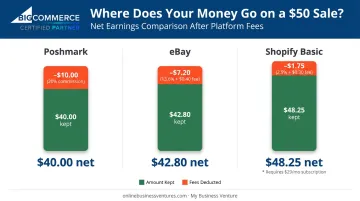
The fee math makes this concrete. On a $50 sale, verified platform fees produce roughly $40.00 net on Poshmark (20% commission), $42.80 net on eBay (13.6% + $0.40), and $48.25 net on Shopify Basic (2.9% + $0.30) — before the $29/month annual subscription.
Who Each Model Suits
Marketplaces are a strong entry point for casual sellers, part-timers testing the waters, or resellers with highly niche inventory that benefits from platform-specific search (Etsy's vintage buyers, Poshmark's fashion community). The built-in audience removes one major barrier.
A branded storefront is the smarter long-term move for entrepreneurs serious about building a scalable business — no commission ceiling, no algorithm dependency, and no risk of a platform policy change wiping out your revenue.
For entrepreneurs ready to take that route, My Business Venture (MBV) provides a structured path into branded e-commerce. MBV builds BigCommerce-powered online stores pre-loaded with 2,500+ products from a catalog of over 1 million items, using a blind dropship model — meaning no inventory to stock and free shipping on every order. Profit margins run 35–200%, and every package includes one-on-one consulting and MBV University training, so new store owners have support from day one.
How to Choose the Best Reselling Platform for Your Goals
Match Platform to Product Category
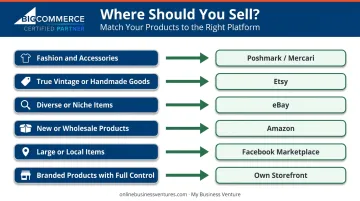
Your product category should be the first filter — everything else comes after:
- Fashion and accessories → Poshmark, Mercari
- True vintage or handmade goods → Etsy
- Diverse, niche, or hard-to-find items → eBay
- New or wholesale products at volume → Amazon
- Large, bulky, or low-cost local items → Facebook Marketplace
- New branded products with full margin control → Your own storefront
Run the Fee Math Before You List
Many resellers calculate profitability from the sale price. The number that actually matters is what you keep after every fee is deducted — listing fee, transaction fee, payment processing, and shipping.
A $50 item sold on Poshmark nets you $40. The same item on eBay nets roughly $42.80. On your own branded storefront using Shopify Basic, you keep approximately $48.25 — minus the monthly subscription. Over hundreds of transactions, those differences add up to real money.
Factor in Your Selling Style
Some platforms require ongoing effort to perform. Poshmark rewards sellers who share listings daily and engage with the community. If you're not willing to spend time on social features, your visibility will suffer regardless of how good your inventory is.
Other platforms are more passive: eBay and Amazon rely on search discovery, not community interaction. Your honest assessment of how much time and which style of engagement you'll sustain should be part of your platform decision.
Think About the Ceiling
Marketplace platforms cap your growth in ways that aren't always obvious at the start. Algorithm changes can suppress your listings overnight. Fee structures can shift. Policy updates can restrict entire product categories.
Sellers who build a full-time income on marketplaces eventually hit that wall — and the ones who break through it typically do so by launching their own branded storefront alongside the marketplace, not instead of it. If scalable, long-term income is the goal, plan for that channel from day one, not after the marketplace stops working for you.
Conclusion
Choosing the right reselling platform in 2026 comes down to fit: your product category, selling style, fee tolerance, and where you want your business to be in two years.
Marketplace platforms are a legitimate starting point. They reduce friction, provide built-in audiences, and help new resellers learn what sells. But every per-sale fee is a cost of renting someone else's customer base, and those fees never go down as you scale.
Entrepreneurs serious about building a real online business should evaluate whether their chosen platform can grow with them, or whether the better investment is a branded storefront where margins are higher, customer relationships are yours, and growth isn't capped by a third party's rules.
If you're ready to explore a fully supported path to owning your own business, My Business Venture can help. MBV has been launching branded e-commerce stores for aspiring entrepreneurs for over 30 years, with a BBB A+ rating, a turn-key model that gets stores live in days, and consulting backed by Shark Tank's Kevin Harrington. Reach out to an MBV consultant at 1-800-639-6644 or visit the website to learn more.
Frequently Asked Questions
What platform is best to resell on?
The best platform depends on what you're selling. eBay works for diverse or niche inventory, Poshmark for fashion, Etsy for vintage and handmade goods, and Amazon for volume sales of new products. Entrepreneurs building full-time income are better served by a branded storefront, where you keep more of every sale instead of handing a cut to the platform.
What is the most profitable reselling platform?
Facebook Marketplace (local sales) and your own storefront yield the highest margins because you keep more per sale. High-traffic platforms like Amazon and eBay offset higher fees with greater volume. Own-store models using dropshipping can deliver margins of 35–200%.
How do I start reselling online with no money?
Start with Facebook Marketplace for local, fee-free sales of items you already own, or Mercari, which has no listing fee. For building a product-based business without upfront inventory costs, dropshipping models — like those offered through MBV — eliminate the need to purchase stock before selling.
Can I resell products on my own website instead of a marketplace?
Yes. Platforms like BigCommerce and Shopify let you build fully branded online stores. The trade-off is that you drive your own traffic — but you keep more profit, own your customer relationships, and pay no per-sale marketplace commission.
What is the difference between reselling and dropshipping?
Reselling typically means buying inventory upfront and selling it at a markup. Dropshipping means listing products you don't stock. When a sale is made, the supplier ships directly to your customer, so you never purchase inventory upfront.
Do I need to pay taxes on reselling income?
Yes. Reselling income is taxable in the U.S. regardless of whether you receive a 1099-K form (platforms currently issue one only above $20,000 and 200 transactions, per the 2025 One Big Beautiful Bill). Track fees, shipping, and sourcing costs as deductions, and consult a tax professional for your situation.