Introduction
You've got a product. Maybe you've even built a website. But now what? Many first-time entrepreneurs pour everything into what they're selling and almost nothing into how they'll reach buyers — and that gap is where businesses quietly run out of momentum.
Marketing fundamentals are the core principles and frameworks that answer this question: how do you find the right customers, communicate real value, and turn strangers into loyal buyers? The good news — you don't need a degree. A handful of frameworks that professionals have used for decades will get you there.
This guide covers the core building blocks: the 7 Ps of Marketing, the 5 C's situational framework, the marketing funnel, the most effective channel types for online stores, and a three-step approach to building your first real marketing strategy.
Key Takeaways
- Marketing is the process of identifying customer needs, communicating value, and building relationships that turn prospects into repeat buyers
- The 7 Ps (Product, Price, Place, Promotion, People, Process, Physical Evidence) form the backbone of any marketing strategy
- The 5 C's (Company, Customers, Competitors, Collaborators, Context) map the competitive environment before you build a strategy
- The marketing funnel guides which tactics to use at each stage of the customer journey
- Your first strategy starts with knowing your audience, setting measurable goals, picking the right channels, and refining with data
What Are Marketing Fundamentals?
Marketing fundamentals are the principles and frameworks businesses use to identify target audiences, create value, and communicate that value effectively. The American Marketing Association defines marketing as "the activity, set of institutions, and processes for creating, communicating, delivering, and exchanging offerings that have value for customers, clients, partners, and society at large" — a definition approved in 2017 that still holds up because it covers far more than advertising.
That scope matters. Many first-time entrepreneurs treat marketing as a promotional task: write some social media captions, maybe run an ad. In reality, marketing touches every stage of the business:
- Research — understanding who your customer is and what they need
- Pricing — communicating value through what you charge
- Product positioning — differentiating your offer in the market
- The purchase experience — how easy and trustworthy your store feels
- Post-sale relationships — turning one-time buyers into repeat customers
For online entrepreneurs, that reach has a direct consequence. Without a foundational understanding of how marketing works, a store can go unnoticed regardless of what it sells. The product isn't the problem — the absence of a deliberate strategy is.
The 7 Ps of Marketing: The Core Framework
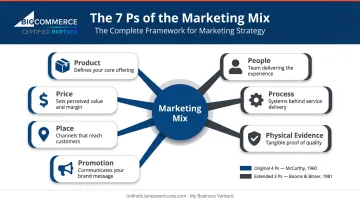
The 7 Ps — also called the Marketing Mix — are the most widely used framework in marketing strategy. E. Jerome McCarthy introduced the original 4 Ps (Product, Price, Place, Promotion) in his 1960 book Basic Marketing: A Managerial Approach. Booms and Bitner expanded this to 7 Ps in 1981, adding People, Process, and Physical Evidence to better address service-based and digital businesses. Most modern marketers use all seven.
Product, Price, and Place
Product is always the starting point. Marketing can't compensate for a weak product or a vague value proposition. You need to know what you're selling, what problem it solves, and why a customer should choose it over every alternative. For online entrepreneurs, this means being able to state your unique selling proposition in a single sentence — and meaning it.
Price does more than cover costs. Research by Rao and Monroe found statistically significant relationships between price and perceived quality in consumer product experiments. Charge too little, and customers may assume something is wrong. Charge too much without communicating value, and you lose the sale.
Pricing is a signal — and it needs to match what your brand is trying to say. A luxury candle brand charging $8 per candle sends the wrong message, even if the product is excellent.
The three common approaches:
- Set a markup above your production cost (cost-based pricing)
- Charge what the outcome is worth to the buyer (value-based pricing)
- Match or strategically undercut what competitors charge (competitive pricing)
Place refers to where and how customers find and purchase your product. For online entrepreneurs, this is your e-commerce store — and its quality, speed, and professionalism directly affect whether visitors convert. A cluttered, slow, or untrustworthy storefront is just as damaging as no marketing at all.
Promotion, People, Process, and Physical Evidence
The first three Ps define your offer. The next four shape how customers experience it — and whether they come back.
Promotion is how you reach your audience: digital ads, SEO, email campaigns, social media, content, influencer partnerships. The best promotion strategy isn't the one with the biggest budget; it's the one that puts your message where your specific audience actually spends time.
The three extended Ps address the customer experience around your product:
- People: How your support team handles questions and complaints directly shapes repeat purchases and word-of-mouth. Customer-facing interactions carry more weight than most entrepreneurs expect.
- Process: The reliability of how your product is delivered — smooth checkout, fast fulfillment, accessible support. Baymard Institute reports an average cart abandonment rate of 70.22% across 50 studies, and friction in the buying process is one of the biggest revenue leaks for online stores.
- Physical Evidence: The tangible proof of your brand's credibility. For a digital business, this includes your website design, branded packaging, SSL certification, customer reviews, and social media presence. Every visible signal either builds trust or erodes it.
The 5 C's of Marketing
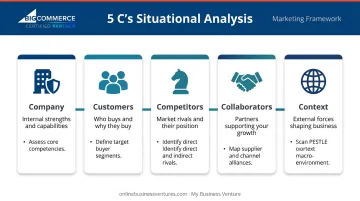
While the 7 Ps define what and how you market, the 5 C's help you understand the environment you're marketing in. Harvard Business School's Thomas Steenburgh and Jill Avery structured this as a situational analysis framework covering Company, Customers, Competitors, Collaborators, and Context. Think of it as the diagnostic step before strategy.
Here's how each C works in practice:
- Company — Start with an honest internal audit. What are your real strengths, and what can you do better than competitors? That clarity keeps your marketing authentic rather than aspirational.
- Customers — The most critical C. Knowing your audience's problems, motivations, and shopping behavior shapes every downstream decision. Customer surveys, persona development, and social media listening help you move beyond assumptions.
- Competitors — No business operates in isolation. Even a basic review of competitors' websites, pricing, and reviews can reveal how they position themselves and where gaps exist for you to fill.
- Collaborators — These are the partners, suppliers, distributors, and affiliates that help your business function and grow. For e-commerce entrepreneurs, that might mean dropship suppliers or fulfillment partners. My Business Venture (MBV), for example, partners with Doba (a dropshipping platform connecting retailers with suppliers), giving MBV clients access to 1M+ products without holding any inventory — removing one of the heaviest operational burdens for new entrepreneurs.
- Context — The external factors you can't control: economic conditions, cultural shifts, legal regulations, and technology changes. Adobe Analytics found smartphones generated 54.5% of U.S. online purchases during the 2024 holiday season, when total online spending hit $241.4 billion. Businesses that hadn't optimized for mobile by then were already at a disadvantage. Tracking context early means you adapt before the market forces your hand.
The Marketing Funnel: From Awareness to Loyal Customer
The marketing funnel maps the stages a potential customer moves through — from first discovering your brand to becoming a repeat buyer. Understanding it helps you assign the right tactics to the right moment.
The Four Stages
| Stage | What's Happening | Tactics That Work |
|---|---|---|
| Awareness | Customer discovers your brand | SEO, social media, paid ads, blog content |
| Consideration | Customer researches options | Product comparisons, testimonials, guides |
| Decision | Customer makes a purchase | Promotions, guarantees, simple checkout |
| Loyalty/Advocacy | Customer returns and refers | Email campaigns, loyalty programs, great service |
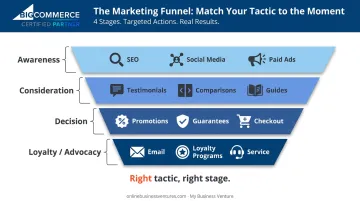
Many new entrepreneurs invest heavily in awareness — the top of the funnel — and then do almost nothing to convert or retain. This is where growth stalls. Content that builds traffic is valuable, but it only pays off when there's a path to purchase and a reason to come back.
Why Retention Deserves More Attention
Post-purchase marketing is often the highest-ROI activity a small business can do. According to Harvard Business Review, acquiring a new customer can cost 5 to 25 times more than retaining an existing one. Email campaigns, loyalty rewards, and proactive customer service are what make that retention happen — and they compound over time.
That same logic applies earlier in the funnel. Clear promotions, easy checkout, and satisfaction guarantees close the gap between a shopper who's interested and one who follows through.
Common Types of Marketing Every Online Entrepreneur Should Know
Most successful online businesses use a mix of channels rather than betting everything on one. Here are the most relevant types for e-commerce entrepreneurs:
- Content marketing — blogs, guides, and videos that build trust and drive organic traffic over time
- Social media marketing — platforms like Instagram and Facebook for brand awareness and community building
- Email marketing — one of the highest-ROI channels for nurturing relationships and driving repeat sales
- SEO (Search Engine Optimization) — helping customers find your store organically when they search for what you sell
- Paid advertising (PPC) — Google and social ads for faster visibility, especially useful when launching
Inbound vs. Outbound
Inbound marketing attracts customers through valuable content and organic search — they come to you. Outbound marketing reaches customers proactively through ads, cold outreach, and direct mail — you go to them. Most small online businesses see stronger compounding returns from starting with inbound strategies, given the lower upfront cost and the long-term traffic and trust you build through SEO and content.
B2C Marketing in Practice
Knowing which strategy to prioritize is one thing — seeing it work in practice is another. For entrepreneurs selling products directly to consumers, emotional connection and social proof are the most powerful tools. Pura Vida Bracelets is a well-documented example: the brand combined social media and email marketing to achieve 50% year-over-year revenue growth, a 4x increase in email revenue, and a 350% increase in email subscribers — all driven by consistent content and community engagement.
MBV builds several of these channels directly into its platform. Every package includes SEO-friendly website architecture, blog and newsletter tools, and Google Analytics integration.
The Millennium package ($5,995) adds fully managed social media services through MBV Digital, where MBV's team sets up accounts, creates custom content, and publishes regular posts on the client's behalf. For first-time entrepreneurs who haven't yet run social campaigns, that means one fewer thing to figure out before the store goes live.
How to Build Your First Marketing Strategy
Step 1: Know Your Audience
Every effective marketing strategy starts with a clear picture of who you're trying to reach. Create a basic buyer persona: your ideal customer's age range, location, motivations, challenges, and shopping habits. This shapes every downstream decision — which platforms to use, what tone to write in, which benefits to emphasize. Without it, you're guessing.
Step 2: Set SMART Goals and Choose Your Channels
Marketing without measurable goals produces effort without direction. SMART goals — Specific, Measurable, Achievable, Relevant, and Time-bound — turn vague intentions into measurable targets. The framework was introduced by George T. Doran in 1981 and remains the clearest standard for setting marketing objectives.
Start with 2–3 focused goals:
- Grow organic website traffic to X visitors per month within 90 days
- Achieve a 2–4% conversion rate (Adobe's broad e-commerce benchmark range) within 6 months
- Build an email list of X subscribers in the first quarter
Your goals also inform which channels make sense. A traffic goal points toward SEO and content; a sales goal might prioritize paid ads or email. Choose channels based on where your audience actually is — not just the platforms you're already comfortable with. Customer acquisition costs vary dramatically by category: Shopify's 2025 data shows average CAC ranges from $21 in arts and entertainment to $533 in business and industrial for small e-commerce stores. Understanding your category's cost reality helps set realistic budget expectations.
Step 3: Execute, Measure, and Refine
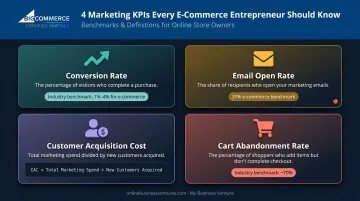
No first strategy is perfect. The entrepreneurs who grow are the ones willing to track results, identify what's working, and adjust. Core KPIs to start with:
- Conversion rate — the percentage of visitors who complete a purchase
- Email open rate — a signal of list health and subject line quality (Klaviyo's 2026 platform data reports a 31% average for e-commerce campaigns)
- Customer acquisition cost (CAC) — total marketing spend divided by new customers acquired
- Cart abandonment rate — the share of shoppers who add items but don't check out
MBV's platform includes a built-in Google Analytics dashboard and traffic monitoring tools accessible directly through the store admin. For entrepreneurs who want guidance beyond the tools, MBV's business consultants — trained under the advisory framework of Shark Tank's Kevin Harrington — offer one-on-one coaching to help clients implement their strategy and adjust as the data comes in.
Frequently Asked Questions
What are the 7 basic marketing concepts?
The 7 basic marketing concepts are the 7 Ps of the Marketing Mix: Product, Price, Place, Promotion, People, Process, and Physical Evidence. Together, they guide how a business creates, delivers, and communicates value — covering everything from what you sell to how customers experience buying it.
What are the 5 C's of marketing?
The 5 C's are Company, Customers, Competitors, Collaborators, and Context. This framework is used for situational analysis — helping businesses understand both their internal capabilities and the external environment before committing to a marketing strategy.
What is the difference between the 4 Ps and 7 Ps of marketing?
The original 4 Ps — Product, Price, Place, and Promotion — were developed in 1960 and cover the core mechanics of any marketing strategy. The 7 Ps expand on that by adding People, Process, and Physical Evidence to account for service businesses and the full customer experience. Both frameworks remain in use, but the 7 Ps offer a more complete picture.
What is the marketing funnel and how does it work?
The marketing funnel maps the journey a customer takes from first hearing about you to becoming a repeat buyer: Awareness, Consideration, Decision, and Loyalty. Each stage calls for different tactics — social content early on, promotions closer to purchase, and email or loyalty programs to keep customers coming back.
What types of marketing work best for small or online businesses?
Content marketing, SEO, social media, and email marketing tend to offer the strongest long-term return for small and online businesses because they build compounding value over time. Paid ads (PPC) can supplement for faster reach, especially at launch.
How do I start marketing my online store with no prior experience?
Start by defining your target audience, pick one or two channels to focus on first, and set 2–3 simple, measurable goals. Resources like this guide are a solid starting point, and working with a dedicated e-commerce consultant — like those at My Business Venture — can shorten the learning curve considerably and help you sidestep the most common early mistakes.