Introduction
Picking a product that looks good is easy. Knowing there's real, measurable demand for it before you spend a dollar on ads or inventory — that's the actual skill.
Most dropshipping mistakes trace back to this gap. Sellers browse supplier catalogs, spot something with visual appeal or a "bestseller" badge, launch a store, and then wonder why traffic never comes. The missing step is keyword research — the process that converts product hunches into data-backed decisions.
The dropshipping market is projected to reach $583.5 billion by 2026, according to Grand View Research. In a market that size, gut instinct isn't a strategy — validated demand is.
This guide walks through the full keyword research process: how to find winning products, which metrics actually matter, common mistakes to skip, and where to confirm demand beyond Google.
Key Takeaways
- Search volume, trend direction, and competition must all be checked together — no single metric is enough
- Buyer-intent keywords ("buy," "best," "under $X") are stronger product signals than informational searches
- Use CPC as a profitability proxy — higher CPC signals stronger commercial demand
- Long-tail keywords (3–5 words) frequently outconvert broad terms dominated by major retailers
- Revisit keyword research quarterly to keep your catalog aligned with actual demand
Why Keyword Research Gives Dropshippers a Competitive Edge
In dropshipping, you're choosing from an enormous pool of possible products. You cannot afford to build a store around something nobody searches for. Keyword research acts as a demand filter, showing which products people are actively looking for and spending money on — regardless of how compelling they look in a supplier catalog.
The data reveals more than raw popularity:
- Search intent — Are people browsing for information or ready to buy?
- Seasonal patterns — Is this a Christmas spike or consistent year-round interest?
- Market saturation — Are Amazon and Walmart already locking up every top result?
Profitable dropshipping depends on finding the overlap of real demand and manageable competition. Keyword data is the fastest way to confirm whether that overlap exists — and where it's worth competing.
When Keyword Research Is Non-Negotiable
Relying on social media virality or supplier bestseller labels is a shaky foundation. A product going viral on TikTok doesn't automatically mean people are searching for it on Google or ready to buy.
Keyword research becomes especially critical when:
- Launching a new store or niche
- Evaluating whether to add a product category
- Testing a product before running paid ads
- Writing SEO-optimized product pages
Shopify notes that search patterns can predict retail revenue shifts as much as three quarters in advance — making search data one of the earliest signals available to dropshippers.
How to Find Profitable Dropshipping Products Using Keyword Research
Step 1: Start With a Seed Product Idea
Keyword research starts with a seed — a rough product concept drawn from browsing supplier catalogs, Amazon bestseller lists, trending social content, or general category interest.
One advantage for entrepreneurs using a platform like My Business Venture (MBV): instead of starting from scratch, you begin with a curated catalog of 2,500+ top-selling products across categories like electronics, pet items, toys and games, home and office products, gifts, and colognes and perfumes. That's a ready-made pool of seed ideas to validate — no blank page required.
The next move is translating your product idea into the language customers actually use. Suppliers might call it a "cervical traction device." Shoppers search for "neck stretcher." Your seed keyword should match customer language, not supplier language.
Once you have a working seed keyword, check whether demand is growing or fading before investing further.
Step 2: Check Trend Direction With Google Trends
Take your seed keyword to Google Trends. Set the location to the US, then compare "Past 12 months" against "Past 5 years." Here's what each pattern signals:
| Trend Pattern | What It Means for Dropshipping |
|---|---|
| Consistent upward | Strong entry opportunity — growing demand |
| Flat/stable | Reliable, steady market with predictable demand |
| Seasonal spikes | Viable with timing strategy (plan around peaks) |
| Declining | Risky — shrinking returns over time |
| Sharp spike then crash | Likely a fad — proceed with caution |
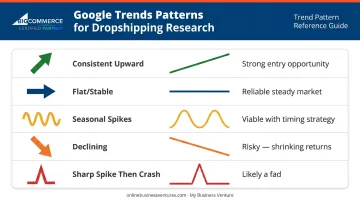
Google Trends uses a normalized scale of 0–100 (relative interest, not raw query counts). Also check the Related Queries section — the "Rising" tab surfaces fast-growing adjacent terms that often have lower competition than the main keyword, revealing more specific product niches worth targeting.
Step 3: Measure Volume and Competition With a Keyword Tool
Three free tools worth using:
- Google Keyword Planner — requires a Google Ads account with billing info; shows search volume and top-of-page bid ranges
- Ubersuggest — free tier available; shows search volume, SEO difficulty, and keyword suggestions
- Ahrefs Free Keyword Generator — no account required; returns 100+ keyword ideas with volume and difficulty scores
Pull monthly search volume, keyword difficulty, and CPC for your seed keyword and its variations. Expand the list by entering related terms and capturing long-tail variations (3–5 word phrases). A strong dropshipping keyword list usually contains one or two primary terms and several supporting long-tail variations — not a single isolated keyword.
One important note: Keyword Planner's "Competition" metric reflects advertiser competition, while Ubersuggest and Ahrefs report organic ranking difficulty. These measure different things and shouldn't be treated as interchangeable.
With a solid keyword list in hand, the next step is filtering for the searches most likely to convert.
Step 4: Filter for Buyer-Intent Keywords
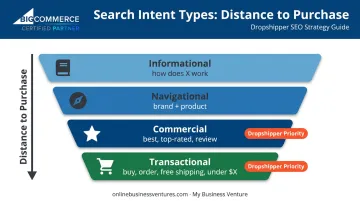
Not all searches represent the same mindset. There are four types of search intent:
- Informational — "how does a standing desk work"
- Navigational — "IKEA standing desk"
- Commercial — "best standing desk under $300"
- Transactional — "buy standing desk free shipping"
Dropshippers should prioritize transactional and commercial keywords. These represent shoppers who are close to purchasing, not just researching.
Look for these signal words in your target keywords:
- buy, order, get
- best, top-rated, review
- cheap, under $X, free shipping
- for sale, where to buy
To verify intent without a paid tool, Google your keyword in incognito mode. If the top 10 results are mostly product pages and comparison guides, intent is commercial or transactional — strong for dropshipping. Mostly blog posts and Wikipedia entries? The keyword is too informational to drive consistent sales.
Even with the right intent, high volume won't matter if you can't rank. That's where SERP analysis comes in.
Step 5: Assess SERP Competition for Rankability
High search volume and strong intent still won't help if every top result is Amazon, Walmart, or Target. Examine the first page of results manually:
- Small niche stores, blogs, or Etsy listings in the top 10 — room to compete
- Big-box retailers dominating every result — much harder to rank without significant domain authority
Free browser extensions like MozBar or the Ahrefs Toolbar show domain authority scores for each result. Lower domain authority among the top-ranking pages means the keyword is more accessible for a newer or growing dropshipping store.
Key Metrics That Separate Winning Keywords from Duds
Raw keyword data doesn't mean much on its own. The four metrics below only tell a complete story when you read them together — no single number makes or breaks a product.
Monthly Search Volume (MSV)
MSV shows how often a keyword is searched each month, giving you a baseline for potential traffic.
Shopify's e-commerce keyword guide identifies 1,000 monthly searches as a reasonable prioritization baseline — though this is one publisher's guideline, not a universal industry standard. Long-tail keywords with fewer than 1,000 searches can still be profitable when buyer intent is strong.
- Too low — You're in a niche with minimal demand
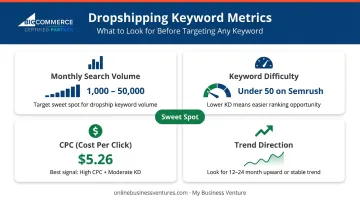
- 1,000–50,000 — Generally workable for niche dropshipping when competition is moderate
- 100,000+ — Often signals a market where major retailers have locked up most visibility
Keyword Difficulty (KD)
KD scores estimate how hard it will be to rank organically for a keyword. But the scales differ by tool:
| Tool | Scale | Bands |
|---|---|---|
| Ahrefs | 0–100 | No official published bands; considers referring domains to top-10 pages |
| Semrush | 0–100 | 0–14 Very Easy / 15–29 Easy / 30–49 Possible / 50–69 Difficult / 70–84 Hard / 85–100 Very Hard |
Don't translate scores directly between tools. A 35 on Semrush and a 35 on Ahrefs reflect different methodologies entirely. For newer stores, Semrush's e-commerce guidance suggests targeting keywords with a Personal KD below 50%.
Cost-Per-Click (CPC)
CPC reflects what advertisers pay per click on a keyword — and Semrush identifies high CPC as a signal of commercial value and a greater likelihood of sales. When businesses compete aggressively to pay for clicks, it's because those clicks convert into revenue.
CPC is an auction metric, so it shifts by category, geography, and competition. Use benchmarks as context, not hard thresholds:
- Google Search average CPC: $5.26 (WordStream, 2025)
- Apparel/Fashion/Jewelry average: $4.31
- Best combined signal: high CPC + moderate KD — commercially proven demand that well-funded competitors haven't fully locked up yet
Trend Direction
A keyword's current volume only tells part of the story. An upward or stable trajectory over 12–24 months suggests durable demand worth building around. A sharp spike followed by a crash is usually a fad — you'd be entering just as interest collapses.
Always use Google Trends alongside your keyword tool. Don't rely on a single 30-day snapshot; Shopify recommends looking at at least 12 months, ideally 3–5 years, to distinguish sustained demand from seasonal noise.
No single metric here is a green light on its own. The strongest product opportunities show up where all four align: workable search volume, manageable difficulty, high advertiser CPC, and a stable or rising trend line.
Common Keyword Research Mistakes That Kill Dropshipping Profits
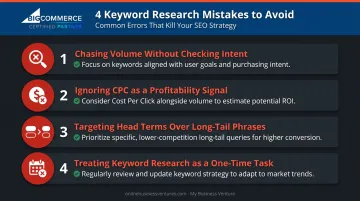
Most keyword research errors aren't about missing data — they're about misreading it. These four mistakes consistently drain dropshipping margins before a single product ships.
Chasing volume without checking intent. High search volume means nothing if people are researching, not buying. A keyword like "how do air fryers work" brings traffic that rarely converts. Filter for buyer intent first — then evaluate volume.
Ignoring CPC as a profitability signal. Many beginners focus only on volume and difficulty, skipping cost-per-click data entirely. Low CPC in a crowded niche typically signals thin margins and price-sensitive buyers — a tough environment when you have no supply chain leverage over established retailers.
Targeting head terms over long-tail phrases. Keywords like "phone cases" or "yoga mats" are dominated by mega-retailers. A phrase like "phone cases for iPhone 16 Pro with card holder" has lower competition, higher specificity, and better conversion — it matches exactly what a ready-to-buy shopper types.
Treating keyword research as a one-time task. Search behavior shifts with seasons, new products, and trend cycles. A keyword that performed well six months ago may be declining now. Revisit your research quarterly, especially before adding products or launching paid campaigns.
Catching even one of these mistakes early can redirect budget toward keywords that actually drive sales.
Beyond Google: Validating Product Keywords Across Other Platforms
Amazon and Marketplace Autocomplete
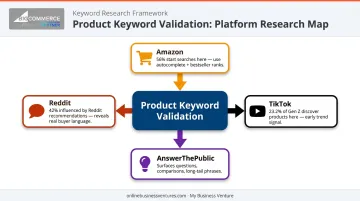
According to a Jungle Scout Q1 2024 survey of 1,000 US consumers, 56% began their product searches on Amazon versus 42% on a traditional search engine. What Amazon autocompletes when you type in the search bar is what actual buyers type when ready to purchase.
Run Amazon's autocomplete and bestseller rankings as a parallel validation layer, then cross-reference those phrases with a keyword tool to confirm search volume and CPC on Google.
TikTok and YouTube Search Signals
TikTok has become a genuine product discovery engine. eMarketer reported that 23.2% of Gen Z shoppers said TikTok was where they most often discovered products. A product with strong Google keyword demand and an active content community on TikTok is double-validated.
TikTok's search bar and YouTube autocomplete regularly surface demand earlier than traditional keyword tools — giving you a window to act before trends peak in Google volume.
AnswerThePublic and Reddit for Long-Tail Discovery
AnswerThePublic pulls autocomplete data from Google, Bing, YouTube, and Amazon, organizing results into questions, comparisons, and related phrases. This surfaces the exact language customers use when they're curious, confused, or close to buying — directly translating into long-tail keyword ideas and product page content.
Reddit also delivers something formal tools can't: an Attest survey found 42% of US monthly social media users said a Reddit recommendation was most influential in a recent purchase decision. Together, these two sources uncover:
- Real buyer objections and hesitations by product category
- Specific use cases that reveal underserved keyword angles
- Natural language phrases that translate directly into product page copy
- Niche subreddit threads where purchase intent surfaces organically
Conclusion
Keyword research turns product selection from guesswork into a repeatable process. The combination of search volume, keyword difficulty, CPC, and trend direction gives you a reliable filter for separating products worth building a store around from ones that just look good on paper.
The approach works best as an ongoing practice. Markets shift, competition changes, and new products enter niches all the time. Research that's months old is already outdated — treat it as a habit, not a one-time task.
Once you've confirmed demand, the next step is getting a product page live before the opportunity closes. For entrepreneurs who want to act on validated products without building from scratch, My Business Venture offers a fast path to market:
- A professional BigCommerce store, ready to sell from day one
- Access to 2,500+ curated products across proven categories, with profit margins of 35–200% on most items
- One-on-one consultant support to guide your launch
Most clients go from signup to live store in a matter of days.
Frequently Asked Questions
What search volume is considered good for a dropshipping product keyword?
Shopify identifies 1,000 monthly searches as a reasonable prioritization baseline, though it's one guideline rather than a universal standard. For most dropshippers, the practical sweet spot sits in the low-to-mid thousands — real demand, but not so much that major retailers have already locked up every top result. Long-tail keywords with lower volume can still convert well when buyer intent is strong.
What's the difference between search volume and buyer intent?
Search volume measures how many people search a keyword; intent describes what those people are actually trying to do. A high-volume keyword with informational intent brings traffic but few sales. A lower-volume keyword containing words like "buy" or "best" signals a shopper ready to spend — and those keywords drive actual revenue despite smaller audience sizes.
Can I do dropshipping keyword research with free tools?
Yes. Google Keyword Planner, Ubersuggest's free tier, Ahrefs' free keyword generator, and Google Trends together provide enough data to validate most product ideas at no cost. Paid tools add deeper historical data and competitor analysis, but you can get a solid read on demand and competition without spending a dollar.
How do I find low-competition keywords for dropshipping?
Target long-tail phrases of 3–5 words and check keyword difficulty scores — aim for under 30 on Semrush's scale if your store is newer. Then manually scan the SERPs to confirm that top-ranking pages belong to smaller, beatable sites rather than established retailers.
How often should I redo keyword research for my dropshipping store?
At minimum, revisit keyword research quarterly. Do it more frequently before launching new products, running paid ad campaigns, or entering a new niche. Search trends, competition levels, and buyer behavior all shift — a stale keyword strategy leads to diminishing returns regardless of how strong the original research was.
What does a high CPC mean for a dropshipping product keyword?
High CPC signals that advertisers are competing to reach buyers in that niche because those buyers convert and spend. It's a positive indicator of commercial value — especially when paired with manageable keyword difficulty. Combined with strong intent signals, high CPC is one of the most reliable early indicators that a niche is worth entering.