

Introduction
Launch a product today, and you'll immediately share shelf space — virtual or physical — with dozens of competitors selling nearly identical items. Competing on price alone is a race to the bottom that no entrepreneur wins.
What actually separates the stores customers remember from the ones they scroll past is a deliberate brand. Not a logo slapped together in Canva, but a real identity: intentional design, a visual language customers recognize on sight, and a story they actually believe.
This guide covers everything you need to build that identity from the ground up:
- What product branding actually means (and why it's different from corporate branding)
- The visual design elements that create instant recognition
- How storytelling converts browsers into loyal buyers
- A five-step framework you can start using today
Whether you're building your first store or tightening up an existing one, you'll leave with a clearer picture of what your brand should say — and how to make it say it.
Key Takeaways
- Product branding creates a distinct identity for a specific product or line — separate from the parent company
- Visual elements (logo, color, typography, imagery) must work together, not independently
- Brand stories center the customer as the hero — not the product's spec sheet
- Consistency across every touchpoint builds trust — and trust converts first-time visitors into repeat buyers
- Strong branding doesn't require a big budget — you can build a professional identity from day one
What Is Product Branding?
Product branding is the process of giving a specific product or product line its own recognizable identity — separate from the company behind it.
Coca-Cola is a classic example. The parent company owns several distinct product brands — Coca-Cola Classic, Diet Coke, and Coke Zero each target a different audience with a different visual palette, tone, and emotional hook. Same corporate parent. Completely different brand experiences.
Product Branding vs. Corporate Branding
| Product Branding | Corporate Branding | |
|---|---|---|
| Focus | Specific product or line | The company as a whole |
| Audience | Defined buyer segment | Broader stakeholders |
| Key Assets | Packaging, design, product story | Company values, reputation |
| Example | Tide, Pampers, Gillette | Procter & Gamble |
For a first-time e-commerce entrepreneur, this distinction has a direct practical impact. Even a single-product dropship store needs its own brand story — a reason for customers to choose your store over the next one selling the same item.
Product branding also differs from service branding. Product brands lean heavily on tangible visual cues: packaging, photography, design. Service brands rely more on trust signals and delivery consistency. Because most entrepreneurs building e-commerce stores sell physical products, this guide focuses squarely on product branding principles.
Why Product Branding Matters for Your Business
The Psychology Behind the Purchase
Most purchasing decisions aren't rational. Harvard Business School professor Gerald Zaltman, writing in How Customers Think, asserts that 95% of purchase decision-making occurs in the subconscious mind — meaning customers feel their way to a choice before they rationalize it.
Your brand is what manufactures that feeling before a customer clicks "add to cart."
This is backed by hard trust data. Edelman's 2019 Trust Barometer surveyed 16,000 consumers across eight markets and found that brand trust was a deciding purchase factor for 81% of respondents. Consumers who trusted a brand were more than twice as likely to buy first (53% vs. 25%) and to remain loyal (62% vs. 29%).
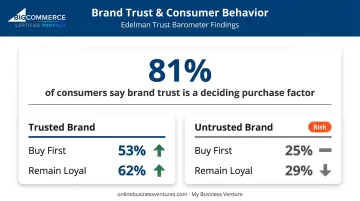
Trust isn't built in a single interaction — it accumulates across every visual and verbal signal your brand sends. That accumulated perception is exactly what drives the business outcomes worth building toward.
The Business Case for Branding Early
New entrepreneurs often treat branding as something to figure out after they start making sales — but in e-commerce, where a visitor decides whether to trust your store in seconds, that delay costs you conversions before you ever know you lost them.
Strong product branding delivers:
- Customers pay more for products that feel premium, even when the underlying item is comparable
- A consistent visual identity makes your store memorable in a crowded feed
- Buyers return to brands they feel connected to, not just products they found convenient
- A trusted brand makes launching new products significantly easier
Strong branding doesn't require a large budget. A professional logo, a consistent color palette, and a clear value message can all be built from day one — and the earlier you start, the less ground you have to recover.
The Core Elements of Product Brand Design
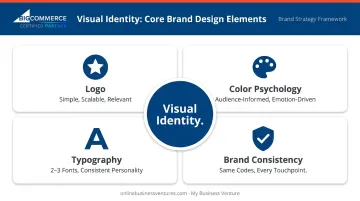
Visual identity is the fastest signal a brand sends. Before a customer reads a single word, they've already formed an impression based on what they see. Four foundational elements shape that impression.
Logo
An effective product logo does three things: it's simple enough to be recognized at a glance, scalable enough to look sharp on a website header and a product thumbnail, and relevant enough to communicate the brand's personality without explanation.
When briefing a designer — or working with a platform that includes logo design — prioritize clarity over cleverness. A logo that looks good only at large sizes will fail everywhere else that matters.
For entrepreneurs launching a dropship store, this is worth factoring into your platform choice. My Business Venture (MBV) bundles custom logo design into all three of its e-commerce startup packages ($3,995–$5,995), so branding is handled from day one rather than pieced together later.
Color Psychology
Color does more than decorate — it actively shapes how customers perceive your brand before they read a word. Research published in Exciting Red and Competent Blue by Labrecque and Milne in the Journal of the Academy of Marketing Science found across four empirical studies that color dimensions shape brand personality perceptions and influence downstream consumer responses.
Practical applications:
- Blue — signals trust and reliability (financial, tech, health brands)
- Green — conveys nature, wellness, and sustainability
- Red — creates urgency and excitement
- Black/gold — suggests premium and luxury
Color choice should be deliberate and audience-informed. Pick colors that match how your target customer wants to feel, not just colors you personally like.
Typography
Font choices communicate personality before readers process the words:
- Serif fonts (Times New Roman, Georgia) — tradition, authority, established credibility
- Sans-serif fonts (Helvetica, Inter) — modernity, approachability, clarity
- Script fonts — creativity, personal touch, artisanal quality
Limit yourself to 2–3 complementary fonts. More than that reads as amateur across both digital and print applications.
Brand Consistency Across Touchpoints
All four elements must be applied uniformly across every customer-facing surface:
- Same hex codes on every platform
- Same logo at every size and placement
- Same fonts across web, email, and print
- Same image style on product pages and social profiles
Inconsistency doesn't just look unprofessional — it erodes the trust that visual branding is designed to build. A quick check: if you covered your logo on any piece of brand material, could a customer still identify it as yours?
How Storytelling Powers Your Product Brand
Why Stories Stick
Feature lists don't build loyalty. Stories do. A 2014 meta-analysis published in the Journal of Consumer Research synthesized 132 effect sizes from 76 studies and found that narrative transportation — being drawn into a story — is directly associated with consumer beliefs, attitudes, intentions, and purchasing behavior.
The implication for product brands is direct: a story that pulls a customer into your world is more persuasive than any bullet-point comparison.
The Customer Is the Hero
A product brand story is not your company's founding history. That's corporate branding. For a product brand, the story centers on the customer — their problem, their aspiration, and where your product fits into the life they're trying to build.
Your brand is the guide. The customer is the hero.
Glossier built its entire identity on this principle. Described in an HBS case study as "born from content; fueled by community," Glossier reported 600% sales growth in 2017 with its customer portfolio growing 3x — driven significantly by making buyers feel like insiders, not targets.
Three Story Elements Every Product Brand Needs
Define these three things before writing a word of product copy:
- The problem — What specific pain point or frustration does this product solve?
- The transformation — What does life look or feel like after using it?
- The values — What does this brand stand for that makes it the right choice over competitors?
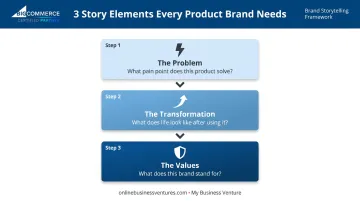
These elements should appear in some form across your product descriptions, about page, social content, and marketing copy.
Story in Practice
Storytelling shows up across every brand touchpoint:
- Product pages that describe outcomes and lifestyle, not just specifications
- Social media that shows the product in real-world context — in use, in someone's home, in a moment that matters
- Founder narratives that build human connection (MBV's own founder, Thomas Stridiron, started the company from a two-bedroom apartment with $100 — a story that resonates with the very entrepreneurs he now helps get started)
- Customer testimonials that serve as third-party proof of the brand's promise
Aligning Story and Design
Once your story is clear, your visuals need to carry it. A brand that promises simplicity and calm but uses chaotic fonts and neon colors sends mixed signals — and customers notice the contradiction faster than you'd expect.
Visual identity and narrative must reinforce each other at every touchpoint.
Do a quick alignment check: read your brand story aloud, then look at your visual identity. Does every design decision support the tone of what you just read? If it doesn't, start with the element that feels most off — usually typography or color — and adjust from there.
5 Steps to Build a Product Brand From Scratch
Step 1: Define Your Unique Selling Proposition (USP)
Your USP is the single, clear answer to: "Why should a customer buy this from me instead of anyone else?"
It could be a specific audience you serve, a product attribute, a cause alignment, or a distinctive experience. Use this template to draft yours:
"I help [target customer] achieve [desired outcome] through [unique product or approach]."
Be specific. "I help pet owners find eco-friendly accessories through a curated store with free shipping" beats "I sell pet products" every time.
Step 2: Know Your Target Customer Deeply
Every brand decision — visual, verbal, and strategic — must flow from a clear understanding of your ideal customer. Build a basic buyer persona covering:
- Age, location, and income level (the practical context shaping what they can buy)
- Values, lifestyle, and self-identity (what they want their purchases to say about them)
- Where they browse and what triggers a purchase decision
- What frustrates them — and what version of themselves they're buying toward
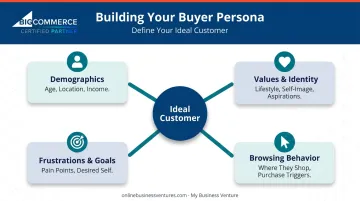
The more specific the profile, the more resonant the brand will be. Vague personas produce vague brands.
Step 3: Build Your Visual Identity
Visual identity is how your brand shows up before anyone reads a word. At minimum, invest in:
- A professional logo
- A defined color palette (3–5 colors with exact hex codes)
- A typography system (2–3 fonts)
- A consistent image style
Even a one-page brand style guide — documenting logo usage, color codes, fonts, and image direction — will dramatically improve consistency across every piece of content you create. If you're launching through MBV, custom logo design and a fully branded storefront are included in every package tier — so the visual foundation is built before you publish your first product.
Step 4: Craft Your Brand Story and Voice
Write two foundational assets before creating any other content:
- Brand story paragraph — Who is this product for? What problem does it solve? Why does this brand exist? Keep it to 3–4 sentences.
- Brand voice guide — Define your tone in 3–5 words (e.g., "warm, direct, unpretentious") and list 2–3 phrases that reflect how the brand always sounds. These will guide every piece of copy you write going forward.
Step 5: Apply Consistently and Measure
Roll out your visual identity and story across every touchpoint: website, product pages, social profiles, email templates, and any packaging materials.
Then track these brand health indicators:
| Metric | Good Benchmark |
|---|---|
| Social engagement rate | 2–4% (Hootsuite, 2026) |
| Repeat purchase rate | 20–30% (Klaviyo) |
| NPS (retail average) | 29 (XM Institute, 2024) |
| Branded search growth | Monitor trend direction monthly |
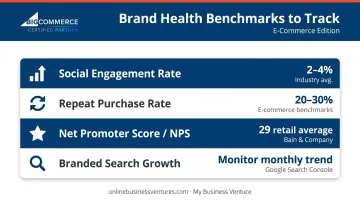
Set a calendar reminder to audit your brand quarterly. Check whether your visuals, copy, and customer experience still tell the same story — and adjust wherever they've drifted apart. Brands that stay aligned at every touchpoint tend to see higher repeat purchase rates and stronger organic word-of-mouth over time.
Frequently Asked Questions
How much does a branding service cost?
Branding costs range widely — from a few hundred dollars for freelance logo work to tens of thousands for full agency packages. Entrepreneurs can access professional logo design and a fully branded store setup more affordably through platforms like MBV, where both are included in packages starting at $3,995 as a one-time investment.
What is an example of service branding?
FedEx is a classic example. Built around the historic promise "Absolutely, Positively, Overnight!," FedEx turned a service guarantee into a memorable brand identity through consistent visual and verbal messaging. Service branding differs from product branding in that it depends on consistent experience and earned reputation rather than physical design cues.
What are the 5 C's of branding?
The 5 C's of branding — Clarity, Consistency, Content, Connection, and Credibility — are a practitioner framework for evaluating brand effectiveness. Use them as a quick audit: if your brand scores well on all five, it's communicating clearly and building the right associations across channels.
What is the 3-7-27 rule of branding?
The 3-7-27 rule is an industry heuristic suggesting consumers need roughly 3 exposures to recognize a brand, 7 to remember it, and 27 to develop trust. The takeaway is straightforward: repeated, consistent brand touchpoints are how recognition and loyalty build over time.
What is the difference between product branding and corporate branding?
Corporate branding represents the overall company identity and reputation. Product branding creates a distinct identity for a specific product or line. Procter & Gamble is the corporate brand; Tide, Pampers, and Gillette are each separately branded products with their own visual identities and audience targeting.
How do I create a brand identity for my product if I'm starting from scratch?
Start with your USP and target customer profile, then build your visual identity (logo, colors, typography) and brand story around those foundations. Apply both consistently across your website, social media, and product pages from day one. If you want a faster path, MBV includes logo design and a branded store setup in every package tier, so you're not piecing together those foundations on your own.