It's no surprise more people want a piece of it. Low overhead, dropshipping models that skip inventory investment, and the option to start part-time make online retail more accessible than ever. We're seeing side-hustlers, stay-at-home parents, laid-off professionals, and retirees launch stores alongside seasoned entrepreneurs.
But "accessible" isn't the same as "simple." This guide walks through exactly what starting an ecommerce business requires, step by step. MBV has guided entrepreneurs through this exact process for over 30 years, so consider this the checklist we wish every new owner had on day one.
Key Takeaways
- Dropshipping and turn-key models let you launch without buying inventory upfront
- Validating demand and locking down legal basics matters more than a polished website
- Startup budgets range from a few hundred dollars for lean dropshipping to $5,995 for a full turn-key package
- Turn-key platforms and consultants can compress a months-long launch into days
- The 80/20 rule applies to ecommerce too: roughly 20% of your products typically drive 80% of your sales
What Is an Ecommerce Business?
An ecommerce business sells products or services online, through a dedicated website, a marketplace, or social channels, instead of (or alongside) a physical store. The customer experience is the point: shoppers get convenience and faster access, browsing and buying without ever walking into a shop.
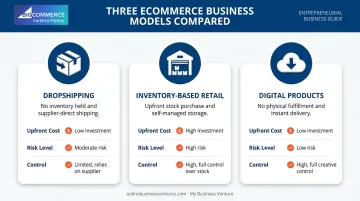
There's no single way to build one. Common formats include:
- Dropshipping: you sell products a supplier stocks and ships, so you never touch inventory
- Inventory-based retail: you buy stock upfront and manage warehousing yourself
- Digital products: courses, software, or downloadable goods with no physical fulfillment at all
How you build it matters too. You can handle every piece yourself, or partner with a turn-key provider like MBV, which sets up your branded store and connects you to a dropship fulfillment network so you're not managing logistics solo.
Each format changes your upfront costs, workload, and risk profile. That's the first decision every new owner has to make.
Why Start an Ecommerce Business Today? (When It Makes Sense)
Starting now isn't a guaranteed win. It's a sound decision under specific conditions: low barriers to entry, the ability to test a niche cheaply, and a market that's still growing fast.
The Market and Margins Favor Testing Now
Online retail's climb to 16.9% of total U.S. retail sales (Census Bureau) means customers are already shopping in this channel. You're meeting existing demand, not creating new shopping habits.
The margin data backs this up, with some fine print attached. Shopify reports 10%-15% profit margins as typical for stores dropshipping from open marketplaces (Shopify's dropshipping guide). That's a general benchmark, not a guarantee.
Turn-key providers with curated, brand-name catalogs can perform differently. MBV's own client stores, for instance, run 35-200% margin ranges on curated products, because pricing control sits with the store owner rather than an open marketplace race to the bottom.
Lower Startup Costs and Real-Time Data
Traditional retail means renting shelf space and buying stock before you've sold a single unit. Dropship models flip that.
MBV's storefronts, for example, run on a no-inventory-stocking model: you feature products from a live catalog, and a fulfillment partner picks, packs, and ships only after a customer pays. No warehouse, no unsold stock sitting in a garage.
Beyond lower overhead, going digital gives you visibility a physical shop can't match. Analytics dashboards show what's converting, what's abandoned in carts, and where traffic originates. A brick-and-mortar shop owner waits weeks for that kind of clarity; you get it in real time.
What to Know Before You Start (Setting Realistic Expectations)
Knowing what effort, cost, and timeline actually look like matters more than whether you feel "capable." Skip that step, and you risk quitting three months in, frustrated by expectations that were never realistic.
Time and Effort Add Up Early
Research, supplier vetting, customer service, and content creation eat more hours in month one than most beginners plan for. The store itself is the easy part.
Costs Vary Sharply By Model
| Model | Typical cost range | Notes |
|---|---|---|
| DIY website build | $0-$250,000+ | Depends entirely on customization (BigCommerce's ecommerce cost breakdown) |
| Custom professional build | Most under $10K, average $51,943 | Reflects scope, not a DIY project |
| Inventory-based store | 17%-25% of startup budget on stock | Product and order volume drive the total |
| Dropshipping/turn-key | $200-$300 first month (lean DIY) to $3,995-$5,995 (full turn-key package) | Turn-key includes site, catalog, hosting, and support bundled together |
Profitability Takes Months, Not Days
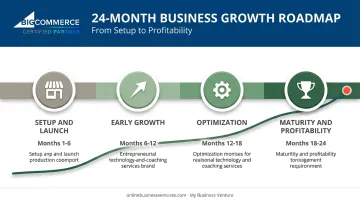
Shopify recommends planning for an 18-24 month runway as a realistic timeline before a business fully matures, not a promise of profit. Anyone selling overnight riches is selling a fantasy.
Skills and Legal Friction Are Often Underestimated
Basic organizational skills matter as much as tech savvy, and a good consultant can fill gaps in either.
Legal requirements add another layer of complexity. Business registration, EIN applications, and sales tax permits all vary by state:
- Texas requires a permit for any taxable sales
- California requires a seller's permit for tangible goods
- Oregon skips general sales tax altogether
There's no one-size-fits-all answer here. Check your state's specific requirements before you launch.
The Ecommerce Business Checklist: Step-by-Step
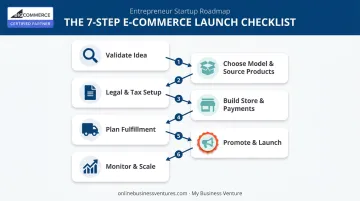
This is the practical execution sequence, from validating an idea to scaling a working store. The most common mistakes? Rushing to launch, skipping demand validation, underpricing to win early customers, and scaling before the business is stable.
Step 1: Validate Your Idea, Niche, and Target Audience
Confirm someone has an urgent problem and a budget to solve it before building anything.
- Research competitors and demand signals: search interest, reviews, active online communities
- Test willingness to pay through pre-orders, surveys, or a small pilot batch
- Confirm the market isn't empty (no demand) or oversaturated (no differentiation)
Step 2: Choose Your Business Model and Source Products
Decide between dropshipping, wholesale/inventory, manufacturing, or digital products based on your capital and risk tolerance.
- Vet suppliers for reliability, quality, and fulfillment speed
- Consider blind dropshipping, where packages ship under your brand name, not the supplier's, to keep the customer relationship yours
- Skip months of sourcing legwork with turn-key providers like MBV, which give beginners a curated catalog of 2,500+ products (over 1 million total), built-in fulfillment, and 35-200% profit margins
Step 3: Set Up Legal, Tax, and Business Basics
Handle this before you accept a single dollar.
- Register your structure: sole proprietorship, LLC, or corporation, depending on liability preference
- Get a federal EIN: required for most entities beyond a basic sole proprietorship, and free through the IRS
- Apply for state sales tax permits: requirements vary widely; Texas and California both require permits for taxable goods
- Open a business bank account and secure basic insurance before your first sale
Step 4: Build Your Online Store and Payment System
Your platform choice affects scalability, ease of use, and available support long after launch.
Non-negotiables:
- Mobile responsiveness
- SSL security
- Clear product pages
- Legal pages: terms of service, shipping, and returns policies
MBV, as a Certified BigCommerce Developer, builds a fully branded, SSL-secured storefront live in days, bundling custom logo design and fraud-prevention monitoring for owners who want to skip the DIY build entirely. Whichever route you take, set up your payment gateway and test the full checkout flow before going live.
Step 5: Plan Fulfillment, Shipping, and Customer Support
Decide on in-house fulfillment, third-party logistics, or dropship, and set delivery expectations customers can actually trust.
- Establish a clear returns and refund policy before your first sale
- Confirm inventory availability if you're stocking products, to avoid backorders that tank early reviews
- Set up basic customer service channels: email, chat, or phone
Step 6: Promote and Launch to the Market
A store with no traffic won't succeed, no matter how well it's built.
- Build pre-launch buzz through social media and an email list
- Use basic SEO and content marketing to start ranking for target searches
- Identify potential affiliates or brand promoters to extend reach beyond your own channels
The most common miss here: relying on a single marketing channel and guessing at what actually drives leads instead of tracking it.
Step 7: Monitor, Optimize, and Prepare to Scale
Launch day is the beginning, not the finish line.
- Track conversion rate, cart abandonment, average order value, and direct customer feedback
- Fix pricing or operational gaps before spending more on paid ads
- Reinvest in channels that are already working before expanding your catalog
Conclusion
Starting an ecommerce business successfully comes down to a few fundamentals:
- Validate demand before you invest
- Handle legal setup properly
- Secure reliable fulfillment
- Market consistently
Speed matters less than getting these pieces right the first time.
Partnering with an experienced guide can shorten that learning curve considerably. MBV's consultants and MBV University training exist specifically to help new owners sidestep the mistakes that sink first-time stores. Use this checklist as your working roadmap, or reach out to MBV for one-on-one support building yours.
Frequently Asked Questions
What do I need to start an ecommerce business?
You need a validated niche, a registered business structure, a website or selling platform, a payment processing setup, and a plan for sourcing or fulfilling orders. Skipping any of these often creates costly problems later.
What are the 7 C's of ecommerce?
The framework covers Context (site design), Content, Community, Customization, Communication, Connection, and Commerce (transaction capability). It's a useful lens for auditing whether your store covers all the bases customers expect.
What is the 80/20 rule in ecommerce?
It's the Pareto principle applied to online retail: roughly 80% of revenue often comes from 20% of products or customers, according to Shopify's breakdown of the 80/20 rule. The ratio isn't exact, but it's a useful guide for where to focus your effort.
How much does it cost to start an ecommerce business?
Costs vary widely by model. Lean dropshipping can start around $200-$300 for the first month, while turn-key packages bundling a website, catalog, and support typically run $3,995-$5,995 as a one-time investment.
How long does it take to launch an ecommerce store?
DIY builds can take anywhere from one week to five months, depending on complexity. Turn-key providers, MBV included, can have a fully branded storefront live in days.
Do I need a business license to sell online?
Yes, but requirements vary by state and product category. Sales tax permits, entity registration, and product-specific licenses are separate requirements, so check your state's rules early rather than after your first sale.