Introduction
Millions of Americans are turning spare bedrooms, garages, and kitchen tables into storefronts. U.S. e-commerce sales hit $1,192.6 billion in 2024, up 8.1% from the prior year and now accounting for 16.1% of total retail sales, according to the U.S. Census Bureau. Regular people building side businesses from home are a big part of that growth.
Getting started isn't always simple, though. Common questions include which model fits, how much capital it takes, and whether you can skip holding inventory.
The people doing this aren't one type. Stay-at-home parents build product lines around nap schedules. Retirees start stores to stay active and add to a fixed income.
Corporate employees launch stores on weekends to test whether a side hustle could eventually replace a paycheck. Aspiring entrepreneurs skip the traditional retail lease and go straight online.
This guide covers both major paths: joining a direct sales company or building your own branded e-commerce store. We'll break down what each option actually costs, how to get started, and how a turnkey option like MBV can compress months of setup work into days.
TL;DR
- Selling from home follows three main paths: direct sales/MLM, dropshipping, or a branded online store
- Direct sales offers instant brand recognition; a branded store offers full control and higher margins
- Startup costs range from $25 starter kits to several thousand dollars for a fully built store
- Six steps take you from idea to sales: product, model, setup, pricing, marketing, fulfillment
- Turnkey platforms like MBV can take a store live in days instead of months
What Is a "Sell Products From Home" Business?
At its simplest, a sell-products-from-home business is any venture where you sell physical goods directly to consumers without renting a traditional retail storefront. Your store lives online, in a spare room, or in the trunk of your car on the way to a pop-up.
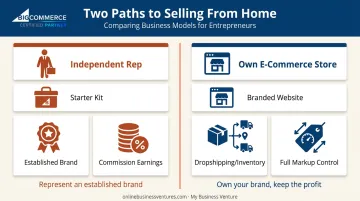
Nearly every home-based selling business falls into one of two paths:
- Independent rep for an established brand: Join a direct sales or MLM company, buy a starter kit, and sell their existing line for commission. Common in beauty, wellness, and kitchenware brands.
- Owner of your own e-commerce store: Build and control a branded online store, sourcing products via dropshipping or your own inventory, and keep the full markup.
The format varies within each path, too:
- Party-plan or social selling: hosting online parties, posting in Facebook groups, or texting your contact list (typical in direct sales)
- Website-based storefronts: a branded site you own outright, built on platforms like BigCommerce
- Marketplace reselling: listing products on Etsy, eBay, or Amazon under their existing customer base
Which path fits depends on how much control, and how much brand-building, you actually want.
Why Start a Sell-From-Home Business Today (When It Makes Sense)
Selling from home isn't a guaranteed win. It works best under specific conditions: you want flexible hours, low overhead, and control over your own income. If you need guaranteed income by next Friday, this probably isn't it.
Lower Barrier to Entry, Lower Risk
Opening a physical retail store means signing a lease, buying fixtures, and staffing a location before selling a single item. The Small Business Administration lists typical costs retailers face before opening day: office space, equipment, licenses, insurance, inventory, and marketing. A home-based e-commerce business skips most of that. You need a laptop, an internet connection, and a product.
That lower cost also means lower risk. A home-based setup lets you validate a product or niche with minimal financial exposure. Run a store for a few months on the side, watch what actually sells, and decide whether to go full-time without ever quitting your job.
Shoppers Already Trust Independent Sellers
Consumers have grown comfortable buying from small, independent online stores instead of only big-box retailers. Direct-to-consumer e-commerce sales in the U.S. are forecast to reach $239.75 billion in 2025, representing 19.2% of total retail e-commerce sales, according to EMARKETER.
That's a large pool of buyers already primed to click "buy" on a store they've never heard of, as long as it looks credible.
Build an Asset, With Support Built In
A 1099 gig ends the moment you stop working it. A well-built online store accumulates a customer list, reviews, and search rankings that keep generating sales, and it can eventually be sold as a business asset.
Beginners don't have to build that asset from scratch, either. Direct sales companies offer training and product catalogs, and turnkey e-commerce providers, MBV included, package training, a built store, and a product catalog together so a first-time owner isn't guessing at every step.
What to Know Before You Start (Early Decisions That Matter)
Most home-based sellers who quit don't fail from lack of skill. They underestimate the effort. Setting realistic expectations upfront saves you from quitting at month two, right before things usually start moving.
Set Realistic Income Expectations
The first three to six months typically go toward sourcing products, listing them, and testing marketing, not collecting steady paychecks. Be skeptical of promises that suggest otherwise. An FTC review of 70 MLM income-disclosure statements found that many participants received no payments at all, and the vast majority earned $1,000 or less per year.
That's a reason to treat "quick income" claims with caution, regardless of which model you pick. Chasing fast income usually leads to underpricing, overpromising, or burning out fast. Businesses that last instead reinvest early profits and build gradually.
Know Which Skill Set You're Leaning On
- Direct sales rewards people skills: hosting parties, following up with contacts, and recruiting
- E-commerce or dropshipping rewards systems thinking: setting up a store, running ads, and improving conversion rates
Pick the model that matches how you actually like to work, not the one that sounds easiest on paper.
Budget for Costs and Legal Requirements
Expect starter kits, inventory purchases, website or hosting fees, or catalog access charges depending on your model. Direct sales kits often run $25 to $200, while a fully built e-commerce store with training and support costs more upfront but skips the ongoing recruitment-driven expenses. Turn-key packages, like the ones MBV offers, bundle store setup, product catalog access, and training into a single one-time payment instead of a string of separate fees.
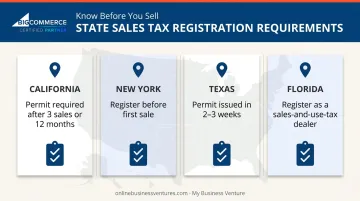
Once you've budgeted for setup, factor in the legal side too. Requirements vary by state, but most home sellers need at least a sales tax permit if they're selling taxable goods:
- California requires a seller's permit once you make three or more sales in 12 months
- New York requires registration before you begin selling, even for occasional sellers
- Texas issues sales tax permits within roughly 2 to 3 weeks of applying
- Florida requires registering as a sales-and-use-tax dealer
Check your state's department of revenue before your first sale, not after.
How to Start Selling Products From Home – Step by Step
This breaks the process into six practical stages. Skip a step, especially product validation or pricing, and you'll likely repeat it later the hard way.
Step 1: Choose What You'll Sell
Start with products you already use, understand, or are willing to learn deeply, not just whatever's trending this week. Then validate demand:
- Check competitor listings on Etsy, Amazon, or eBay to see what's already selling
- Search marketplace and social media hashtags for interest signals
- Look for gaps: underserved price points, missing sizes, or weak customer service among existing sellers
Common miss: picking a product with no personal connection, or diving into an oversaturated niche with zero differentiation.
Step 2: Choose Your Business Model (Direct Sales vs. Your Own Online Store)
This decision shapes everything that follows.
Direct sales/MLM means joining an established company (beauty, wellness, and kitchenware brands are common), buying a starter kit, and earning commission on your sales. You may also earn on sales made by people you recruit.
You get instant brand recognition and a ready-made product line, but earning potential is often capped by the compensation plan.
Your own e-commerce store means you control pricing, product selection, and the customer relationship. Dropshipping lets you sell without holding inventory: a supplier ships the product once you make the sale, and you keep the difference between wholesale and retail.
| Direct Sales / MLM | Owned E-Commerce Store | |
|---|---|---|
| Brand recognition | Instant | Built over time |
| Earning potential | Often capped by comp plan | Uncapped, margin-based |
| Recruiting required | Frequently | Never |
| Setup effort | Lower | Higher, unless turnkey |
Turnkey platforms bridge that gap. MBV builds a fully branded e-commerce store, gives clients access to more than 2,500 curated dropship products drawn from a catalog of over 1 million, and includes training through MBV University.
The result: a beginner owns a real business without the recruiting pressure built into most MLM structures.
Step 3: Set Up Your Sales Channel or Store
You have three broad options: a personal website, an established marketplace like Etsy, Amazon, or eBay, or a social media storefront. Most sellers eventually use more than one.
A professional setup needs, at minimum:
- Secure, encrypted checkout (SSL certificate)
- Clear product photos and descriptions
- Mobile-friendly design, since most shoppers browse on their phones
Building this from scratch usually takes weeks of trial and error. MBV's consultants get a fully operational, SSL-secured store live within days, not weeks, which matters if you're eager to start generating sales while the motivation is fresh.
Step 4: Price Your Products and Understand Margins
Price for margin, not just volume. Factor in:
- Product or wholesale cost
- Shipping, if not included in your platform
- Platform or transaction fees
- The time you're investing per order
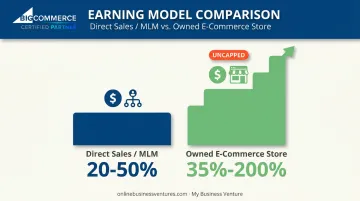
Margin structures differ by model. Direct sales typically pays a commission percentage set by the parent company. Owned e-commerce stores set their own markup: MBV clients, for instance, work with profit margins of 35% to 200% on most catalog products, since they set retail prices themselves rather than earning a fixed commission.
Common miss: underpricing to win early customers. It feels good short-term and becomes unsustainable once fees and returns eat into the margin.
Step 5: Market Your Products and Build Trust
Go where your customers already spend time: Instagram, Facebook groups, local community pages, or a relevant marketplace. Trying to be everywhere at once usually means being effective nowhere.
Once you have traffic, build credibility:
- Collect and display genuine reviews
- Write clear, honest product descriptions
- Respond to messages quickly, since slow replies lose sales
Track what's actually working: link clicks, page visits, and conversion rate, rather than guessing from likes or follower counts.
Step 6: Fulfill Orders and Plan for Growth
Decide upfront how orders get fulfilled: shipping inventory yourself, using a dropship supplier, or relying on a company's built-in fulfillment. Set up a simple process for returns, questions, and complaints before you need one, not after the first complaint email arrives.
In a dropship setup like MBV's, this step is largely handled already. Orders are picked, packed, and shipped under your brand name, with tracking sent automatically to both you and the customer. Once your pricing and operations are stable, that's your signal to expand into new products, not before.
Conclusion
Success selling from home comes down to basics done well: validating your product, picking the right model, and staying consistent when it isn't exciting yet. Speed matters less than most people think.
Beyond nailing those basics, the bigger decision is direct sales versus owning your own store. One trades control for instant brand recognition; the other trades a longer setup for full ownership of pricing, products, and customer relationships. Get that choice right, and the rest of the steps get easier.
For anyone who wants expert guidance along that path, MBV offers a faster route to a fully branded online store. With over 30 years of e-commerce experience, hands-on business consultants, and personalized training, the company can shortcut the learning curve.
Frequently Asked Questions
What is the best product to sell from home?
The best product depends on your personal interest, validated demand, and margin, not what's trending this week. Beauty, wellness, home goods, and accessories consistently perform well because they combine repeat purchases with healthy markup.
Where can I sell my stuff and get paid instantly?
Facebook Marketplace, eBay, and Poshmark all offer relatively fast payouts, though each has its own hold periods before funds arrive. Owning a store with an integrated payment gateway gives you the most control over exactly when you get paid.
How much money do I need to start selling products from home?
Direct sales starter kits typically run $25 to $200. E-commerce or dropshipping setups vary more widely: a DIY store might cost a few hundred dollars, while a fully built, done-for-you package — like MBV's turn-key stores, priced from $3,995 to $5,995 — includes the website, product catalog access, and training.
Is selling products from home actually profitable?
Profitability depends on your effort, model, and consistency, not the model alone. Direct sales commissions commonly range from 20-50%, while owned e-commerce stores can see markups of 35% to 200% since the owner sets retail pricing directly.
Do I need a business license to sell products from home?
Requirements vary by state and city, but most home sellers need at least a sales tax permit if they're selling taxable goods. Check your state's department of revenue before your first sale.
What's the difference between joining a direct sales company and starting my own online store?
Direct sales means selling an existing brand's products for commission under someone else's rules. Owning a store, like the turn-key e-commerce sites MBV builds for clients, means running your own branded business with full control over pricing, products, and customer relationships.