
Introduction
A small business website can cost anywhere from under $100 to well over $50,000. That range isn't a typo. It reflects what business owners actually pay today.
Most small businesses now have a website, with 83% already online and 12% launching within the past year, according to a 2025 Clutch survey of 406 U.S. small-business owners.
What explains the massive price gap? It comes down to three things: the type of site (informational vs. e-commerce), who builds it (DIY, freelancer, agency, or turn-key platform), and the features you actually need.
This guide breaks down real pricing ranges, hidden cost components, and what drives price up or down. It also covers a turn-key alternative for owners who'd rather launch an online store than build one from scratch.
Key Takeaways
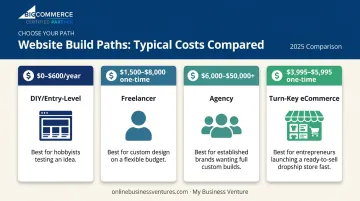
- DIY $0–$600/year, freelancers $1,500–$8,000, agencies $6,000–$50,000+
- Turn-key eCommerce platforms run $3,995–$5,995 one-time, with a store live in days
- Page count, design customization, and payment functionality drive price the most
- A simple brochure site costs far less than a multi-product online store with integrations
- Spending more makes sense when you want built-in sourcing, marketing, and training instead of DIY guesswork
How Much Does a Small Business Website Cost? (Pricing Overview)
There's no single "average" price for a small business website. Cost depends entirely on the build method, the functionality required, and how far the business plans to scale.
Here's what commonly trips owners up when they underestimate cost:
- Underbudgeting for hosting, apps, and content after the initial build wraps up
- Picking a DIY template that has to be rebuilt once the business outgrows it
- Ignoring recurring maintenance, security, and marketing costs entirely
Typical Cost Range
| Build Path | Typical Cost | What's Usually Excluded |
|---|---|---|
| DIY / entry-level | $0–$600/year | Custom design, advanced features |
| Freelancer / custom build | $1,500–$8,000 one-time | Ongoing marketing, premium plugins |
| Agency / high-end or E-Commerce | $6,000–$50,000+ | Varies by scope; ask for a written quote |
| Turn-key E-Commerce platform | $3,995–$5,995 one-time | Merchant processing fees |
For a broader industry benchmark, freelancer web design work typically runs $500–$10,000+, while agency projects land between $3,000–$30,000+, according to WebFX's website cost estimates. These figures usually cover design and build plus basic hosting — but rarely include content creation, marketing, or ongoing maintenance unless stated upfront.
Price Range 1: DIY Website Builder
Platforms like Wix, Squarespace, or WordPress.com give you a template, basic hosting, and limited support. You manage the content yourself.
Best for: Solopreneurs testing an idea or needing a simple digital business card online.
Price Range 2: Freelancer or Agency Custom Build
This tier typically includes custom design, mobile optimization, on-page SEO, and anywhere from a handful to dozens of pages. Agencies add project management on top.
Best for: Established local or service businesses that need a branded, professional presence built around their specific offerings.
Price Range 3: Turn-Key E-Commerce Platform (like MBV)
This path gets you a fully built, branded online store launched in days, not weeks. It typically includes a curated product catalog with no inventory to stock, SSL security, and personalized training.
Companies like My Business Venture (MBV) specialize in exactly this. MBV's turn-key packages run $3,995 to $5,995 one-time, and stores go live in under a week — client Tris T. noted his consultant had the site "operational in less than a week."
Best for: Owners who want to sell online quickly without building a site, sourcing products, or learning web development from scratch.
Key Factors That Affect the Cost of a Small Business Website
Pricing depends on technical, functional, and business considerations, not just who builds the site.
Website Type & Design Complexity
Informational or brochure sites cost far less than transactional eCommerce sites. A brochure site just needs to display information, while an eCommerce site needs a shopping cart, checkout flow, and payment processing wired together correctly.
Design choices affect price too. Off-the-shelf templates keep costs low, while fully custom branding and UX design raise the price significantly since every element gets built from scratch instead of adapted from a pre-made theme.
Functionality & Content Needs
Cost scales with what the site actually does:
- Contact forms and basic SEO: low upfront cost
- Booking systems: moderate added cost, often recurring
- Payment gateways and product catalogs: higher upfront and ongoing cost
More pages, blog sections, or case studies also add design and copywriting hours. WebFX estimates page design alone can run $1,000–$10,000 for sites with up to 250 pages, a wide range that depends heavily on complexity per page.
Platform, Hosting & Ongoing Support
Self-hosted WordPress requires you to separately choose hosting, plugins, and maintenance. Turn-key providers like MBV bundle hosting, security, and support into one predictable cost, which matters more than it sounds since juggling five vendors is its own hidden expense.
Cost Breakdown of a Small Business Website
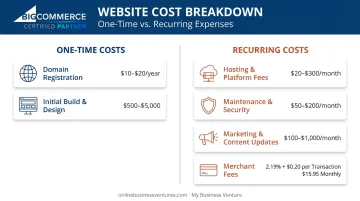
The total cost of ownership goes well beyond the initial build price. Here's where the money actually goes:
| Cost Item | One-Time or Recurring | Description |
|---|---|---|
| Domain name & initial build | One-time (domain renews annually) | Registering your web address plus design/development labor or subscription setup |
| Hosting & platform fees | Recurring | Monthly or annual cost to keep the site live — ranges from a few dollars to hundreds |
| Maintenance, security & backups | Recurring | Software updates, SSL renewal, malware scanning, and data backups |
| Marketing, SEO & content updates | Recurring | Ongoing investment to drive traffic and keep information current |
Maintenance costs alone vary widely. Elementor's 2026 pricing breakdown puts a small-business maintenance stack at $435–$3,210 annually, depending on whether it's self-managed or professionally handled.
That's the part most owners forget to budget for. MBV bundles hosting, SSL security, and fraud prevention into the one-time package price, cutting out several fees most site owners pay separately.
The only ongoing cost is the merchant account fee, which is standard for any store that processes payments:
- 2.19% + $0.20 per transaction
- $15.95 monthly account fee
DIY vs. Professional vs. Turn-Key — Which Option Fits Your Budget?
Each build path trades cost, speed, and support differently. Here's the comparison side by side.
Cost & Speed to Launch
- DIY: Lowest cash cost, highest time investment. A simple site can take a weekend — or months, depending on your skill level.
- Freelancer/Agency: Higher cost with 4–16+ week timelines for a fully custom build.
- Turn-key (such as MBV): Moderate one-time investment, professional store launched in days rather than weeks.
Technical Skill & Effort Required
With DIY, you handle design, hosting, and troubleshooting yourself, including the 2 a.m. plugin conflict nobody warns you about. Freelancer, agency, and turn-key paths handle the technical work for you, freeing your time to focus on running the business.
Ongoing Support & Training
| Path | Support Structure |
|---|---|
| DIY | Self-serve forums and documentation only |
| Freelancer | Depends entirely on that individual's availability |
| Turn-key (MBV) | One-on-one consulting, structured training, 24/7 support included |
MBV's model includes dedicated business consultants plus MBV University training, tiered by package (Enterprise, Premier, or Millennium). Clients also get live phone support, 24/7 email support, and round-the-clock BigCommerce platform support, all included in the package price with no extra charge.
Product Sourcing (for eCommerce-Focused Businesses)
DIY dropship setups require you to research and vet suppliers yourself, a process that can take weeks and still leave you with unreliable partners. Turn-key eCommerce providers skip that step entirely.
MBV, for example, pre-loads client stores with 2,500+ curated products at launch, drawn from a catalog of over 1 million items spanning electronics, toys, home goods, and more. Products carry built-in profit margins of 35–200%, and a Low Price Guarantee lets clients undercut competitor pricing by an extra 10% when needed.
How to Estimate the Right Budget for Your Website
The "right" budget fits your business goals — it isn't just the lowest number you can find. Budgets can span from under $500 for a bare-bones DIY template to $5,000 or more for a fully built, ready-to-sell storefront.
Consider these factors before setting a number:
- Does the site need to simply inform, or actively sell and process payments?
- How fast do you expect traffic to grow, and how quickly do you plan to scale online?
- How much time and technical comfort do you personally have to manage the site?
- Should training, support, or marketing help be bundled in from the start?
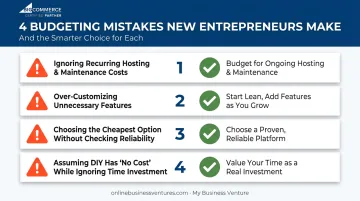
Once you've weighed those factors, watch for these common budgeting mistakes:
- Focusing only on the upfront price and ignoring recurring hosting/maintenance costs
- Over-customizing features you don't need yet
- Choosing the cheapest option without checking long-term reliability or support
- Assuming a DIY build has "no cost" when your own time is the hidden expense
If you're weighing whether to build eCommerce infrastructure piece by piece or get it bundled, that last mistake is the one to watch closest: a $0 builder plan can quietly cost you dozens of unpaid hours you didn't plan for.
Conclusion
Small business website costs vary enormously based on build method, functionality, and ongoing needs. A brochure site for a local service business might cost a few hundred dollars a year. A custom eCommerce build with integrations can run tens of thousands.
Understanding each cost component, including build, hosting, maintenance, and support, is what separates a smart budgeting decision from a costly surprise six months in.
For owners who'd rather skip the DIY learning curve altogether, a turn-key partner like MBV can help launch a fully branded, functional online store in days. Training and support come built into the price, so there's no separate scramble to figure out either one after launch.
Frequently Asked Questions
How much should I pay for a website for my small business?
Costs realistically range from free DIY builds to $50,000+ for custom agency or eCommerce sites. Budget based on whether you need a simple informational page or a full online store.
Is a website worth it for a small business?
Yes. A website builds credibility, offers 24/7 accessibility, and supports sales and marketing goals. It's one of the highest-return investments a small business can make when it's built to match actual business goals.
How much does it cost to maintain a small business website annually?
Maintenance, hosting, and security typically add $200 to a few thousand dollars per year, depending on complexity and whether it's self-managed or professionally supported.
What's the cheapest way to build a small business website?
DIY website builders or WordPress.org with shared hosting are the lowest-cost options. Both require your own time and a reasonable comfort level with basic tech tasks.
Is it better to hire a freelancer or an agency for a small business website?
Freelancers cost less but rely on one person's availability. Agencies cost more but offer full-service strategy, design, and longer-term support capacity.
How much does an eCommerce website cost for a small business?
eCommerce sites cost more than informational sites due to product pages, payment processing, and catalog management. Turn-key platforms like MBV bundle a branded store, product catalog, and dropship fulfillment into one one-time investment, letting you skip the build-and-source process entirely.