Introduction
Type "start dropshipping with no money" into Google and you'll find millions of results, fueled by TikTok success stories and the promise of building a business from your phone.
That excitement isn't hype for nothing. TikTok reports that more than a third of monthly US TikTok Shop purchases in 2024 went to small businesses, proof that scrappy sellers really can find an audience.
No inventory. No storefront lease. No boss. The appeal is real. But here's what those viral videos leave out: "no money" almost never means zero cost. It usually means trading cash for hours of manual work, slower growth, and a fair amount of trial and error.
This guide covers both paths honestly, from the DIY $0 route, step by step, to a faster alternative: launching with a turn-key dropship store like MBV's. By the end, you'll know which one actually fits your situation.
Key Takeaways
- Free dropshipping exists, but it trades cash for time and labor
- Marketplaces and free suppliers limit your branding, control, and speed
- Fees, domains, and payout delays mean "free" stores still need capital
- Turn-key setups compress months of work into a launch of days
What Is Dropshipping (and What "No Money" Really Means)?
Dropshipping is a retail model where you sell products without ever holding inventory. A customer buys from your store, you place that order with a supplier, and the supplier ships directly to the customer. You never touch the product.
"No money" dropshipping refers to skipping the upfront inventory purchase — not zero cost overall. You'll still run into:
- Pay transaction and platform fees on every sale
- Register a domain if you want your own branded site
- Cover occasional paid tools for research or design
There are really two paths here:
- The fully manual/free DIY route: marketplaces, organic content, no paid setup
- A paid turn-key setup (the model MyBusinessVenture (MBV) offers): a professional store, curated catalog, and branding handled for you
Both can work. They just ask different things of you: time versus money.
What to Know Before You Start Dropshipping With No Money
Most beginners underestimate one thing: the time-for-money trade-off. Building a $0 store from scratch often takes weeks of manual product listing, content testing, and customer service before the first sale even lands.
The Cash-Flow Gap Is Real
Customers pay you first, sure. But suppliers frequently want payment right away, and marketplace payouts aren't instant. eBay, PayPal, and Stripe all hold funds based on account history, tracking status, and risk factors, meaning your money isn't always there when you need it to pay a supplier.
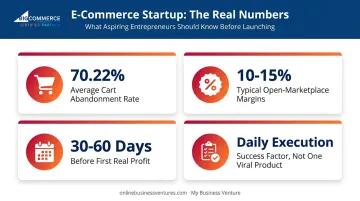
Then there's the abandonment problem. Shoppers who reach checkout don't always finish the purchase. Averaged across 50 e-commerce studies, the cart abandonment rate sits at 70.22%, a huge chunk of potential sales evaporating before payment ever clears.
Margins Are Thin Without Leverage
Shopify's own guidance puts typical margins for open-marketplace dropshipping at 10-15%. That's what happens when you don't have negotiating power with suppliers and platform fees eat into every sale.
A few more things to set your expectations straight:
- Success depends on daily execution (listing, fulfilling, creating content), not finding one miracle product
- Most $0 dropshippers spend their first 30-60 days testing and learning, not profiting
- Consistency beats cleverness in this game, every time
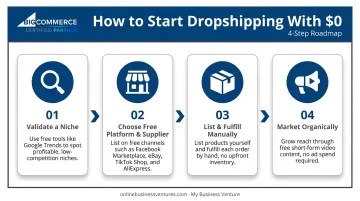
How to Start Dropshipping With $0 — Step by Step
This is the practical, no-budget path most beginners try first. The single biggest mistake? Spreading yourself across five platforms at once instead of mastering one.
Step 1: Pick a Low-Cost Niche and Validate Demand
Use free tools before you list a single item:
- Google Trends to spot rising interest over time
- TikTok's trend discovery feed to catch what's gaining traction right now
- Amazon Best Sellers to see what's already moving in a category
Don't stop at curiosity, though. A product with lots of comments and views isn't automatically a buyer. Check reviews, look for repeat listings across multiple sellers, and gauge purchase intent from comments. Those signals reveal real demand, not just curiosity.
Step 2: Choose a Free Selling Platform and Supplier
Compare your free-to-start options:
- Facebook Marketplace — built-in local and national traffic
- eBay — established buyer trust, up to 250 zero-insertion-fee listings monthly for most casual sellers
- TikTok Shop — no setup fee, content-driven discovery
Pair any of these with a free-to-list supplier like AliExpress, which charges no subscription; you only pay once a customer orders. The trade-off: you get free reach, but almost zero control over branding or the customer experience inside someone else's marketplace.
Step 3: Create Listings and Fulfill Orders Manually
Write clear, benefit-driven titles and descriptions. When an order comes in, you place the matching order with your supplier and pay for it, ideally after the customer's payment lands in your account.
This works fine at low volume. At scale, it becomes a full-time data-entry job. This is exactly where solo dropshippers hit a wall — there's only so much manual order processing one person can handle before quality (or sanity) slips.
Step 4: Market Organically to Drive Traffic
No ad budget means your growth engine is content. Short-form video (TikTok, Reels, YouTube Shorts) with new hooks tested daily is the job now.
Set realistic expectations here. Organic traffic overall converts modestly; Shopify's dropshipping guide cites organic-search-referred conversion rates around 5.3%. Beginner social content typically performs below that. Translation: you need volume, not one viral swing, to get consistent sales.
The Hidden Cost of Free: Why Many "No Money" Dropshippers Struggle
A $0 store still has a real cost: hours spent daily on manual listing updates, price checks, and order fulfillment with no automation backing you up.
There's also a control problem, since selling inside someone else's marketplace typically means:
- Limited or no branding on your storefront
- No email list or direct customer relationship
- Repeat customers going to the platform, not to you
Platform risk compounds these challenges, since account restrictions, sudden delisting, and algorithm dependency are all real threats. eBay and Meta enforce strict dropshipping and sourcing policies, and violations can mean suspended selling privileges overnight.
Saturated product competition adds further pressure, and it's easy to see why many free-route sellers plateau long before they ever have money to reinvest in growth.
A Faster, Lower-Risk Path: Launching With a Turn-Key MBV Dropship Store
If months of manual trial-and-error sound exhausting, there's another route. My Business Venture (MBV) has built turn-key, SSL-secured e-commerce stores since 1992, bringing over 30 years of e-commerce experience to a launch that takes days, not months.
What's Included Out of the Box
An MBV store arrives with:
- A curated catalog of 2,500+ top-selling products, with access to over 1 million total items
- A custom logo and fully branded storefront
- Free shipping setup and complete fulfillment handled by the supplier network
- Automatic real-time catalog updates via XML technology, adding new arrivals and removing out-of-stock items without you lifting a finger
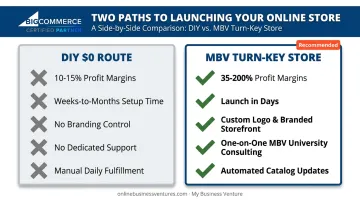
That catalog access also changes the profit equation. Remember that 10-15% margin ceiling on manual, open-marketplace dropshipping? MBV clients typically see 35-200% profit margins per product, with no inventory to stock or manage. That gap comes down to curated, higher-margin catalog access instead of competing on razor-thin marketplace pricing.
Support and Trust Built Into Every Store
Every package includes one-on-one consulting through MBV University. Consultant Bruce Witkin, for example, is known for getting new client stores operational in under a week, a stark contrast to the weeks of manual setup the DIY route requires.
Strategy guidance is also shaped by insight from Kevin Harrington, an original Shark Tank investor whose ventures have generated over $6 billion in global sales.
MBV also carries risk-reduction features a $0 marketplace store simply doesn't offer:
- BBB A+ accreditation
- Fraud prevention monitoring on every order
- 24/7 hosted uptime with SSL encryption
- A Low Price Guarantee that beats any lower competitor price by 10%
For entrepreneurs who want the speed of "no money down" without the manual grind, requesting a consultation with MBV is the next logical step to see if a turn-key store fits your budget and goals.
Frequently Asked Questions
How hard is it to start dropshipping?
Starting is technically easy: anyone can list a product today. Succeeding is the hard part, and it comes down to consistent product research and fulfillment discipline, with regular content creation woven in over time.
Can you really start dropshipping with no money?
You can avoid upfront inventory costs, yes. But ongoing fees and cash-flow timing gaps still mean you need some resources to keep things running.
How much money do you actually need to start dropshipping?
A fully manual start can be close to $0. A professional turn-key setup like MBV's runs $3,995–$5,995 one-time, replacing months of manual setup work and guesswork.
What's the fastest way to start dropshipping if I have very limited funds?
The marketplace-first free approach costs less upfront but takes weeks to build momentum. A turn-key store trades a modest investment for a launch measured in days, not weeks.
Is dropshipping still profitable in 2026?
Profitability depends heavily on execution and margins, and it's never guaranteed. Curated, higher-margin catalogs tend to outperform saturated, race-to-the-bottom marketplace products.
How is a turn-key dropshipping store different from building one myself for free?
A DIY $0 store demands your time, offers little branding control, and comes with no dedicated support. A turn-key model like MBV's delivers a branded, curated store with one-on-one consulting from day one.