Introduction
Online shopping isn't a side trend anymore. U.S. retail e-commerce sales hit $1.1926 trillion in 2024, an 8.1% jump from the year before, according to Census Bureau data.
Mobile browsing, next-day delivery expectations, and a growing appetite for flexible income are all fueling that growth.
So many people are exploring e-commerce right now. Overhead is a fraction of what a physical storefront demands, and you can run the business evenings and weekends or go all-in.
Yet most first-time sellers stall out before launch, unsure what to sell or how to build a store without holding inventory. Dropshipping and turn-key models solve that: you don't need to invent a product to get started.
The interest isn't limited to tech-savvy founders, either. Career changers, retirees, side-hustlers, and stay-at-home parents are all building online stores today.
This guide walks through what actually goes into launching an e-commerce business — and how a turn-key partner like MyBusinessVenture (MBV) can compress that timeline dramatically.
Key Takeaways
- E-commerce businesses sell online through dropshipping, wholesale, or private label—not a physical storefront
- Real time, cost, and skill commitments matter more than potential upside
- Key steps: niche selection, platform choice, legal setup, sourcing, build, and marketing
- DIY builds take weeks to months; turn-key providers like MBV launch stores in days
- Long-term success needs consistent product validation and disciplined pricing, not just a fast launch
What Is an E-Commerce Business?
An e-commerce business sells goods or services to customers over the internet through a website, marketplace, or app instead of a physical store.
The value it delivers comes down to convenience and broader reach, plus much lower overhead than running a brick-and-mortar operation. You're not paying rent on retail square footage or staffing a storefront during business hours.
Before choosing a path, it helps to understand the landscape:
Store setup formats:
- DIY self-built stores: you build, host, and maintain everything yourself
- Turn-key/managed platforms: a provider builds and supports the store for you
Common business models:
- Dropshipping: a supplier holds and ships inventory; you never touch the product
- Wholesale: you buy in bulk and resell at a markup
- Private label: you brand a manufacturer's product as your own
- Subscription: customers receive recurring shipments on a schedule
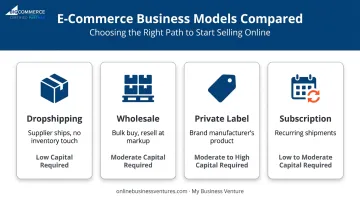
Each model comes with different capital requirements and day-to-day responsibilities, which is exactly what the next section covers.
What to Know Before You Start Your E-Commerce Business
Many beginners underestimate the day-to-day effort involved: customer service emails, marketing testing, fulfillment coordination. None of this is a judgment on whether you're capable of running a business. It's simply about setting realistic expectations before you commit money and time.
Time Investment and Skill Requirements
In the early stages, expect to spend real hours on:
- Sourcing products and vetting suppliers
- Setting up your storefront and product listings
- Testing marketing channels to see what actually converts
MBV's done-for-you setup shortens this phase considerably, since the storefront and product catalog arrive already built and stocked with curated products.
As for timelines to steady income, the U.S. Small Business Administration is candid: some companies take years to turn a profit, and many lose money in their first months or years of operation. There's no universal timeline, so budget for a runway rather than an overnight payoff.
Success also depends less on technical or design skills than most people assume. Pricing discipline, responsive customer service, and consistency matter far more than knowing how to code.
Commonly Overlooked Costs and Risks
Watch for these before you launch:
- Startup costs beyond the platform fee: inventory, marketing tests, and business registration all add up
- Competitive pricing pressure from established sellers in your niche
- Legal and compliance requirements: business registration, permits, and sales tax obligations vary by state
- Over-dependence on the founder for every task, which limits how fast you can grow
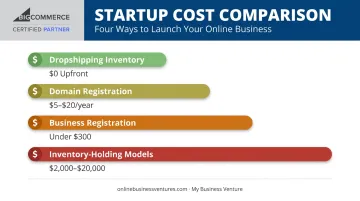
Registering a business typically costs under $300, though this varies by state and entity type. Domain registration runs roughly $5 to $20 per year. Inventory-holding businesses often need $2,000 to $20,000 to get started, though that range drops significantly if you choose a dropshipping model with no upfront stock.
How to Start an E-Commerce Business – Step by Step
This section breaks the launch process into practical stages, whether you're building solo or working with a turn-key partner. The most common mistakes? Skipping niche validation, choosing a platform based on price alone, and launching before fulfillment and support systems are actually in place.
Step 1 – Choose Your Niche, Product, and Business Model
Define what you're selling and to whom. Then decide between B2C, dropshipping, wholesale, or private label based on the capital and time you have available.
Poor product-market fit is a real risk: it appeared in 43% of failure cases in a CB Insights review of shut-down venture-backed startups. That's general startup data, not e-commerce-specific, but the lesson translates: validate demand before you commit.
Common miss: Picking a trendy product with no repeat-purchase potential or real demand behind it.
Step 2 – Select Your E-Commerce Platform and Selling Approach
Compare DIY website builders against done-for-you, turn-key providers. Weigh setup time, technical skill required, and the level of ongoing support you'll get.
A fully custom DIY build can take considerably longer than most people expect, often stretching into weeks or months once you factor in design, integrations, and testing. Turn-key platforms, like MBV's BigCommerce-based packages, compress this dramatically, with some stores going live in days rather than months.
Common miss: Underestimating how long a custom build takes compared to a managed platform.
Step 3 – Handle Legal Setup, Registration, and Payment Processing
Register your business, obtain an EIN through the IRS (free, and only after your entity is formed at the state level), secure any required licenses or permits, and set up an SSL-secured, PCI-compliant checkout.
Don't skip sales tax research. Since the South Dakota v. Wayfair Supreme Court decision, states can require tax collection even without physical presence. Thresholds vary by state, so check each one where you sell.
Common miss: Delaying sales tax or home-occupation permit research until after launch.
Step 4 – Source Products and Plan Fulfillment
Choose a sourcing method (dropship supplier network, wholesale purchasing, or private label) and plan shipping, packaging, and branded fulfillment. Dropship networks like the one MBV partners with typically offer profit margins between 35% and 200%, depending on the product category.
Common miss: Choosing suppliers without checking margins, delivery times, or whether blind drop shipping and custom branding are even options.
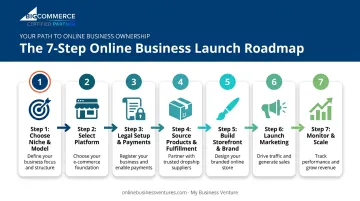
Step 5 – Build Your Storefront and Brand Identity
Set up a domain, logo, product photography, and descriptions. Make sure the site is mobile-friendly and easy to navigate. Most shoppers browse on a phone.
Common miss: Launching with unclear product information or a slow, cluttered checkout flow that drives people away before they buy.
Step 6 – Launch Marketing and Customer Acquisition
Combine SEO, social media, and paid or organic channels to drive traffic. Set up basic tracking for conversion rate and cart abandonment from day one.
Cart abandonment is a real challenge industry-wide: Baymard Institute's analysis of 50 studies puts the average cart-abandonment rate at 70.22%. Expect it, and build checkout reminders and retargeting into your plan from the start.
Common miss: Relying on a single marketing channel instead of testing several early on.
Step 7 – Monitor, Optimize, and Scale
Track financial health and customer feedback. Fix operational gaps as they surface, and reinvest in inventory or marketing once the business stabilizes.
Common miss: Scaling ad spend or inventory before pricing and fulfillment systems are proven.
Why Launch Your E-Commerce Business with MBV
If the DIY path above feels like a lot to juggle, that's exactly the gap MyBusinessVenture (MBV) was built to close. MBV has helped entrepreneurs launch turn-key online stores for over 30 years, since 1992, long before "e-commerce" was a household word.
Speed, Products, and Margins
MBV clients typically go live in days, not weeks or months. That's backed up by real client experience: one MBV consultant, Bruce Witkin, is known for getting client sites operational in less than a week.
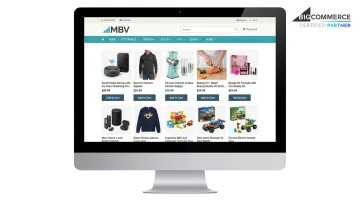
Each store launches with a curated 2,500+ product superstore, backed by a dropship catalog of over 1 million products (and in some cases up to 2 million). Profit margins on products range from 35% to 200%, and clients never stock inventory. The dropship partner handles picking, packing, and shipping under the client's own brand name.
MBV offers three one-time-payment package tiers:
| Package | Investment | Notable Inclusion |
|---|---|---|
| Enterprise | $3,995 | 2,500+ Product Superstore, 24-month SEO submission |
| Premier | $4,995 | Lifetime search engine submission |
| Millennium | $5,995 | Branded email, SSL trust badges, full marketing upgrade |
A separate merchant account (2.19% + $0.20 per transaction, plus $15.95/month) is required across all tiers to process payments.
Credibility and Support That Back It Up
MBV is a BBB Accredited Business with an A+ rating (the highest rating a company can receive) and is registered with Dun & Bradstreet with an exemplary company rating. As a certified BigCommerce developer, MBV builds on an established e-commerce platform rather than a custom, unproven one.
Kevin Harrington, an original Shark Tank investor, serves as MBV's Strategic Advisor, having launched over 1,000 products and generated more than $6 billion in global sales across his career.
Clients also get:
- One-on-one training through MBV University
- Dedicated business consultants available throughout the entrepreneurial journey
- SSL-secured, PCI-compliant checkout
- Real-time fraud monitoring, with loss coverage if fraud slips through
- 24/7 hosted uptime
For entrepreneurs who want the speed of a done-for-you platform without losing personalized guidance, requesting a consultation with MBV is a reasonable next step before committing to a DIY build.
Conclusion
Launching a successful e-commerce business comes down to fundamentals: validating demand, pricing sustainably, and executing consistently. None of that changes whether you build solo or partner with a turn-key provider.
That same consistency matters more than how fast you launch. Whether you spend months building a custom store or go live in days with MBV, the businesses that last are the ones that keep reviewing performance and refining their approach.
Focus less on a perfect launch and more on steady, deliberate improvement over time.
Frequently Asked Questions
How much does it cost to start an e-commerce business?
Costs vary widely based on model — expect $5 to $20 for a domain, under $300 for business registration, and $2,000+ if you're holding inventory. Turn-key providers reduce upfront technical and design costs.
How long does it take to launch an online store?
A DIY build can take anywhere from weeks to several months depending on complexity. Turn-key setups like MBV can get a store live in days.
Do I need my own inventory to start an e-commerce business?
No. Dropshipping models, like the one MBV offers, let you sell products without stocking or purchasing inventory upfront, and you only pay for goods after a sale is made.
What e-commerce business model is best for beginners?
Dropshipping is typically the lowest-risk entry point due to lower capital requirements and simpler logistics, since a supplier handles storage and shipping.
Can I really make money with a dropshipping business?
Yes, though results vary. Products often carry markups of 35% to 200%, but consistent marketing and disciplined pricing drive whether that margin turns into real profit.
What's the difference between building my own store and using a turn-key e-commerce provider like MBV?
A self-built store demands more time, technical skill, and ongoing maintenance from you directly. A managed platform like MBV handles the build, hosting, and support, so you can focus on running the business.