By the time she realized what was happening, she'd already shipped $2,400 worth of inventory to addresses that didn't match a single billing record.
Sarah's story isn't rare. Online payment fraud now costs merchants 3.2% of total annual e-commerce revenue globally, according to the Merchant Risk Council's 2026 Global Payments and Fraud Report. For a new store owner running on thin margins, that's not a rounding error — it's the difference between profit and closing shop.
This guide breaks down what causes online payment fraud, the warning signs to watch for, and the practical steps that actually stop it — including how choosing the right e-commerce partner can build protection in from day one.
Key Takeaways
- Online payment fraud uses stolen or falsified payment data for unauthorized purchases
- Phishing, stolen card data, weak security, and account takeovers are common entry points
- Prevention combines encrypted checkout, verification checks, monitoring, and owner awareness
- Built-in fraud monitoring eases the technical burden for first-time store owners
What Is Online Payment Fraud and What Causes It
Online payment fraud is the use of stolen, falsified, or unauthorized payment information to obtain goods, services, or funds electronically. It shows up as a stolen card number used at checkout, a hijacked customer account, or a fake identity used to dodge payment entirely.
The problem has scaled right alongside e-commerce itself. Card-not-present (CNP) debit transactions reached 34.4% of total transaction volume in 2023, according to Federal Reserve data, accounting for nearly half of all transaction value. More checkout volume online means more surface area for fraud.
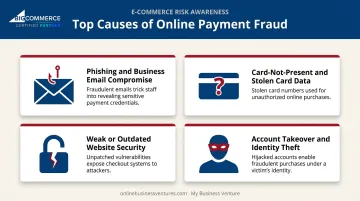
Four causes account for most of what new store owners face.
Phishing and Business Email Compromise
Fraudsters impersonate trusted brands, vendors, or even the store owner's own payment processor through email or text. The goal: trick someone into revealing checkout credentials or payment data.
A typical scenario looks like this: a store owner gets an urgent "payment verification required" email that appears to come from their processor. One click, one login, and the attacker now has access to the merchant dashboard.
Card-Not-Present (CNP) and Stolen Card Data
Stolen card numbers, pulled from data breaches or skimming operations, get used online where there's no physical card to check. This is one of the fastest-growing fraud categories for online stores, precisely because there's no in-person verification step to catch it.
Criminals often test stolen numbers first using card testing: a burst of small transactions run through automated scripts to see which cards still work before a larger purchase is attempted.
Weak or Outdated Website Security
Stores without SSL encryption, address verification, or updated checkout software are easy targets for bots. Mastercard found that merchants with critical software vulnerabilities were 3.3 times more likely to experience digital skimming attacks than those without.
Many first-time store owners launch without realizing these protections weren't automatically part of their setup.
Account Takeover and Identity Theft
Fraudsters gain access to a customer or admin account (often through reused or phished passwords), then quietly change shipping or payment details to redirect funds or goods.
Watch for this pattern: a returning "customer" account suddenly updates its shipping address right before placing an unusually large order.
Warning Signs and the Cost of Ignoring Them
Fraud left unaddressed doesn't stay small. It compounds.
Beyond the immediate financial hit from a fraudulent order, unresolved fraud brings:
- Chargeback fees that stack up per dispute — Mastercard puts the true cost at $128 per chargeback once third-party fees and labor are included
- Unrecoverable product costs paid to your dropship supplier when a fraudulent order ships, with no way to recoup the expense
- Damaged reputation, since customers who experience one bad dispute often don't return
- Processing privileges at risk: card networks monitor chargeback ratios and can restrict or terminate merchant accounts that exceed their thresholds
Signs to Watch For
Train yourself (and any staff) to flag these patterns before fulfillment:
- Unusually large orders or rush shipping requests with no clear buying pattern
- Mismatched billing and shipping addresses, or several failed card attempts in a short window
- Orders placed from IP addresses or locations that don't match the billing address on file
None of these guarantee fraud on their own. Together, though, they're a signal worth a second look before you ship.
How to Prevent Online Payment Fraud
There's no single fix here — prevention is a combination of secure technology, verification habits, and smart platform choices working together.
Use Secure, Encrypted Payment Processing
SSL-encrypted checkout and tokenization keep sensitive card data from being exposed during a transaction. This isn't optional or "nice to have"; it should be table stakes for any store accepting payments, regardless of size.
Verify Cardholder Information
Address Verification Service (AVS) checks confirm that a submitted billing address matches issuer records. CVV checks confirm the buyer can provide the code printed on the physical card. Neither alone is bulletproof, but combined, they meaningfully reduce the odds of a stolen card slipping through unchecked.
Monitor Transactions in Real Time
Automated monitoring flags unusual order patterns (odd order sizes, rapid repeat attempts, mismatched locations) before fulfillment happens. Manual review of every single order simply isn't scalable once a store starts growing past a handful of daily sales.
Choose an E-Commerce Partner With Built-In Fraud Protection
Most first-time entrepreneurs don't have the technical background to configure fraud tools, payment gateways, and encryption on their own, and honestly, they shouldn't have to.
This is where MBV's turn-key e-commerce packages take that burden off the table. Every MBV store (Enterprise, Premier, or Millennium) launches with:
- SSL-encrypted, secure shopping carts built into the site from day one, not bolted on later
- A dedicated Fraud Prevention Program that screens every incoming order in real time, around the clock
- Loss coverage: if a fraudulent transaction somehow slips past MBV's screening, MBV covers the resulting financial loss
- 24/7 hosted uptime so the store stays available and stable
- One-on-one consulting with an MBV business consultant to help new owners understand what suspicious activity looks like and how to respond
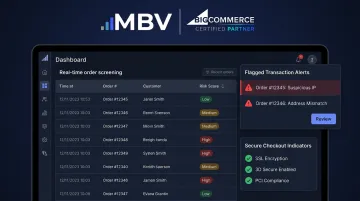
Rather than piecing together a payment gateway, an SSL certificate, and a third-party fraud tool separately, each with its own setup and monthly fee, MBV builds all of it into the package price from the start.
Tips for Long-Term Prevention and Control
Fraud prevention isn't a set-it-and-forget-it task. It needs upkeep.
- Review transaction and chargeback data regularly. Patterns emerge over months, not days — a spike in disputes from one region or product line is worth investigating.
- Keep software and certifications current. PCI DSS v4.0.1 is now the only supported version, and its e-commerce-specific requirements (6.4.3 and 11.6.1) took effect in March 2025. Don't wait for renewal season to check compliance.
- Log past fraud attempts. Keeping records of suspicious emails, IP addresses, and order details helps you spot repeat offenders faster, and gives law enforcement something concrete if you ever need to file a report.
MBV's fraud dashboard flags many of these patterns automatically, but checking data yourself still matters.
None of these steps take much time individually. Skipped consistently, though, they're exactly how small fraud problems turn into recurring ones.
Conclusion
Online payment fraud has identifiable causes and recognizable warning signs — it isn't some unpredictable force you're powerless against. Encrypted checkout, cardholder verification, real-time monitoring, and a bit of ongoing vigilance meaningfully protect both your revenue and your customers' trust.
You don't have to build all of that from scratch, either. Platforms like MBV bake SSL encryption, fraud monitoring, and 24/7 uptime into the store from launch. New owners can then focus on what they actually started the business to do: sell products and grow.
Frequently Asked Questions
How do I prevent online payment fraud?
Combine SSL-encrypted checkout, AVS/CVV verification, and real-time transaction monitoring. Choosing a platform with fraud protection already built in, like MBV, removes most of the technical setup burden.
What payment method has the strongest fraud protection?
Credit cards offer the strongest built-in protection, capping consumer liability at $50 under the Fair Credit Billing Act. Debit cards and ACH transfers have protections too, but they depend heavily on how quickly you report the issue.
What is online payment fraud?
It's the use of stolen, falsified, or unauthorized payment information to complete a purchase or transfer funds electronically without the account holder's consent.
Can I get my money back if I get scammed online?
It depends on the payment method and how fast you report it. Credit card disputes are easier to resolve than wire transfers or cryptocurrency, which are often irreversible once sent.
What are the most common types of online payment fraud?
Phishing, card-not-present fraud, friendly/chargeback fraud, and account takeover are the four most frequent types merchants encounter.
Do I need expensive software to protect my online store from fraud?
Not necessarily. Turn-key platforms like MBV include SSL encryption and a real-time Fraud Prevention Program as standard features, not a separate purchase.