This is the moment most new entrepreneurs hit a wall. Building an online store is the easy part. Getting strangers to find it, trust it, and buy from it is the real challenge, and it's the top obstacle new business owners face right after going live.
This guide breaks down what customer acquisition actually means, the four stages every new customer moves through, low-cost strategies that work without a big budget, and how to tell if your efforts are paying off.
MBV builds acquisition support directly into its turnkey e-commerce launch process, so new business owners aren't left to figure this out alone.
Key Takeaways
- Customer acquisition turns strangers into paying customers through awareness, interest, intent, and purchase
- Most acquisition journeys move through four core stages, though tactics vary by business type
- Target a 3:1 CLV-to-CAC ratio, the widely used benchmark for a financially healthy strategy
- SEO, social media, email, and referrals are especially valuable for new and home-based sellers
- MBV's fast, professionally built stores include built-in marketing support, helping new owners acquire customers faster
What Is Customer Acquisition?
Customer acquisition is the strategy and process a business uses to identify, attract, and convert potential buyers into paying customers. It covers everything from the first ad impression to the final checkout click.
This differs from general brand marketing, which builds awareness at scale through brand recognition, social following, or press mentions. Customer acquisition is narrower and more measurable: it's judged by conversions, not impressions. A campaign can rack up thousands of views and still fail at acquisition if nobody buys.
Here's what that looks like in practice. A new store owner runs a targeted social media ad for a home fragrance product. A first-time visitor clicks through, reads the product description, checks a review or two, and completes a purchase. That's the entire acquisition journey: stranger to shopper to customer, in a matter of minutes.
Why Customer Acquisition Is the Make-or-Break Moment for New Businesses
For first-time entrepreneurs, acquisition is the biggest hurdle right after launch. There's no existing customer list to email, no repeat buyers to lean on, and no word-of-mouth momentum yet.
This isn't a minor inconvenience. In a February 2024 survey of more than 1,300 small and midsize business leaders, 60% named finding new customers as their top marketing challenge, ahead of budget constraints or lack of resources. Nearly three-quarters weren't confident their current strategy was even working.
New and home-based business owners feel this most acutely: without an established brand behind them, every single sale has to be earned from scratch.
Customer Acquisition vs. Customer Retention
Acquisition brings in new buyers, while retention keeps them coming back. Both matter, but brand-new businesses have to prioritize acquisition first, because retention has nothing to retain yet.
Once a store has its first wave of customers, retention tactics like loyalty programs and win-back emails start to pay off. Until then, the entire focus needs to stay on filling the top of the funnel.
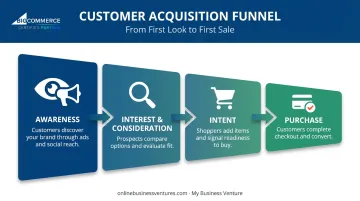
The Four Stages of the Customer Acquisition Funnel
Marketing funnels can stretch to five stages or more depending on the framework. For a new business owner, the acquisition journey boils down to four stages worth knowing cold.
Stage 1: Awareness
This is the first moment a potential customer discovers your brand, through a search result, a social post, or a friend's recommendation. First impressions happen fast, and a professional, credible-looking storefront makes that first glance count.
A homemade-looking site with broken images or a generic template can lose a shopper before they even see a product. Turn-key platforms like MBV solve this by launching every client store as a professionally built, ready-to-sell storefront from day one.
Stage 2: Interest & Consideration
Once aware, prospects start comparing. They read product descriptions, check reviews, and look for signs the store is legitimate. Clear product copy and visible trust signals, like secure checkout badges and a real contact page, keep them moving forward instead of bouncing to a competitor.
Stage 3: Intent
Intent shows up in specific actions:
- Adding an item to cart
- Signing up for a newsletter
- Searching for a coupon code
These moments signal a prospect is close to buying but hasn't pulled the trigger. A retargeting ad or a follow-up email often closes that gap.
Stage 4: Purchase
This is the conversion moment. A smooth, simple checkout process matters here more than almost anywhere else in the funnel. Every extra form field, confusing step, or missing security badge is a chance for someone to abandon their cart.
What happens right after the sale, a thank-you email or onboarding sequence, sets up the retention work that comes later.
Proven Customer Acquisition Strategies for New Business Owners
SEO & Content Marketing
Optimizing product pages and publishing helpful blog content lets a new store get discovered organically, without spending a cent on ads. Search engines remain a major starting point for shopping. In a 2023 survey, 42% of U.S. consumers said they began online product searches with a search engine, close behind major marketplaces.
Quick wins for a new store include:
- Writing descriptive, keyword-rich product titles
- Swapping manufacturer copy for unique product descriptions
- Publishing blog posts that answer real customer questions
MBV packages include built-in SEO tools and MBV University training, so new owners can execute these tactics without hiring an outside agency.
Social Media Marketing
Platforms like Instagram, Facebook, and TikTok let new sellers build an audience and show off products without a big ad budget. This matters most for home-based businesses without existing brand recognition. Consistent posting, behind-the-scenes content, and short product demos tend to outperform polished ads for a brand nobody's heard of yet.
Email Marketing
Capturing emails from day one, through a discount code or a simple signup incentive, gives a new owner a way to nurture leads who aren't ready to buy yet. It's cost-effective and keeps the brand top-of-mind until a prospect is actually ready to convert.
Paid Advertising
Search and social ads can generate quick traffic and sales for a brand-new store, which is tempting when the goal is fast momentum. The catch: budgets need close tracking from day one. It's easy to overspend on ads before a store has proven it can convert that traffic profitably.
Referral and Word-of-Mouth Programs
Referrals convert better than almost any other channel because they carry built-in trust. Nielsen's global trust study found that 88% of respondents trust recommendations from people they know more than any other advertising channel. For a brand-new business with zero reputation, a simple referral incentive can do more for credibility than an entire ad campaign.
Customer Acquisition Cost (CAC): What It Is and Why It Matters
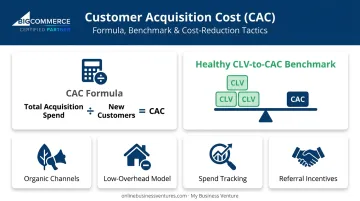
Customer acquisition cost, or CAC, is what it costs to turn a stranger into a paying customer. The formula is simple:
CAC = Total acquisition spend ÷ Number of new customers
Say a new store spends $500 on ads and organic promotion in a month and gains 25 new customers. That's a CAC of $20 per customer.
On its own, that number doesn't mean much. It only becomes useful when compared to customer lifetime value (CLV), meaning how much revenue that customer generates over the life of the relationship.
A commonly cited benchmark: Adobe and HubSpot both point to a 3:1 CLV-to-CAC ratio as a healthy target. For every $1 spent acquiring a customer, that customer should generate roughly $3 in lifetime value.
It's an industry rule of thumb rather than a strict law, but it's a useful gut check. Below 3:1, margins get thin fast.
Keeping CAC low as a new or home-based seller:
- Lean on organic channels first (SEO, social, email) before spending on ads
- Choose a low-overhead business model, like dropshipping, that removes inventory costs and frees up cash for marketing
- Track spending against actual sales, not just clicks or impressions
- Use referral incentives to acquire early customers at a lower cost than paid ads
How MBV Helps New Entrepreneurs Launch and Start Acquiring Customers Fast
Getting a store live is only useful if it frees up time to focus on customers, not code. MBV's turnkey e-commerce packages get a fully branded, SSL-secured store live in days, not months, so new owners can start on acquisition immediately instead of wrestling with technical setup.
Once the store is live, marketing tools come bundled in from day one, not bolted on later:
- Social media integration and campaign support
- Custom branding, including a logo built for the store's identity
- SEO and search engine submission (24 months up to lifetime, depending on package tier)
- A built-in Google Analytics dashboard to track what's working
New sellers also get one-on-one training through MBV University and hands-on coaching from MBV consultants. Strategy insights come from Kevin Harrington of Shark Tank, whose ventures have generated more than $6 billion in global sales. That combination turns acquisition theory into an actual customer base faster than figuring it out solo.
MBV's own credentials help too: over 30 years in business and a BBB A+ rating give new owners a layer of trust already built in. That trust matters when a brand-new store has zero reviews of its own.
Frequently Asked Questions
What do you mean by customer acquisition?
Customer acquisition is the process of attracting and converting prospects into paying customers through marketing and sales efforts. It's measured by actual conversions, not just awareness or reach.
What are the four stages of customer acquisition?
The four core stages are awareness, interest and consideration, intent, and purchase. A prospect moves through each one before becoming a paying customer.
What is an example of customer acquisition?
A social media ad that leads a first-time visitor to make their first purchase from an online store is a simple, real-world example. The full journey, from stranger to buyer, happens in that single interaction.
What is a customer acquisition role?
A customer acquisition role, such as an acquisition marketer or growth specialist, plans campaigns and manages marketing channels, using metrics like CAC to guide new customer growth.
What is a good customer acquisition cost?
A "good" CAC varies by industry and business model. A commonly used benchmark is a CLV that's at least three times higher than CAC.
How can a new business lower its customer acquisition cost?
Leaning on organic channels like SEO and social media, plus building a referral program, helps keep CAC down early on. Choosing a low-overhead model like dropshipping adds further savings.