But there's a catch most guides skip over. Building a BigCommerce dropship store from scratch means researching niches, vetting suppliers, comparing a dozen apps, and handling design and marketing entirely on your own. For a first-time business owner, that's a lot to juggle.
This guide breaks down how BigCommerce dropshipping actually works, walks through the DIY path and its hidden challenges, and introduces a turn-key alternative — the MBV Dropship Store — that removes most of the guesswork.
Key Takeaways
- BigCommerce covers the storefront, not suppliers or fulfillment, unless you choose a turn-key partner
- DIY app stacks often charge per-order overage fees that climb as your store grows
- MBV builds a fully branded, supplier-connected BigCommerce store in days, not weeks
- Turn-key models like MBV's can offer 35–200% product margins with zero inventory risk
What Is Dropshipping on BigCommerce?
Dropshipping is a fulfillment model where the seller never holds inventory. A customer orders from your store, and the supplier ships the product directly to them under your brand. You never touch the product.
BigCommerce doesn't sell you suppliers, though. Its own dropshipping app directory describes a setup where products get imported into a store and orders route out to fulfillment partners. Everything else, the supplier relationships, the sync tools, is on you or whoever builds your store.
Why entrepreneurs gravitate toward BigCommerce specifically:
- Built-in product variant controls (no plugin required to manage size, color, or style options)
- Native SEO tools, including editable meta fields, automatic sitemaps, and schema markup
- No added platform transaction fee when using an embedded payment provider
- That growth signals a platform businesses are sticking with long-term. Still, BigCommerce only builds the storefront engine; the supplier network is up to you. You either integrate that network yourself through third-party apps, or partner with a provider like MBV that has already built the connections for you.
The DIY Route: Steps and Hidden Challenges
Building your own BigCommerce dropship store is absolutely doable. It's just more involved than most "start dropshipping today" videos let on.
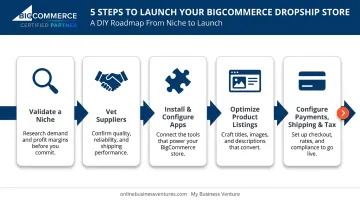
The typical DIY roadmap looks like this:
- Validate a niche: research demand, competition, and margin potential
- Vet suppliers: confirm reliability, shipping times, and product quality
- Install and configure apps: inventory sync, order routing, and shipping tools
- Optimize product listings: write descriptions, source images, set pricing
- Configure payments, shipping, and tax settings: a process that varies by state and product category
App Overload and Rising Costs
Here's where it gets tricky. Most dropship automation requires stacking multiple apps: one for supplier sync, one for order routing, sometimes another for shipping labels. Each has its own pricing tier.
Take Inventory Source as an example. Its full-automation plan starts with 500 monthly orders included, then charges $0.30 for every additional order beyond that allowance. That fee structure sounds manageable at low volume.
But if your store has a strong month, or gets a traffic spike from a viral post, those per-order charges add up fast. They stack on top of whatever you're already paying for inventory sync and shipping tools.
The Design and Time Investment
BigCommerce's store editor is capable, but there's a real learning curve. Without developer help, many first-time sellers end up with a generic-looking storefront that doesn't build much trust.
And the time commitment is significant:
- Market research and niche validation: days to weeks
- Supplier vetting: ongoing, often trial-and-error
- Marketing strategy development: weeks
- Technical setup and testing: additional weeks
Support gaps matter too. BigCommerce will help with platform issues, but it won't step in if your supplier ships the wrong item or misses a delivery window. That dispute is entirely yours to resolve.
The Turn-Key Alternative: How the MBV BigCommerce Dropship Store Works
My Business Venture is a Certified BigCommerce Developer, and it builds this entire stack for you. Instead of spending weeks assembling apps and vetting suppliers, MBV configures a fully functional dropship store, and clients typically go live within days.
Curated Catalog, Real-Time Updates
MBV clients get access to a curated catalog of 2,500+ top-selling products, scalable up to over 1 million items from brand-name manufacturers, through supplier partnerships that include Doba. Automated XML technology keeps that catalog current:
- New arrival products get added automatically
- Out-of-stock or discontinued items get removed in real time
- Pricing and stock levels stay synced without manual intervention
Custom Branding and Secure Checkout
Every package includes a custom logo design and a professional, branded storefront. Checkout runs through an SSL-secured, encrypted connection, which matters for building trust with customers who've never bought from the store before.
Fulfillment, Fraud Protection, and Uptime
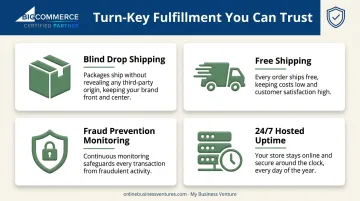
- Blind drop shipping under the client's own brand — packages ship with the store owner's name, not MBV's
- Free shipping on all orders
- Fraud prevention monitoring, including real-time screening and manual review of every transaction
- 24/7 hosted uptime through MBV's hosted servers
Guidance That Goes Beyond the Build
MBV's consultant team provides ongoing, one-on-one support, backed by training through MBV University. Strategic input also comes from Kevin Harrington, an original Shark from Shark Tank, whose ventures have generated over $6 billion in global sales. That knowledge gets passed to MBV's team and, from there, to clients.
MBV also backs a Low Price Guarantee: if a shopper finds an item cheaper elsewhere, MBV beats that price by 10% on the product itself. Combined with a flat one-time package cost, it's a far more predictable investment than stacking separate app subscriptions and hoping the fees stay reasonable.
Key Benefits of Choosing a Turn-Key Store Over DIY
| Factor | DIY BigCommerce Store | MBV Turn-Key Store |
|---|---|---|
| Launch timeline | Weeks to months | Days |
| Margin potential | 15–30% (Forbes Advisor's editorial gross-margin estimate) | 35–200% on curated products |
| Inventory risk | Varies by supplier terms | None — zero inventory required |
| Supplier vetting | Owner's responsibility | Pre-established supplier partnerships |
| Training | Self-taught | One-on-one consulting + MBV University |
The margin gap deserves a closer look. Forbes Advisor cites a 15-30% gross margin range as typical for dropshipping stores, once platform fees, advertising, and refunds get factored in. MBV's curated catalog, by contrast, carries built-in markups of 35–200% before those overhead costs even enter the picture.
What removing inventory risk actually means:
- No upfront capital tied up in warehousing
- No guessing on which products will sell before you've paid for stock
- Owners can put their energy into growth and marketing instead of logistics
Personalized consulting also cuts down on the trial-and-error mistakes that trip up first-time DIY sellers, including weak product descriptions, poor supplier choices, and checkout errors that quietly kill conversions. Credibility matters too. As a BBB A+ accredited, Dun & Bradstreet-registered company with over 30 years in business, MBV carries more weight than an unfamiliar app-based supplier found through a quick Google search.
Which E-Commerce Platform Is Best for Dropshipping?
BigCommerce, Shopify, and WooCommerce each take a different approach.
- BigCommerce: Strong native features (up to 600 product variants, built-in SEO controls) with no added platform fee when using an embedded payment provider
- Shopify: Extensive app ecosystem, but third-party transaction fees apply when merchants use outside payment providers instead of Shopify Payments
- WooCommerce: No platform revenue share on its open-source core, but dropship automation runs through paid extensions
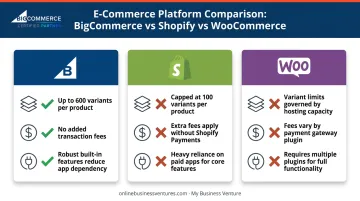
For dropshipping specifically, BigCommerce's native variant handling and SEO tools reduce how much you need to lean on third-party apps just to run a functional catalog. That matters more as your product count grows.
That said, the "best platform" debate matters a lot less once you're working with a turn-key partner. MBV already made that decision, building the infrastructure and supplier connections you'd otherwise have to piece together yourself. You skip the platform research entirely and start with a setup that's already optimized.
How to Get Started with an MBV Turn-Key Dropship Store
Getting a store live doesn't require months of preparation. MBV's process moves fast:
- Schedule a free consultation with an MBV business consultant to talk through your goals, niche interests, and budget
- Receive your branded storefront, built by MBV's certified developers and configured with your curated product catalog, typically completed within days
- Get onboarded through MBV University, with one-on-one training and ongoing consultant support to guide your marketing and growth after launch
You can review the Getting Started Guide for more detail on what the onboarding process covers before you commit to a package.
Frequently Asked Questions
Which platform is best for dropshipping?
BigCommerce's built-in features and scalability make it a strong choice for growing dropship stores. Pairing it with a turn-key provider like MBV removes the need to research and compare platforms yourself.
Is dropshipping on BigCommerce profitable?
Typical dropshipping margins fall in the 15–30% range, according to Forbes Advisor. Curated, turn-key models like MBV's can improve on that, with products carrying built-in markups of 35–200%.
How much does it cost to start a dropshipping business with MBV?
MBV offers three one-time package tiers: Enterprise ($3,995), Premier ($4,995), and Millennium ($5,995) — plus standard merchant account fees. That's far more predictable than the stacking monthly app costs common in a DIY build.
Do I need prior experience to start a BigCommerce dropship store?
No. MBV's turn-key setup and MBV University training are designed specifically for first-time entrepreneurs with no technical or e-commerce background.
How long does it take to launch a turn-key BigCommerce dropship store?
MBV clients typically go live within days of signing up. A DIY build, by comparison, often takes weeks or months when you factor in supplier vetting and app configuration.
What happens if there's an issue with a supplier or shipment?
MBV's fulfillment process includes fraud prevention monitoring, and if a fraudulent transaction slips through undetected, MBV covers the resulting loss. Clients also get direct consultant support to help resolve shipping or supplier concerns.