Introduction
Most first-time dropshippers picture a simple setup: a storefront, a supplier, and a few clicks to go live. Then reality sets in.
Within weeks, many owners find themselves juggling separate subscriptions for supplier sourcing, order automation, email marketing, analytics, and customer support — often five or more tools before a single sale ships. Each one solves a real problem. Together, they create a management headache that first-time entrepreneurs rarely see coming.
This guide breaks down the five tool categories every dropshipping business actually needs, what they cost when purchased separately, and why the setup process often takes longer than expected. Then we'll look at a different model entirely: the turn-key MBV Dropship Store, which bundles these functions into one supported platform instead of a stack of logins.
Key Takeaways
- Success requires five tool categories: sourcing, automation, marketing, analytics, and support
- Stacking individual SaaS subscriptions adds up fast and demands ongoing technical upkeep
- A turn-key store consolidates most of these functions under one supported roof
- MBV delivers a fully built store with curated products, branding, and training in days
- The right choice comes down to your budget, technical comfort, and timeline
The Essential Dropshipping Tool Categories You Need
Regardless of which platform you build on, every dropshipping business runs on tools from the same four functional areas. Skip one, and you'll feel it in lost sales, overselling, or a mountain of unanswered support tickets.
Product Sourcing & Supplier Directories
Supplier directories help sellers find vetted suppliers and cut through the noise of low-quality manufacturers. Catalog sizes vary enormously, from niche directories with a few thousand listings to massive networks spanning tens of millions of products.
That breadth is a discovery advantage, not a guarantee of quality. Every supplier still needs vetting: reviews, sample orders, shipping speed, and stock reliability. Manual product research alone can eat entire weekends. That's exactly why curated catalogs exist: they trim the guesswork down to a shortlist worth testing.
Automation & Order Fulfillment Software
Automation tools sync inventory, route orders to the right supplier, and push tracking updates without manual entry. Skip this step and you're stuck copying order details by hand, which invites overselling and shipping mistakes.
There's no magic order count where automation suddenly becomes mandatory. But once weekly orders climb into the dozens, the labor adds up fast:
- Manual order tagging can quietly consume hours per week
- Stockouts and overselling become more frequent without real-time sync
- Customer complaints about wrong tracking info start piling up
Marketing & Store-Building Tools
Traffic doesn't show up on its own. Email marketing platforms, social integrations, and ad research tools all work together to drive visitors and convert them into buyers.
Branding belongs in this category too, and it matters more than most beginners assume. In a large-scale study of 2,684 participants evaluating website credibility, visual "design look" came up in 46.1% of all credibility comments, more than any other factor, according to research highlighted by Consumer Reports' analysis of the Stanford Web Credibility Project. A polished logo and coherent storefront function as trust signals, not just decoration.
Analytics, Competitor Research & Customer Service Tools
Before spending ad dollars on a product, smart sellers validate it first. Competitor tracking and sales analytics tools help confirm a product has real demand instead of relying on gut instinct alone.
Customer service tools matter just as much once volume grows. Forrester's retail research found that shoppers who used live chat were 2.8 times more likely to convert and spent 60% more on average than those who didn't. A helpdesk or live chat widget functions as a genuine conversion tool, not just a support feature.
Turn-key platforms fold these categories into one package. MBV's dropship stores, for instance, pair curated product catalogs with automated fulfillment, built-in marketing support, and consultant-led training, removing the need to assemble these tools separately.
The Hidden Cost of Building Your Own Tool Stack
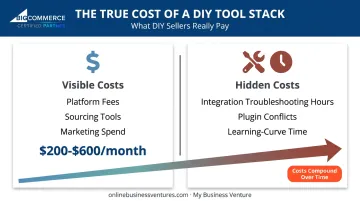
Piecing together your own stack looks affordable at first glance. The reality gets more expensive once you add it all up.
Shopify's own cost guide estimates a lean dropshipping setup runs $200 to $600 per month, once you factor in platform fees, sourcing tools, and marketing spend. That figure assumes everything works smoothly, which rarely happens on the first try.
Integration headaches are the real hidden cost. Every tool you add needs to talk to your platform, whether that's Shopify, WooCommerce, or BigCommerce. When it doesn't:
- Plugin conflicts can slow load times or break checkout entirely
- Troubleshooting one broken integration can eat an entire afternoon
- Adding "just one more app" often means disabling and testing others to isolate the problem
Beginners consistently underestimate this learning curve. Configuring five or more separate dashboards, each with its own settings, permissions, and quirks, becomes an ongoing part-time job that competes with the time you'd rather spend on marketing and sales.
Introducing the MBV Turn-Key Dropship Store: Every Tool, Built In
My Business Venture has spent over 30 years building e-commerce solutions, and its Dropship Store model takes a different approach. Instead of stacking separate subscriptions, MBV bundles the essential tool categories into one managed platform:
- Sourcing, handled: Through its partnership with dropship supplier Doba, MBV gives clients access to 2,500+ curated, top-selling products, with a live feed reaching over 1 million items from brand-name manufacturers. There's no separate supplier directory to manage or vet.
- Automation, built in: MBV's proprietary XML technology keeps the product catalog and inventory synced automatically. New arrivals get added, discontinued items disappear, and the storefront reflects live warehouse stock, all without manual uploads or a separate sync tool.
- Marketing and branding, included: Every package comes with a custom logo design, a fully branded storefront, and social media integration. Higher tiers add a managed Social Media Upgrade Package, Titanium Marketing Package, and lifetime search engine submission, replacing what would otherwise be several separate marketing subscriptions.
- Security and support, covered: Stores run on SSL-secured, encrypted checkout with real-time fraud screening, and if MBV's team misses a fraudulent order, MBV covers the loss. Hosting comes with a 24/7 uptime guarantee, removing the need for separate security add-ons entirely.
- Training, rounded out: MBV University provides one-on-one consulting from business consultants and strategic guidance shaped by Shark Tank's Kevin Harrington, who serves as MBV's strategic advisor.
DIY Tool Stack vs. Turn-Key Store: Which Fits Your Business?
There's no universally "right" answer here — it depends on what you value more: control or speed.
| Factor | DIY Tool Stack | Turn-Key Store (MBV) |
|---|---|---|
| Customization | Full control over every tool choice | Pre-built, professionally configured |
| Setup time | Weeks of research and configuration | Live in days |
| Technical skill needed | Moderate to high | Minimal to none |
| Cost structure | Stacked monthly subscriptions | One-time package investment |
| Support | Scattered across vendors | Dedicated consultant + 24/7 email support |
Choose DIY tools if you:
- Already have e-commerce experience and a clear tech stack in mind
- Want granular control over every tool and vendor relationship
- Have time to research, configure, and troubleshoot on your own
Choose a turn-key model if you:
- Want to launch in days, not weeks
- Prefer one dedicated consultant instead of juggling multiple vendors
- Are starting your first dropshipping venture and want guided support from day one
When speed and support matter more than granular customization, a bundled solution like MBV is the more practical starting point.
Getting Started with Your MBV Dropship Store
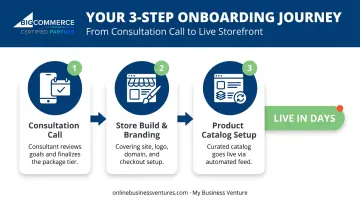
The onboarding path moves quickly:
- Consultation call: a certified consultant reviews your goals and finalizes your package tier
- Store build and branding: MBV's team sets up your site, logo, domain, and secure checkout
- Product catalog setup: your curated selection goes live, synced through the XML feed
Client feedback backs up the speed. One client working with consultant Bruce Witkin noted he "did everything he told us he would do, including getting our site operational in less than a week." Another client, working with consultant Jason Backer, reported a fully running website within the first week of signing up.
The speed matters because it gets your store earning sooner. Products carry built-in profit margins of 35% to 200%, and MBV's fulfillment model includes free shipping on every order, so your storefront can compete on price without eating into your margin.
Frequently Asked Questions
Is $500 enough to start dropshipping?
$500 can cover a lean, DIY starter setup: platform fees, a domain, and basic tools. A turn-key platform bundling sourcing, branding, and support involves a different investment structure, so compare total cost of ownership, not just the sign-up price.
Is AI dropshipping legal?
Yes. Using AI for product descriptions, image editing, or customer service chat is legal, provided you follow standard business, tax, and consumer protection rules. The FTC confirms there's no special exemption for AI-generated content: deceptive claims are still illegal.
Which tool is best for dropshipping?
There isn't one universal answer. The right tool depends on whether you need sourcing, automation, marketing, or an all-in-one managed solution. These are the categories covered earlier in this guide.
Do I need coding or technical skills to use dropshipping tools?
Most modern sourcing and automation tools are no-code. But managing multiple integrations still involves a learning curve. A turn-key store like MBV removes this requirement almost entirely.
How long does it take to launch a dropshipping store?
DIY setups can take weeks to configure tools, vet suppliers, and test integrations. A turn-key solution like MBV can have a store live in days.
Can I use multiple dropshipping tools together?
Yes, combining tools (like a sourcing app with a separate marketing platform) is common. Just check compatibility and total cost before stacking several subscriptions at once.