She's not alone. Most first-time entrepreneurs hit this exact wall before they ever list a single product.
Online storefronts are the digital front door of modern retail, and that door is getting busier every quarter. According to the U.S. Census Bureau, ecommerce sales hit $326.7 billion in Q1 2026, accounting for 16.9% of all U.S. retail sales and up 9.8% year-over-year.
This guide breaks down exactly what an online storefront is, how it differs from a marketplace listing, and how MBV helps entrepreneurs launch a fully-functioning one in days, not months.
Key Takeaways
- An online storefront is the customer-facing side of your website that displays and sells products directly.
- Unlike marketplace listings, a storefront lets you own the branding, customer data, and relationship.
- Core components include product listings, cart, checkout, payments, and mobile-optimized design.
- Turn-key solutions like MBV help entrepreneurs launch a branded storefront without starting from scratch.
What Is an Online Storefront?
An online storefront is the digital interface through which a business sells goods or services directly to customers. Think of it as everything the shopper interacts with: the product catalog, site navigation, shopping cart, checkout flow, and payment system.
Here's the key distinction: a general website communicates information. A storefront is engineered to move a visitor toward a completed purchase. A restaurant's homepage tells you their hours. A storefront lets you actually buy the meal kit and pay for it right there.
You'll see several terms used almost interchangeably in this space:
- Online storefront
- Digital storefront
- E-storefront
- Web store
These four all describe the same shopper-facing sales interface. "Online store" and "ecommerce," by contrast, are broader umbrella terms that cover more ground.
Online Storefront vs. Ecommerce
Ecommerce is the entire transaction ecosystem: marketing, fulfillment, analytics, customer service, and backend operations. The storefront is just the customer-facing layer sitting on top of all that machinery.
A standalone storefront, as opposed to a marketplace seller page, gives a brand full control over the customer experience, the data collected, and the long-term relationship with buyers. That's a meaningful advantage if you're building something with your name on it.
That control starts with picking the right platform. Shopify, BigCommerce, and WooCommerce power most of these storefronts today, though each operates differently:
- Shopify: hosted SaaS, commanding an estimated 14% of U.S. ecommerce GMV among merchants
- BigCommerce: "Open SaaS" model built for scalability across multiple storefronts
- WooCommerce: open-source, plugs into WordPress
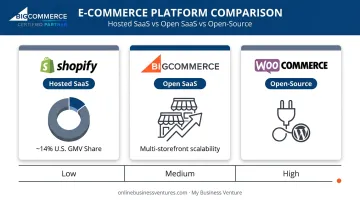
MBV builds every client storefront on BigCommerce as a certified developer, one reason platform choice matters as much as it does. The platform you choose determines exactly how much control you actually retain over checkout, data, and costs.
Key Components Every Online Storefront Needs
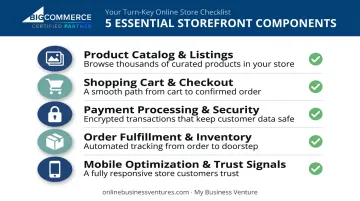
A high-converting storefront blends front-end shopper experience with backend systems working together seamlessly. Miss one piece and the whole thing breaks down — a beautiful catalog with a clunky checkout still loses sales.
Product Catalog & Listings
Listings need clear images, accurate descriptions, transparent pricing, and specifications shoppers can actually use. Organize everything with:
- Categories that match how customers actually search
- Filters for price, brand, size, or color
- An on-site search bar that returns relevant results fast
Shopping Cart & Secure Checkout
The cart-to-checkout flow makes or breaks conversion. Shoppers expect:
- Guest checkout that skips forced account creation before buying
- Saved profiles for faster repeat purchases
- A clear order summary before the final click
Payment Processing & Security
Trust gets built or lost right here. Baymard Institute's research puts average cart abandonment at over 70%, with nearly one in five shoppers citing distrust of the site with their card information. Storefronts need:
- SSL encryption on every page handling payment data
- Multiple payment options, including cards, digital wallets, and buy-now-pay-later
- Fraud-prevention monitoring that flags suspicious orders before they ship
Order Fulfillment & Inventory Management
Three models dominate here:
- Self-fulfillment: you buy, store, and ship inventory yourself
- Dropshipping: a supplier holds and ships inventory under your brand; you never touch stock
- Third-party fulfillment: a logistics partner warehouses your goods and ships on your behalf
Dropshipping removes the biggest barrier for new entrepreneurs: upfront inventory investment. MBV's turn-key stores build on this model, pairing a pre-built storefront with a dropship partner that handles storage and shipping.
Mobile Optimization, Speed & Trust Signals
Mobile isn't a nice-to-have anymore. Adobe reported that mobile devices generated 52.8% of U.S. online sales during the Nov. 1–Dec. 1, 2025 shopping window, edging out desktop for the majority of transactions.
Beyond mobile-responsive design, shoppers look for:
- Customer reviews visible on product pages
- Security badges near the checkout button
- Clear, easy-to-find return policies
Online Storefront vs. Marketplace vs. Website (With Real Examples)
An online storefront is a branded, standalone sales channel a business fully controls. An online marketplace, such as Amazon, eBay, or Etsy, hosts many sellers on shared infrastructure with less branding control and built-in fees. Both differ from a general website, which may only inform visitors without any capability to transact.
Here's how the fee structures actually compare:
| Platform | Fee Structure | Branding Control |
|---|---|---|
| Amazon | $0.99/item or $39.99/month + referral fees | Limited without Brand Registry |
| eBay | ~13.6% final value fee + per-order fee | Store subscribers get logo/banner customization |
| Etsy | $0.20 listing + 6.5% transaction fee | Shop icon, banner, and section customization |
| Owned storefront (such as BigCommerce) | Platform fee + payment processing only | Full control over design, data, and customer relationship |
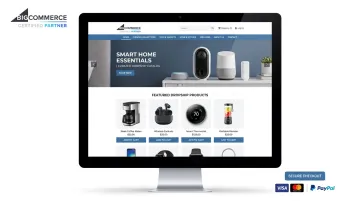
Consider a BigCommerce-powered shop, like those MBV builds for its clients, where one business displays and sells its own curated catalog directly to consumers, under its own name, with its own checkout. Compare that to a seller profile buried inside Amazon's search results, competing against dozens of other listings for the same product.
Which Model Is Right for You?
Marketplaces offer instant access to existing traffic but limit branding and put you in direct price competition with other sellers. An owned storefront gives you full control over data, branding, and the customer relationship, but you're responsible for driving your own traffic.
Many successful sellers don't pick just one channel; they run both. A storefront builds the brand and owns the customer list; a marketplace listing adds reach on the side.
Why Launch Your Own Online Storefront
Running your own storefront means your business is open 24/7, globally, without the overhead of a physical location. No rent, no store hours, no geographic ceiling on who can buy from you.
Beyond that, ownership matters in ways marketplaces can't replicate, and it's exactly what an MBV storefront is built to deliver:
- Brand control: your logo, your design, your voice, not a template shared with competitors
- Customer data ownership: build your own email list and repeat-customer base, something marketplace sellers rarely get access to
- Direct relationships: market to past buyers whenever you want, with no platform restrictions in the way
The growth trend backs this up. EMARKETER forecasts worldwide retail ecommerce sales will hit $6.419 trillion in 2025, up 6.8% year-over-year and representing over 20% of all global retail sales. An owned storefront can scale right alongside that growth, without the physical constraints of leasing more retail space.
How to Launch Your Online Storefront in Days with MBV
The DIY path to launching a storefront usually looks like this: source products, negotiate with suppliers, build a site, integrate payment processing, figure out marketing, often stretching across months before a single sale happens.
MBV removes that timeline entirely. Clients get a fully operational, SSL-secured storefront live in days, not months. Client testimonials back this up directly — one customer reported their site was "operational in less than a week" working with MBV consultant Bruce Witkin.
What's included when you launch with MBV:
- Access to a curated catalog of 2,500+ dropship products, with the ability to expand into a broader catalog of over 1 million items, with no inventory to stock or ship
- Personalized one-on-one training through MBV University, plus a dedicated business consultant guiding setup and early operations
- Strategic input shaped by Kevin Harrington, an original Shark Tank investor whose team has helped launch more than 1,000 products and generate over $6 billion in global sales
- A complete branding package: custom logo design, social media integration, and marketing campaign support to drive traffic from day one
- Fraud prevention monitoring, encrypted checkout, and 24/7 hosted uptime built in from the start
MBV offers three package tiers to match different starting points:
| Package | Price | Training Level | SEO Submission |
|---|---|---|---|
| Enterprise | $3,995 | Starter | 24 months |
| Premier | $4,995 | Silver | Lifetime |
| Millennium | $5,995 | Platinum | Lifetime |
MBV has been doing this since 1992: over 30 years in business, BBB A+ accredited, and a certified BigCommerce Developer. That combination gives clients a professionally built, fully customized storefront.
If you're ready to stop researching and start selling, talk to an MBV consultant about what launching your storefront actually looks like.
Frequently Asked Questions
What is an online storefront?
An online storefront is the customer-facing digital interface (catalog, cart, checkout, and payment system) through which a business sells products or services online. It's the transactional layer that turns a visitor into a buyer.
What's an example of an online storefront?
A branded, standalone shop built on a platform like BigCommerce, where one business displays and sells its own curated catalog directly to consumers. This contrasts with a marketplace seller page, which shares infrastructure and search results with many other sellers.
What are the key differences between an online storefront and an online marketplace?
A storefront gives you full branding control and ownership of customer data, while a marketplace shares that control across many sellers. Marketplaces also charge listing and referral fees that vary by platform and category.
How much does it cost to launch an online storefront?
Costs vary widely depending on platform, features, and whether you build it yourself or use a turn-key service. MBV bundles setup, hosting, training, and marketing into one-time packages ranging from $3,995 to $5,995.
Do I need technical skills to build an online storefront?
No. Modern platforms and turn-key services like MBV are built for non-technical entrepreneurs, handling the website build, hosting, and product feed so you don't need any coding knowledge.
Can I sell on my own storefront and a marketplace at the same time?
Yes, many sellers run both channels together. The storefront builds brand identity and owns the customer relationship, while marketplace listings add extra reach and traffic.