Introduction
Launching an online store feels exciting right up until you hit the word "hosting." Suddenly you're comparing shared plans, VPS tiers, and something called headless commerce, wondering which one keeps your site from crashing on launch day.
This confusion isn't rare. Many first-time entrepreneurs spend weeks trying to become amateur IT experts before selling a single product. People throw around terms like PCI compliance and SSL certificates without explaining what they actually mean for your bottom line.
This guide breaks down the hosting types, the features that actually matter, and real costs you'll encounter. We'll also introduce My Business Venture's fully hosted, done-for-you alternative for entrepreneurs who'd rather launch fast than manage servers.
Key Takeaways
- Hosting quality affects site speed, security, and sales-rush readiness.
- Options range from technical (VPS, dedicated, headless) to fully managed.
- Costs range from a few dollars monthly to $1,500+ for enterprise plans.
- Turn-key hosted solutions let non-technical founders skip hosting headaches.
- MBV builds SSL-secured, fraud-monitored stores that launch in days.
Understanding Ecommerce Hosting: The Main Types Explained
Ecommerce hosting is the infrastructure that stores your product data and images, runs your checkout, and keeps your storefront accessible 24/7. Pick the wrong type, and you'll feel it in load times, security gaps, or a site that buckles during your first big sale.
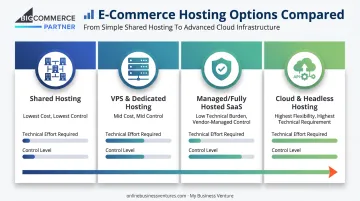
Shared Hosting
Multiple websites split the resources of one physical server. It's the cheapest way to get online, but there's a catch: if a neighboring site gets hacked or hogs bandwidth, your store suffers too. Fine for a hobby blog. Risky for a store processing real payments.
VPS and Dedicated Hosting
VPS hosting partitions a shared server into isolated virtual environments, giving you reserved resources without the noisy-neighbor problem. Dedicated hosting goes further, handing you an entire physical server. Both offer more control, but that control also means you're responsible for configuring, patching, and scaling the environment yourself as your store grows.
Managed and Fully Hosted (SaaS) Platforms
With fully hosted platforms, the provider manages security patches, uptime, and infrastructure entirely. You log in, add products, and sell. This is the model best suited to entrepreneurs without an IT staff, and it's the same approach MBV uses to remove hosting responsibilities from clients entirely.
Cloud and Headless Hosting
Cloud (IaaS) hosting and headless commerce architectures, where the storefront frontend is separated from backend checkout and inventory systems, offer the most flexibility. They also require a development team to build and maintain them. For most first-time store owners, that's simply not practical.
The broader market is already voting with its feet. Shopify alone processed $378 billion in gross merchandise volume in 2025, up 29.3% year over year, with small businesses making up nearly 90% of its merchant base. That's a strong signal that smaller retailers increasingly favor managed platforms over wrestling with their own servers.
Must-Have Features When Evaluating an Ecommerce Host
Not every host is built the same, and the differences show up fast once real customers start visiting your site. Here's what separates a reliable host from a risky one.
Security signals matter more than most founders assume. Baymard Institute's research found that 19% of online shoppers abandon checkout because they don't trust a site with their credit card information. A host offering SSL certificates, firewalls, and active fraud monitoring keeps customers from bailing at the finish line.
Uptime guarantees protect revenue you can't see leaking away. Retail outages carry a steep price tag. New Relic's 2023 survey of retail IT teams found a median annual outage cost of $9.95 million. More than a third of retailers reported high-impact outages at least weekly. Look for hosts publishing a 99.9%+ uptime commitment, not just claiming it.
Page speed shapes conversion rate directly. Portent's analysis of roughly 100 million page views found that ecommerce conversion rates drop by an average of 0.3% for each additional second of load time. A site loading in one second converted 2.5 times more often than one taking five seconds.
Beyond those three, a handful of features are non-negotiable:
- PCI compliance: any site accepting card payments must meet PCI standards, and a good host manages this at the infrastructure level
- Automated daily backups: protects you from losing product data or orders to a bad update or server hiccup
- 24/7 support availability: critical when you don't have in-house IT staff to troubleshoot at 2 a.m.
- Scalability: your host needs to absorb a traffic spike during a holiday sale without the site grinding to a halt
MBV's e-commerce packages build these safeguards in from day one: SSL encryption, active fraud monitoring, and 24/7 uptime come standard on every client's BigCommerce-powered store, so entrepreneurs aren't left checking these boxes alone.
How Much Does Ecommerce Hosting Cost?
Hosting costs vary wildly depending on the model you choose, and the sticker price rarely tells the full story.
| Hosting Type | Provider Example | Advertised Price |
|---|---|---|
| Entry-level WooCommerce hosting | SiteGround StartUp | $2.99/month (renews at $17.99/month) |
| Managed WordPress | WP Engine Startup–Scale | $30–$276/month (billed annually) |
| Fully hosted SaaS | BigCommerce Core–Scale | $29–$299/month (billed annually) |
| Enterprise SaaS | BigCommerce Performance | From $1,499/month |
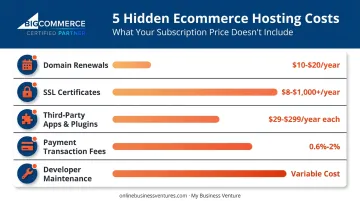
Those numbers only cover the base plan. Several costs tend to sneak up on new merchants:
- Domain renewals: typically $10–$20 per year — a recurring charge many merchants forget to budget for
- SSL certificates can range from free (included by some platforms) to $8–$1,000+ per year depending on certificate type
- Third-party apps and plugins add up quickly, with WooCommerce extensions alone commonly running $29–$299 per year, each
- Payment transaction fees from third-party processors typically run 0.6% to 2%, depending on your plan tier
- Developer maintenance costs accumulate over time through ongoing updates and custom fixes, especially on self-managed platforms
This is exactly why bundled, turn-key packages have appeal. Instead of piecing together hosting, SSL, apps, and a developer relationship separately, a single investment covers the essentials upfront. MBV's turn-key packages fold hosting, design, and support into one predictable cost rather than a growing stack of monthly line items.
Why First-Time Entrepreneurs Choose MBV's Fully Hosted, Turn-Key Solution
Once you've seen the technical checklist above, it's easier to understand why so many first-time founders skip the DIY route entirely. MBV builds and hosts a professional, SSL-secured ecommerce store that can go live in days, skipping the server configuration, PCI research, and SSL-provider hunting that trip up most DIY builds.
No inventory, no warehousing. Clients get access to a curated catalog of 2,500+ dropship products, with up to a million-plus available through the broader feed. Products ship with free shipping and zero inventory held by the client, removing fulfillment complexity right alongside the hosting complexity.
Security and uptime are actively managed. MBV's team monitors every transaction in real time through its fraud prevention program, and if a fraudulent sale slips through, MBV covers the loss. Hosting runs on 24/7 monitored servers with SSL encryption baked in, addressing the same concerns covered in the features section above, minus the technical lift.
Branding is included from day one. Every package includes:
- A custom logo design and fully branded storefront
- Social media integration to support your marketing from day one
- A live product feed that updates automatically via XML technology, adding new arrivals and removing out-of-stock items without manual work
Once your store looks the part, ongoing support matters just as much. You're never troubleshooting alone. One-on-one training through MBV University pairs clients with a dedicated consultant. Consultant Bruce Witkin, for example, is known among clients for getting new sites operational in under a week — a pace that would be tough to match building from scratch.
MBV has been doing this since 1992, carries a BBB A+ accreditation, and works alongside Shark Tank's Kevin Harrington as a strategic advisor. That combination of three decades of accredited experience and Shark Tank-level mentorship gives first-time founders a support system most competitors simply can't offer.
Choosing the Right Hosting Approach for Your Business Stage
The right hosting decision depends less on what's technically impressive and more on where you're starting from.
If speed to launch matters most, a fully managed, turn-key hosted solution like the platform MBV builds on BigCommerce removes the technical burden entirely. You focus on selling products instead of managing servers.
If you have development resources and want full customization, self-hosted or headless options give you more control. Just know that control comes bundled with ongoing technical maintenance, security patching, and the occasional 2 a.m. server alert.
Before committing to any host, run through this quick checklist:
- Is SSL included in the base price, or is it an add-on?
- Is there a published uptime guarantee, not just a vague promise?
- Are backups automated and how often do they run?
- Is customer support accessible around the clock, or only during business hours?
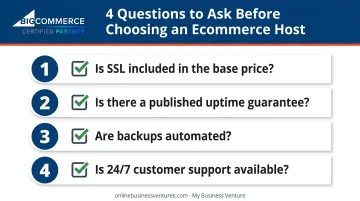
Answering these four questions honestly will tell you fast whether a host fits your business — or whether you need a more hands-off, fully managed option instead.
Frequently Asked Questions
Which hosting is best for an ecommerce website?
It depends on your technical skill and goals. Fully hosted, managed platforms suit non-technical entrepreneurs best, while VPS or dedicated hosting fits those with development resources who want more control.
How much does hosting cost for ecommerce?
Costs range from a few dollars monthly for basic shared hosting to hundreds for managed or enterprise plans. Turn-key bundled solutions often offer more predictable all-in pricing than piecing together separate services.
What is the difference between shared and dedicated ecommerce hosting?
Shared hosting splits one server's resources across multiple sites, keeping costs low but adding some risk. Dedicated hosting reserves an entire server for your business alone, at a higher price with more control.
Do I need technical skills to run a hosted ecommerce store?
No. Fully hosted, turn-key solutions like MBV's are built so entrepreneurs don't need coding or server management knowledge to launch and operate their store day to day.
Is hosting for a dropshipping store different from a regular online store?
Dropshipping stores need the same core hosting essentials — security, uptime, speed — but benefit most from platforms with built-in product catalog integrations and fulfillment support already connected.
How quickly can I get an ecommerce store online?
Self-built stores can take weeks to configure hosting, security, and design correctly. Turn-key hosted solutions like MBV's can get a fully branded, secure store live in a matter of days.