Online Retail Is Rewriting the Rules of American Business
Online shopping isn't a side trend anymore. It's how a growing share of Americans buy everything from electronics to birthday gifts.
The numbers back it up: global e-commerce revenue is projected to hit $3.88 trillion in 2026, climbing to $5.05 trillion by 2030, according to Statista's e-commerce market forecast.
That growth creates opportunity, but it also creates noise. Aspiring entrepreneurs get buried under conflicting trends, technical jargon, and the fear of sinking savings into a store that never gets off the ground.
This guide cuts through that confusion. We'll cover where e-commerce stands today, the trends reshaping it, the challenges tripping up new sellers, and how MBV's turn-key platform helps everyday people launch with confidence instead of guesswork.
Key Takeaways
- Global e-commerce revenue will grow from $3.88T in 2026 to $5.05T by 2030, a 6.84% CAGR
- Mobile and social commerce now drive the majority of online shopping activity in the US
- Cart abandonment averages 70.22%, while fraud costs merchants 3.1% of revenue
- MBV's done-for-you launch model tackles inventory, branding, security, and training in one package
The Current State of Global E-Commerce
E-commerce isn't slowing down. It's compounding. Statista's Market Insights team projects worldwide B2C revenue for physical goods will reach $3.88 trillion in 2026 and climb to $5.05 trillion by 2030, a 6.84% CAGR over that stretch. This year alone, growth is expected to hit 6.5%.
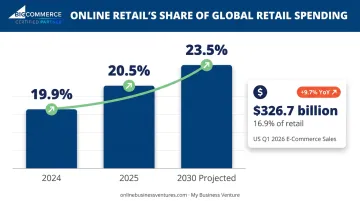
Online retail's share of total global retail spending tells a similar story. It sat at 20.5% in 2025, up from 19.9% the year before, and Statista projects that share will reach 23.5% by 2030. In the US specifically, Census data pegged Q1 2026 e-commerce sales at $326.7 billion, or 16.9% of total retail sales, growing 9.7% year over year.
Big Players, Bigger Opportunity
Amazon and Walmart dominate headlines, holding roughly 40.5% and 9.2% of US retail e-commerce respectively. But don't read that as a closed door. That concentration actually signals something useful:
- Consumers trust buying online enough to spend billions with familiar names
- That trust extends to smaller, niche stores once shoppers find them
- A growing market means more total spending to capture, not a fixed pie being carved thinner
If you're weighing whether to start an online business today, the data points one direction. The market keeps expanding, leaving plenty of room for new sellers to grow alongside it.
Top E-Commerce Trends Shaping the Industry
Five forces are actively reshaping how people shop online right now. Understanding them matters less for trivia purposes and more because they dictate what a competitive store needs to look like in 2026.
Mobile and Social Are Now the Default
Mobile commerce crossed a threshold in 2025, the first full year mobile devices generated more than half of US online spending, according to Adobe. eMarketer expects mobile to hold the majority of US e-commerce sales through 2028.
Social commerce is scaling right alongside it. Worldwide social-commerce revenue sits at an estimated $586 billion in 2026, projected to hit $929 billion by 2030. Influencer content plays a real role here too: 49% of surveyed US and UK consumers say influencer posts drive them to buy at least monthly, per Sprout Social's 2024 research.
Shoppers Are Going Global, and AI Is Leveling the Field
Cross-border shopping has become routine rather than exceptional. DHL's research found 59% of global shoppers buy from retailers outside their home country, with 35% doing so monthly.
Meanwhile, AI tools are closing the gap between small stores and major retailers:
- 68% of small businesses surveyed by Intuit now use AI regularly
- 74% of those users report a measurable productivity boost
- 45% of retailers use generative AI specifically for customer-experience management
Translation: the technology that used to require an enterprise budget is now accessible to a one-person operation running a store from home.
Consumer Behavior & Challenges in Online Retail
Growth numbers are exciting, but they don't guarantee a single sale converts. Two operational realities determine whether a new store actually makes money: checkout friction and fraud exposure.
Shopping Habits and Cart Abandonment
Baymard Institute's research, averaged across 50 studies, puts cart abandonment at 70.22%. That means roughly seven out of ten shoppers who add something to their cart never complete the purchase. The top reasons, according to that same research:
- 40% — extra costs (shipping, taxes, fees) felt too high
- 20% — delivery times were too slow
- 18% — the site forced account creation before checkout
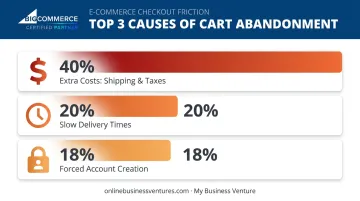
None of these are exotic problems. They're fixable with the right checkout design, free shipping offers, and guest checkout options. These details matter more to conversion than most trendy marketing tactics.
E-Commerce Fraud and Security Risks
Fraud is the other side of that coin. The Merchant Risk Council's 2025 survey of over 1,000 merchant professionals found payment fraud eats up an average 3.1% of e-commerce revenue. Looking ahead, Juniper Research projects global e-commerce fraud losses will jump from $56 billion in 2025 to $131 billion by 2030, a 133% increase.
For a brand-new store owner, unchecked fraud exposure hits margin directly. Built-in fraud monitoring, SSL encryption, and a secure checkout aren't nice-to-haves anymore — they're the baseline cost of doing business online, which is exactly where a done-for-you platform earns its keep.
Why There's Never Been a Better Time to Launch Your Online Business — with MBV
Rising market size, mobile-first shoppers, and AI tools that level the playing field all point to an open window right now. The catch: you have to move fast and operate securely to actually capture it.
Most people never get through that window because of three barriers:
- Technical complexity — building a website, integrating payments, and managing hosting feels overwhelming
- Inventory investment: buying and storing product upfront is a financial risk few can absorb
- Marketing uncertainty — knowing how to actually drive traffic and sales once the site is live
Every one of these barriers stops good ideas before they ever launch, simply because the setup feels impossible.
How MBV Removes Each Barrier
MBV's turn-key, dropship-based model is built specifically to answer these three problems:
- No inventory required — access a live-updating catalog of over 1 million products, with 2,500+ curated items pre-loaded into your store at launch
- Free shipping and built-in margins: profit margins run 35–200% on most items, with orders shipped under your brand, not MBV's
- Speed — a fully operational, SSL-secured store can go live in days, not months. Client Tris T. had a working site in under a week thanks to consultant Bruce Witkin
- Every store includes fraud prevention monitoring, encrypted checkout, and 24/7 hosted uptime — security baked in from day one
Backed by Credibility, Not Just Promises
MBV has operated since 1992 — over 30 years helping first-time entrepreneurs launch online. That track record comes with real accreditation:
- BBB A+ rating, the highest available
- Dun & Bradstreet registration with an exemplary company rating
- Certified BigCommerce developer status
Training runs through MBV University, with Shark Tank's Kevin Harrington advising the MBV Dream Team directly. Harrington's ventures have launched over 1,000 products and generated more than $6 billion in global sales — expertise that flows into every consultant session, whether you choose the Enterprise, Premier, or Millennium package.
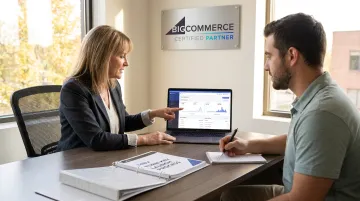
If you've been waiting for the right moment to start, this is it. Speak with an MBV consultant to see which package fits your goals, or call 1-800-639-6644 to get started today.
Frequently Asked Questions
What is the current status of e-commerce?
Global e-commerce revenue is projected at $3.88 trillion in 2026, growing to $5.05 trillion by 2030. Mobile and social commerce now drive the majority of that spending in the US.
Is starting an e-commerce business still profitable today?
Yes. Margins on curated dropship products through platforms like MBV run 35–200%, and the overall market keeps expanding, leaving plenty of room for new sellers.
What is the biggest challenge new online store owners face?
Cart abandonment (averaging 70.22%), payment fraud (averaging 3.1% of revenue), and a steep technical learning curve top the list. Built-in support systems and fraud monitoring offset most of these risks.
How much does it typically cost to start an online store?
Building independently often means juggling separate costs for hosting, design, and marketing tools that add up quickly. A turn-key model like MBV's bundles all of this into one package, ranging $3,995–$5,995.
How quickly can a new e-commerce store go live?
With the right platform and support, stores can launch in days rather than months. MBV clients have reported fully operational, SSL-secured sites within a week of signing up.
Do I need prior experience to start an e-commerce business with MBV?
No. MBV University provides one-on-one training tailored to first-time entrepreneurs, covering everything from store setup to marketing strategy, with no prior experience required.