The numbers back up what you're seeing on your feed. Statista projects worldwide social commerce revenue will hit an estimated $586 billion in 2026, growing roughly 12.14% that year alone and climbing toward $929 billion by 2030 (Statista).
But most aspiring sellers get stuck on the same questions: Which platform actually matters? Where do the products come from? Do I need an LLC before I make my first sale? How do followers turn into paying customers?
This guide walks through each step, from legal groundwork to product sourcing to content strategy. And where the technical setup gets heavy, we'll show where a turn-key partner like MBV's Social Media Package can shortcut the busywork.
Key Takeaways
- Launching on social media takes legal setup, sourcing, and a content plan, not just a profile
- An LLC isn't required to start, but it matters once real sales roll in
- Platform choice should follow your audience, not vanity metrics or what competitors do
- Content ratios like 80/20 keep followers engaged instead of annoyed
- Turn-key e-commerce partners remove inventory and setup headaches so you can focus on growth
Step 1: Build Your Business Foundation
Before you post a single product photo, you need to know what you're actually selling and how you're structured to sell it. Skip this step and you'll rebuild your entire strategy three months in.
Choose Your Business Model First
Your fulfillment method shapes everything downstream, including which platforms make sense and what your content should look like.
- Dropshipping: You market products while a supplier handles shipping, similar to the pre-built dropship stores MBV sets up for clients. Low upfront cost, less control over packaging and delivery
- Digital products or services: Courses, consulting, freelance work. No shipping to worry about, but you're the product
- Handmade or manufactured goods: Full creative control, but you're also responsible for production capacity and quality
Do You Need an LLC for a Social Media Business?
Not right away. A sole proprietorship is the default when you start selling without registering anything else, but it comes with a catch: your personal and business assets aren't legally separate, meaning your liability is unlimited (IRS rules on sole proprietorships).
An LLC changes that. Members generally aren't personally liable for business debts, and the structure adds credibility once you're processing real orders. Forming one involves:
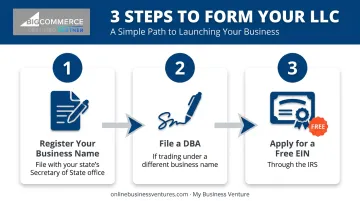
- Registering your business name with your state, often through the Secretary of State's office
- Filing for a DBA if you're trading under a name different from your own
- Applying for a free EIN directly through the IRS once your state entity exists
Note that forming an LLC and choosing a tax classification are separate decisions: a single-member LLC is typically taxed as a disregarded entity by default, not automatically as a corporation.
Set Real Numbers as Goals
Vague goals like "grow my following" won't tell you if you're winning. Set specifics instead: 50 sales in your first 90 days, 1,000 followers by month three, $2,000 in monthly revenue by month six. These numbers will later decide which platform and content mix make sense.
The U.S. saw 1.1 million new business establishments open between March 2023 and March 2024 (SBA 2025 state profile report), proof that the door is wide open. Getting through it just takes a plan.
These targets only matter once you know who you're targeting. Before writing a single caption, spend a week researching your audience: their habits, pain points, and where they hang out online. Surveys and social listening tools work well here.
Step 2: Source Products and Launch Your Online Store
Sourcing is where most first-time sellers either get stuck for months or launch in days. It depends entirely on the model you choose.
Three Ways to Get Products to Sell
| Model | What It Means | Best For |
|---|---|---|
| Dropshipping | A supplier stores and ships directly to your customer | Low startup capital, testing niches fast |
| Private Label | A manufacturer produces goods sold under your brand | Sellers wanting branding control and willing to manage stock risk |
| Handmade | You produce the product yourself | Makers with a repeatable process and time to spare |
Dropshipping wins on simplicity, but it hands you the least control over quality and shipping times. Private label gives you branding power at the cost of inventory exposure. Handmade gives you full creative control, but your time becomes the bottleneck.
Why a Turn-Key Storefront Speeds Things Up
This is exactly the gap MBV's packages are built to close. Instead of negotiating with suppliers or guessing at margins, clients get access to a curated catalog of 2,500+ products pulled from a live feed of over 1 million items. These span categories like electronics, toys, home goods, and pet supplies, with built-in profit margins of 35–200%.
A few things that matter when you're sending social traffic to a checkout page:
- SSL-secured storefronts reassure buyers who are wary of unfamiliar checkout pages
- Consistent branding, including a custom logo included in every MBV package, builds recognition faster than a mismatched DIY setup
- Speed to launch: MBV clients typically go live in under a week, versus the weeks or months it takes to build a store from scratch
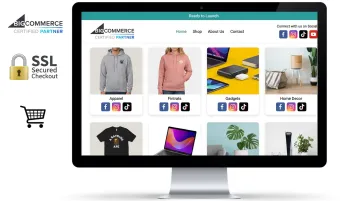
One-on-one training through MBV University also helps new sellers connect that storefront to actual social campaigns, rather than launching a beautiful site nobody knows exists.
Step 3: Choose the Right Platforms and Set Up Your Profiles
There's no universally "best" platform. There's only the one where your specific customer already spends time.
- Instagram, TikTok, Pinterest: visual products that photograph or demo well
- LinkedIn: professional services, consulting, B2B offerings
- Facebook Groups or Reddit: community-driven or research-heavy niches where peer opinion carries weight
Once you've picked a platform, optimize it fully before your first post: complete bio, working contact details, and a direct link to your store or shop tab. Your MBV Social Media Package includes ready-made templates and consultant support for this exact setup, so a professional profile takes hours, not days.
A half-finished profile undercuts trust before a customer even sees your product.
Once your profile is live, resist the urge to be everywhere at once. Start with one or two platforms, not five.
Sprout Social's Q1 2023 pulse survey found 63% of social media professionals experienced burnout in the prior three months, despite managing channels full-time. Spreading yourself thin as a solo founder guarantees inconsistent posting.
Step 4: Create a Content and Engagement Strategy
Consistency beats cleverness here. A predictable posting rhythm outperforms sporadic viral swings almost every time.
Content Pillars and the 80/20 Rule
Mix your posts across four types: educational, entertaining, user-generated, and promotional. This keeps your feed from feeling like a constant sales pitch.
Hootsuite's widely cited guideline is the 80/20 rule — 80% of content should inform, educate, or entertain, while only 20% directly promotes your brand. Followers tolerate promotion when it's the minority, not the majority, of what they see.
What Is the 3-3-3 Rule in Social Media?
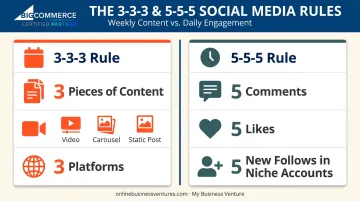
There's no single official source for this framework, but it's commonly used as a weekly content-planning shortcut. Create 3 pieces of content in 3 different formats (say, a video, a carousel, and a static post) for 3 platforms each week. It's less a scientific rule and more a practical way to avoid content ruts.
What Is the 5-5-5 Rule on Social Media?
Similarly, no single authoritative definition exists, but the popular version works as a daily engagement habit. Spend a few minutes commenting on 5 posts, liking 5 posts, and following 5 new accounts in your niche every day. It's a low-effort way to stay visible in your community without doomscrolling.
Batch Your Content, Track Your Response Time
Use a content calendar and batch-schedule a week or two of posts at once. It removes the daily "what do I post today" panic. MBV's Social Media Package includes a pre-built content calendar and consultant support, so you're not creating this rhythm from scratch.
Engagement matters as much as posting. According to Sprout Social, nearly three-quarters of consumers expect a brand response within 24 hours or sooner. Ignore your DMs for two days and you've likely lost the sale.
Step 5: Launch, Track Performance, and Avoid Common Mistakes
Once you're live, guessing isn't a strategy. Track these from day one:
- Reach — how many unique people saw your post
- Engagement rate — total engagements divided by reach (or followers, depending on your platform)
- Click-through rate — link clicks divided by impressions
- Conversion rate — conversions divided by clicks or visits
Each metric ties directly back to the goals you set in Step 1. Low reach but high engagement means your content resonates while distribution needs work. High clicks but low conversions point to a problem on your storefront, not your social strategy.
Common early mistakes to avoid:
- Posting constantly without offering value, just noise
- Ignoring comments and DMs for days at a time
- Leaning too hard into promotion, which drives unfollows fast
- Switching tone or posting schedule so often followers can't predict what to expect
New sellers often can't tell whether a slow week means "the strategy is wrong" or "it just takes time." That's where ongoing guidance helps. MBV clients get access to dedicated business consultants who help interpret analytics and adjust campaigns, rather than guessing in the dark month after month.
Frequently Asked Questions
Do I need an LLC for a social media business?
No, it's not legally required to start. But once sales become consistent, forming one is strongly recommended for liability protection and added business credibility.
What is the 5-5-5 rule on social media?
A popular (though informal) daily habit: comment on 5 posts, like 5 posts, and follow 5 new accounts in your niche each day to stay visible in your community.
What is the 3-3-3 rule in social media?
An informal weekly framework where you create 3 pieces of content, in 3 formats, across 3 platforms, giving you a simple way to keep your content mix varied without overplanning.
How much money do I need to start a business on social media?
It ranges widely, from nearly $0 for organic content only, to a few hundred dollars or more for a proper storefront and starter inventory, depending on your business model.
Which social media platform is best for starting a business?
There isn't one best platform — it depends entirely on your product type and where your specific target audience already spends their time online.
How long does it take to start seeing sales from a social media business?
There's no guaranteed timeline, but consistent posting and engagement over several weeks to a few months is typical before sales become steady and predictable.