Introduction
Starting an online business sounds simple until you actually try it. Suddenly you're comparing website builders, hunting for suppliers, setting up a merchant account, and figuring out Instagram ads — all before you've sold a single product.
Many first-time sellers struggle with exactly this kind of scattered setup. Juggling five or six vendors for one business is a recipe for stalled launches and expensive mistakes.
A one-stop ecommerce solution solves that problem by bundling everything into a single package: store, sourcing, payments, marketing, and support. This guide breaks down what that actually means and how to launch one the right way.
As a real-world example, we'll look at My Business Venture (MBV), which has spent over 30 years turning first-time entrepreneurs into online store owners.
Key Takeaways
- Bundles store setup, sourcing, payments, marketing, and support in one platform
- Saves time and reduces technical headaches versus piecing together separate tools
- Offers secure payments, dropship fulfillment, branding, and ongoing training
- MBV pairs 30+ years of experience with Shark Tank advisor Kevin Harrington
What Is a One-Stop Ecommerce Solution?
A one-stop ecommerce solution is an integrated service that handles the core functions of running an online business under a single provider. Instead of hiring a web developer, a supplier, a payment processor, and a marketing agency separately, you get all of it from one company.
At minimum, that typically includes:
- A ready-to-use storefront
- A product catalog with sourcing and fulfillment
- Payment processing
- Marketing tools or support
- Training or ongoing consulting
There's no formal industry standard defining exactly what belongs in the bundle: the phrase is more of a category description than a certified label. What matters is checking what a specific provider includes before you commit.
What Is an Ecommerce Solution, Exactly?
More broadly, an ecommerce solution is any software or service that lets a business buy or sell online. Investopedia defines ecommerce as the process of buying and selling goods and services over the internet through digital devices and platforms.
Strip that down to its building blocks, and every ecommerce solution needs four things: a storefront, a product catalog, a payment gateway, and a way to fulfill orders. A one-stop solution simply combines all four (plus marketing and support) into one provider relationship rather than four separate ones.
DIY, Modular, or Turnkey: Understanding Your Options
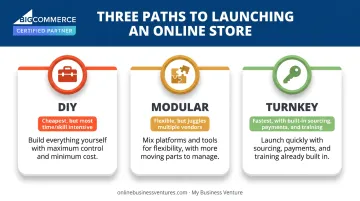
New sellers generally choose one of three paths:
- DIY: Build the site, source products, and manage payments yourself. Cheapest on paper, but demands time and technical skill most beginners don't have.
- Modular: Stitch together separate apps for hosting, inventory, payments, and email marketing. Flexible, but juggling multiple logins, contracts, and support teams gets messy fast.
- Turnkey: Partner with one provider that delivers a working store, complete with sourcing, payments, and training already built in.
Technical overwhelm is a real barrier for small business owners trying to go it alone. An SBA Office of Advocacy report found that technology changes or updates negatively affected profitability for 16.7% of small businesses overall, and 21.9% of small retail businesses specifically.
That skills gap explains the rise of turnkey providers: they absorb the technical burden that trips up DIY and modular attempts, freeing new owners to focus on running the business instead of debugging it.
Essential Features to Look for in a One-Stop Ecommerce Solution
Not every "all-in-one" platform actually delivers on the promise. Here's what to check before signing up:
- Product sourcing and catalog management — Real-time inventory syncing (often via XML feeds) means no manual stock updates or held inventory
- Professional storefront and branding — A ready-to-launch, SSL-secured website with custom logo design, not a recycled generic template
- Secure payment processing and fraud prevention — Encrypted checkout, multiple payment options, and active order monitoring that protects both you and your customers
- Shipping and fulfillment — Dropshipping with blind shipping under your own brand name, plus a clear, competitive shipping cost structure
- Marketing and social integration — Built-in tools or support for social selling, search visibility, and promotional campaigns
- Training and ongoing support — Access to coaching, tutorials, or a dedicated consultant who helps you troubleshoot problems and grow after launch
Why Product Sourcing Deserves Extra Scrutiny
A catalog that isn't synced in real time can leave you selling products that are already out of stock, which damages trust fast. Ask any provider exactly how often their feed updates before you buy.
Benefits of Choosing a One-Stop Ecommerce Solution
Bundling everything under one roof goes beyond convenience: it directly improves your odds of succeeding.
- Speed to launch: A fully operational store can go live in days instead of the months typically needed to build and connect separate systems
- Lower overhead: One upfront investment replaces multiple software subscriptions, developer fees, and freelancer invoices
- Reduced technical burden: No coding or design experience required; the provider handles the backend
- Built-in scalability: Catalog, marketing, and fulfillment tools grow with your business without forcing a platform switch
- Higher likelihood of success: Bundled training and support address the exact gaps that cause first-year mistakes
That last point matters more than it might seem. Across new employer businesses started between 1994 and 2021, only 49.2% survived five years, according to SBA's 2024 small business survival data. Going it alone without support or mentoring is a real risk factor, and it's exactly what a bundled training layer is designed to offset.
How MBV Delivers a Complete One-Stop Ecommerce Launch
MBV's turnkey model answers every item on that checklist above, not just one or two. Here's how each piece comes together:
Store and catalog: Your professional, SSL-secured storefront goes live in days, preloaded with 2,500+ curated products and backed by access to a broader catalog of 1 million or more items. MBV's dropship partner manages fulfillment, with the live product feed updating automatically through XML technology.
Profit structure: Products carry built-in 35–200% profit margins, and every package includes free shipping options to keep your store competitive. MBV's Low Price Guarantee matches any lower price and adds an extra 10% off.
Training that most platforms skip: MBV backs clients with access to MBV University and one-on-one consulting from the Dream Team. Guidance comes directly from Shark Tank advisor Kevin Harrington, whose ventures have launched over 1,000 products and generated more than $6 billion in global sales.
Credibility you can verify: MBV has operated for over 30 years, holds a BBB A+ accreditation, and is registered with Dun & Bradstreet.
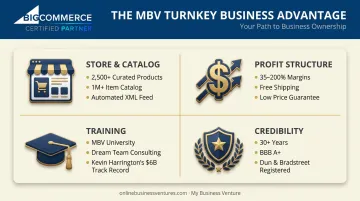
None of these guarantee results on their own, but together they signal a provider that's been vetted and has stayed accountable over time.
How to Choose the Right One-Stop Ecommerce Partner
Before handing over your budget to any provider, run through this checklist.
- Verify credibility first by checking BBB accreditation status, years in business, and platform-specific certifications, such as certified developer status, before you sign anything.
- Compare what's actually included, since some providers advertise "all-in-one" pricing but charge extra for sourcing, marketing, or support. Get a full breakdown of what's bundled versus what's an add-on.
- Ask about post-launch support, because a one-time website build with no follow-up leaves you stranded the moment something breaks. Prioritize providers offering ongoing coaching, not just a launch-day handoff.
A quick way to stress-test any provider: ask them to walk you through their fee structure line by line. If they hesitate or can't answer clearly, that's your answer. MBV meets each of these standards itself: BBB A+ rating, certified BigCommerce developer status, and ongoing consultant coaching with every package.
Frequently Asked Questions
What is a one-stop ecommerce solution?
It's an all-in-one platform or service that combines store setup, sourcing, payments, and marketing into a single turnkey package. Instead of managing multiple vendors, you work with one provider for the entire launch.
What is an ecommerce solution?
It's any tool or service that enables buying and selling online. This covers the storefront, product catalog, and checkout process needed to run a digital store.
How much does it cost to start an ecommerce business with a one-stop solution?
Costs vary by provider, but turnkey solutions often bundle setup, hosting, and training into one predictable investment. MBV's packages, for example, range from $3,995 to $5,995 as a one-time payment rather than stacked monthly tool costs.
Do I need prior experience to launch an online store with a turnkey solution?
No. One-stop solutions like MBV are built for beginners, with guided setup and training so you don't need coding skills or an ecommerce background to get started.
What's the difference between dropshipping and a one-stop ecommerce solution?
Dropshipping is a fulfillment method where you never hold inventory yourself. A one-stop solution is the broader package — it includes dropshipping plus the website, marketing, and support around it.
How long does it take to launch a store with a turnkey ecommerce provider?
With a fully built solution, stores can often go live within days. Custom builds through independent developers, by comparison, average closer to nine months according to Clutch's ecommerce development data.